Driving legally in Portugal touches more separate pieces of paperwork and rules than most visitors expect — a license question, a toll system, a set of enforcement rules, and a handful of city-specific restrictions that don’t apply the same way everywhere. None of it is difficult individually, but few resources put the whole picture together, which is exactly why visitors tend to discover each piece separately, usually at the least convenient moment, whether that’s a rental counter asking for a document you didn’t bring or a fine arriving weeks after a trip has already ended and been mostly forgotten.
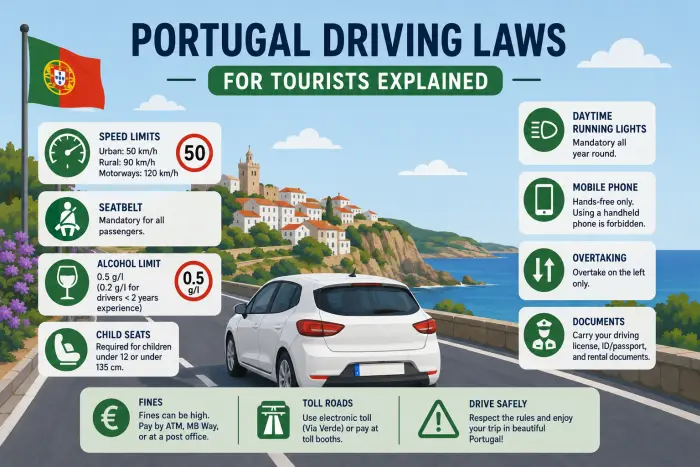
The full picture at a glance
| Category | What it covers |
|---|---|
| License & permits | Whether you need an IDP, digital license options, automatic-only license limits |
| Speed & traffic rules | Limits, roundabouts, night driving, radar detector restrictions |
| Tolls | Via Verde, toll roads generally, billing timing and late-return risk |
| Fines & enforcement | Speeding, parking, and how fines route through a rental car |
| Restricted zones | Historic centers, low-emission zones |
| Mandatory equipment | Warning triangle and reflective vest |
Licenses and permits
Most visiting drivers’ first question is whether they need an International Driving Permit at all — the answer depends heavily on your home country’s license and whether it’s already recognized under EU agreements, covered in more detail in our dedicated IDP guide for rental cars specifically. This is one of the most-asked questions we cover, largely because the answer genuinely varies by country rather than following one simple universal rule — an American license and a Canadian license, for instance, aren’t treated identically under Portuguese rules, and it’s worth checking the specific requirement for your own country rather than relying on general assumptions. Portugal has also moved toward digital driving license options for residents, though this mostly doesn’t affect visiting drivers directly in practice. If your license only covers automatic transmission, Portugal’s rules on automatic-only licenses and manual rental cars are worth checking before you book, since manual transmission is still common in the rental fleet here and not every supplier stocks enough automatic vehicles to guarantee availability at booking time.
Speed, roundabouts, and night driving
Speed limits vary by road type and are enforced more actively than some visitors expect, tying directly into what happens if you’re caught — covered in our guide to Portuguese speeding fines. Roundabouts follow priority rules that trip up drivers from countries with different conventions, and night driving carries its own considerations around visibility and rural road conditions, particularly on unlit stretches away from the main coastal towns. It’s also worth knowing that Portugal restricts more than just your driving behavior — radar detector hardware and certain navigation app features that warn of speed enforcement are themselves illegal, independent of whether you were actually speeding, a distinction that surprises many visitors who assume the rule only concerns actual driving conduct rather than the equipment sitting on their dashboard.
None of these individual rules is unusually strict by European standards, but the combination of unfamiliar road conventions, a language barrier on posted signage, and enforcement patterns that differ from what a visitor is used to at home means small misunderstandings happen more easily here than they might on a familiar domestic drive back home.
Tolls and the Via Verde system
Portugal’s motorway network relies heavily on electronic tolling, and our general explainer of toll roads and how the Via Verde transponder works cover the basics. Billing doesn’t happen instantly — our Via Verde billing timeline explains why a toll charge can take weeks to reach your card, which matters mainly because it means a small, forgotten toll from early in a trip can resurface as a surprise charge well after you’ve returned home and stopped thinking about the rental entirely. A narrower but genuinely costly risk sits at the other end of the rental: some suppliers deactivate the transponder a day or two before your scheduled return, which can turn an ordinary toll crossing into a fine several times its normal cost if you’re not aware of the timing.
Confirming your specific rental’s toll billing setup at pickup — whether the transponder is included, how it’s charged, and when it gets deactivated relative to your return date — is worth the minute it takes, since these details vary enough between suppliers that assuming a standard process based on a previous rental elsewhere isn’t reliable, even within the same country.
Fines and how they reach you
Beyond speeding, parking fines on a rental car follow their own path — tied to the vehicle’s plate, forwarded to the rental company, and eventually charged to your card, often weeks after the trip ends. The same delayed-billing pattern applies broadly across Portugal’s fine system, which is part of why a charge appearing well after a completed trip is more common here than some visitors expect, rather than a sign that anything unusual happened. Understanding this pattern in advance takes most of the surprise out of a late charge — it’s worth checking your card statement for a month or two after any Portugal trip rather than assuming the rental is fully settled the moment you hand back the keys and board your flight home.
💸 Don’t Overpay at the Airport
Compare real-time rental deals with no hidden fees or credit card needed.
Restricted zones and campervan-specific rules
Several city centers, particularly in Lisbon’s historic core, restrict vehicle access in ways that aren’t always obvious from standard road signage, and Lisbon’s low-emission zone adds another layer specific to certain vehicle types, based on emissions classification rather than simply where you’re driving. Both of these restrictions matter more for city-based itineraries than for a straightforward regional road trip, since they concern specific zones rather than the road network generally, and a rental car’s classification isn’t always obvious without checking directly. Travelers with a campervan or motorhome face their own distinct rule set around where overnight parking is legal versus treated as wild camping, a genuinely different framework from standard rental car parking that’s worth understanding well before the first night of a road trip rather than improvising a stopping point on the fly.
Mandatory equipment
Beyond the rules governing how you drive, Portuguese law requires every car to carry a warning triangle and reflective vest, used specifically in the event of a breakdown or accident — one of the more concrete, checkable requirements covered in this guide, and worth confirming is actually in the car during your pickup walk-around rather than assuming it’s there. Unlike some of the rules above that depend on interpretation or circumstance, this one is straightforward to verify in under a minute, which makes it one of the easiest pieces of this entire picture to get right.
Frequently asked questions
Do I need an International Driving Permit to drive in Portugal? It depends on your home country’s license — many EU and some other licenses are recognized without one, while others require an IDP alongside the original license. Check the specifics for your country before traveling rather than assuming based on a previous trip elsewhere in Europe.
What’s the most commonly misunderstood driving rule for visitors to Portugal? Roundabout priority rules and the radar detector restriction both catch out visitors regularly — the former because conventions differ by home country, the latter because it extends into phone navigation app features many drivers don’t realize are affected, having used the same setup without issue elsewhere.
How does Portugal’s toll system work for a rental car? Most tolls are collected electronically through a Via Verde transponder fitted to the car, billed to the rental company first and then to your card, often with a delay of days to weeks after the actual crossing rather than an immediate charge.
Are speeding and parking fines handled the same way in Portugal? Both eventually route through the rental company to your card, but they follow different initial processes — speeding fines typically involve camera or police enforcement, while parking fines are tied to municipal blue-zone systems managed at the local level.
What is Lisbon’s low-emission zone, and does it affect rental cars? It restricts certain older or higher-emission vehicles from parts of central Lisbon — check your specific rental car’s classification if your itinerary includes driving through the city center rather than assuming a rental fleet vehicle is automatically exempt from any restriction.
Is a warning triangle and reflective vest really required by law? Yes, every car in Portugal is required to carry both, and using them correctly in an emergency — vest on before exiting the vehicle, triangle placed a safe distance behind it — is itself part of the legal requirement, not just good practice.
Can campervan rules for overnight parking be different from standard car parking rules? Yes, significantly — campervans and motorhomes fall under a distinct legal framework around overnight stays that doesn’t apply to a standard rental car, with its own restrictions on what counts as legal parking versus wild camping in protected areas.