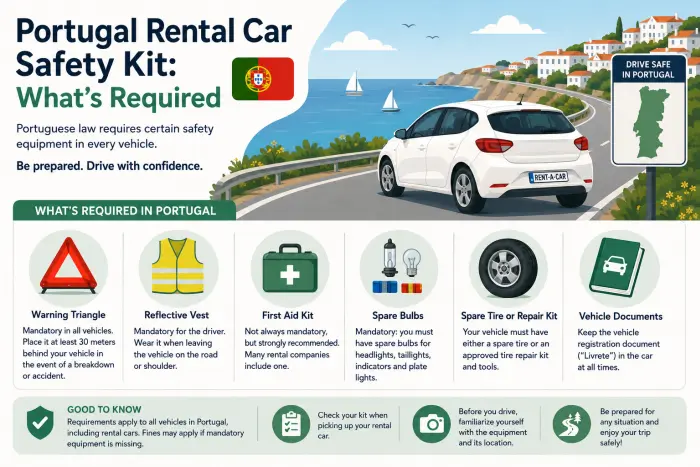
Open the glove box or trunk of a Portuguese rental car and you’ll usually find a small plastic-wrapped bundle sitting alongside the registration papers — a reflective vest and a folding warning triangle, both required by law and both easy to overlook until the moment you actually need them, which is usually the worst possible time to be figuring out where they’re stored.
| Required items | Reflective safety vest, warning triangle |
| Where they’re usually stored | Glove compartment or trunk, often together |
| Vest timing | Must go on before exiting the vehicle in an emergency |
| Triangle placement | ~30m behind the car (100m on motorways) |
| Fine for missing equipment | Roughly €60–300 at a police check |
What the law actually requires
Portuguese-registered vehicles — which covers essentially every standard rental car — must carry at least one warning triangle and one reflective high-visibility vest at all times. The purpose is specific: if your car becomes immobilized on or near the road, whether from a breakdown or an accident, anyone getting out is required to put the vest on before opening the door, then place the triangle far enough behind the vehicle to give approaching traffic real warning time.
There’s a detail worth knowing here that occasionally causes confusion: some sources describe the vest requirement as applying only to Portuguese residents or Portuguese-registered vehicles rather than to visiting foreign drivers specifically. In practice, this distinction doesn’t help a tourist much — a standard rental car booked in Portugal is a Portuguese-registered vehicle regardless of who’s driving it, so the requirement applies in full. Treat it as mandatory rather than trying to reason through the fine print of who’s technically exempt; the same logic that keeps rental-specific insurance and coverage terms tied to the vehicle rather than the driver applies here too.
Where to find it in your rental car
Most suppliers pack the vest and triangle together, commonly in the glove compartment, sometimes in the trunk near the spare tire or repair kit. A handful of rentals include a second vest for a passenger, though the legal minimum is one. It’s worth locating both items during your walk-around inspection at pickup — not because you’re likely to need them, but because fumbling to find safety equipment during an actual roadside emergency is exactly the situation this law is designed to prevent.
If either item is missing when you check, flag it with the rental desk before driving off. This is a quick fix at the counter and a genuinely bad discovery to make for the first time on the shoulder of a motorway. Some larger suppliers include the safety kit as a line item on the vehicle inspection checklist you sign at pickup, in which case it’s already documented whether or not you specifically go looking for it — smaller or independent operators sometimes skip this formality, which is exactly when it’s worth checking yourself.
How to actually use them
If your car needs to stop unexpectedly — breakdown, accident, flat tire — the sequence matters. Put the vest on while still inside the vehicle, before opening the door, particularly on a motorway or any road with fast-moving traffic. Once out, retrieve the triangle and walk it back to a safe distance behind the car: roughly 30 meters on a standard road, closer to 100 meters on a motorway given the higher speeds and longer stopping distances involved, consistent with Portugal’s general road rules. Set it up facing oncoming traffic so it’s visible well before drivers reach your position.
Anyone else exiting the vehicle should also be wearing a vest if a second one is available, and it’s worth moving passengers away from the roadway itself — behind a barrier if one exists — rather than clustering near the car while waiting for help. This applies whether the wait is for the rental company’s own assistance or for one of Portugal’s official roadside patrol vehicles, which cover the country’s motorways and sometimes arrive at a stopped car without being specifically called.
Why this comes up more with rental cars specifically
Owners of their own vehicles in Portugal have usually had the safety kit sitting in the trunk for years without thinking about it — it becomes part of the car and stays there. Rental cars turn over between different drivers constantly, which is exactly the scenario where equipment occasionally goes missing: a previous renter used the triangle and it wasn’t replaced, or a vest ended up misplaced during cleaning between rentals. None of this is common, but it’s common enough that checking at pickup is worth the thirty seconds it takes, rather than assuming a supplier’s standard checklist caught it.
This is also one of the few pieces of required equipment that a police check can verify at a glance without needing to test anything — unlike, say, confirming your insurance documentation is in order, an officer can simply ask to see the triangle and vest. That straightforwardness is part of why it’s worth being certain rather than assuming.
💸 Don’t Overpay at the Airport
Compare real-time rental deals with no hidden fees or credit card needed.
What happens if you don’t have it
Police checks in Portugal do include verifying this equipment, and a missing triangle or vest can result in a fine, generally falling somewhere in the €60–300 range depending on the specifics of the stop — in the same broad category as other on-the-spot traffic fines that visiting drivers sometimes encounter. For a rental car specifically, there’s an added wrinkle: if the missing equipment was the rental company’s responsibility to provide and wasn’t there at pickup, that’s worth raising with them directly — but in the moment of a police check, the fine still applies to whoever’s driving, so it’s not a risk worth taking on the assumption you’ll sort out liability afterward.
Beyond the fine itself, the more meaningful risk is the practical one — being stopped on the shoulder of a busy road without the equipment meant to make you visible to oncoming traffic is a real safety gap, not just a compliance technicality.
What’s not required, but sometimes included
The legal minimum in Portugal is just the triangle and vest — unlike some other European countries, a first-aid kit and fire extinguisher aren’t mandatory requirements here for a standard passenger vehicle. Some rental suppliers include a basic first-aid kit anyway as a goodwill addition, and it’s reasonable to ask about one at pickup if you’d feel more prepared with it, particularly for a longer road trip into more remote parts of the country like the Alentejo interior or the Peneda-Gerês mountains, where help can take longer to arrive than in central Lisbon or Porto.
Spare tires or repair kits are a separate matter from the safety equipment covered here, but worth checking at the same time during your pickup walk-around — some newer rental models use a repair kit and inflator rather than a full spare, which changes what you can realistically do yourself in the event of a flat versus needing to call for assistance. See our complete guide to Portugal’s driving laws for licenses, speed rules, tolls, and fines.
Frequently asked questions
Do I need to bring my own warning triangle and vest, or does the rental car include them? Rental cars in Portugal are required to include both. Check for them during your pickup inspection, and flag it with the desk immediately if either is missing.
Where exactly should I put the warning triangle? Roughly 30 meters behind the vehicle on a standard road, and closer to 100 meters on a motorway, positioned to be clearly visible to approaching traffic.
Do I have to put the vest on before getting out of the car? Yes — the vest needs to go on while you’re still inside the vehicle, before opening the door, especially on roads with fast-moving traffic. This is the same first step covered in our full walkthrough of what to do after an accident.
What’s the fine if I’m caught without the required safety equipment? Generally in the range of €60 to €300, depending on the specifics of the police stop.
Does this rule apply to foreign tourists, or just Portuguese residents? It applies to the vehicle’s registration, not the driver’s nationality — since a standard rental car is Portuguese-registered, the requirement applies to any driver, tourist or resident.
What if the rental company forgot to include the safety kit? Flag it with the rental desk before you leave the lot if you notice at pickup. If you discover it missing later, the fine still applies to the driver at a police check, so it’s worth double-checking early rather than assuming it’s there.
Is one vest enough if I’m traveling with passengers? Legally, yes — Portuguese law requires only one. Some rentals include a second vest for a passenger, but it’s not guaranteed, so check what’s actually in the car if multiple people might need to exit during an emergency.