Portugal’s reputation as an easy wild-camping destination is a few years out of date. The law draws a sharp line between sleeping inside a parked, self-contained vehicle and anything that looks like camping — and getting that distinction wrong is the most common way rental campervan trips run into trouble here.
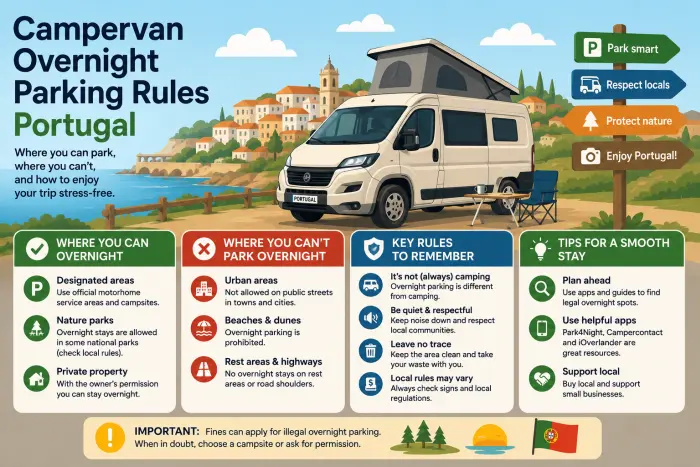
| Sleeping inside the vehicle | Generally permitted, up to 48 hours per municipality, outside protected zones |
| Chairs, tables, awnings outside | Counts as camping — prohibited almost everywhere without a license |
| Protected areas (Natura 2000, coastal zones) | Overnight stays banned entirely, even inside the vehicle |
| Standard fine | Roughly €60–300 |
| Protected-zone fine | Roughly €120–600 |
What the law actually distinguishes
Portugal formally permits overnight stays inside an IMT-approved campervan or motorhome, but only under specific conditions, and explicitly bans wild camping — meaning anything beyond simply sleeping in a parked vehicle — across most of the country’s beaches, forests, and protected natural areas, following a tightening of the rules from the more permissive standard the country was once known for.
The distinction the law draws is specific and worth understanding precisely, because it’s the difference between a legal overnight stay and a fine. Sleeping inside your rented campervan, doors closed, nothing set up outside, generally falls under the more permissive “overnight parking” category. The moment you put out chairs, a table, an awning, or start cooking outside the vehicle, that’s camping — and camping outside a licensed site is prohibited in nearly all of Portugal, regardless of whether the underlying overnight parking would otherwise have been fine.
The 48-hour rule
Outside protected areas, a self-contained campervan can generally stay parked in the same spot for up to 48 hours within a given municipality, provided it’s not displaying camping behavior. This isn’t an invitation to treat any random parking area as a de facto campsite for two full days — local signage sometimes restricts specific lots further, and the 48-hour allowance is a baseline rather than a guarantee that any given spot welcomes overnight stays at all. Motorway service areas are generally not designed or intended for extended overnight stays either, even though a vehicle can legally stop there briefly — worth keeping distinct from the municipal or designated campervan areas covered below.
Quiet hours matter too: overnight stays roughly between 9pm and 7am tend to be the window authorities focus enforcement around, on the logic that a vehicle simply parked and occupied during those hours looks meaningfully different from one that’s set up as an outdoor camp during the day — a distinction that comes down largely to what’s visible outside the vehicle rather than the parking spot itself.
Where the rules bite hardest
Not all of Portugal enforces this equally. Protected areas — Natura 2000 sites, nature reserves, and coastal protection zones (POOC areas) — ban overnight stays in a vehicle outright, not just outdoor camping setups, and this covers a significant share of Portugal’s most scenic coastline, including much of the Algarve and large stretches of the Costa Vicentina that used to be popular free-camping spots before the rules tightened.
The Algarve, Lisbon area, and national parks see the most active enforcement generally, with police patrols specifically checking popular viewpoints and coastal parking areas during peak season. Northern Portugal and the inland regions tend to be more relaxed simply due to lower visitor volume and less concentrated enforcement, though the underlying rules are the same nationwide — a quieter region doesn’t mean different laws, just less active checking.
What this means for a rental campervan trip
If a Portugal campervan trip is part of the plan, the practical approach is to treat wild, free overnight stops as the exception rather than the default, and to actively plan around designated or municipal parking areas that explicitly welcome campervans — a number of towns, particularly in less touristy regions, maintain free or low-cost service areas with water points and waste disposal specifically for this purpose. These areas solve the practical need (a legal, serviced place to stop) without the risk of a scenic-viewpoint fine.
Booking a mix of official campsites and legal municipal stops for the nights that matter most — arrival, departure, and any point where the alternative is genuinely uncertain — while keeping more flexible free stops for well-documented, clearly legal spots, tends to work better in practice than planning an entire route around informal parking and hoping each stop works out. Several dedicated campervan trip-planning apps maintain community-sourced lists of legal Portuguese stopping points specifically, which can be a more reliable starting point than an older blog post or forum thread that predates the current rules.
💸 Don’t Overpay at the Airport
Compare real-time rental deals with no hidden fees or credit card needed.
For beach or coastal stops specifically, it’s worth assuming restriction unless signage or a specific municipal area indicates otherwise, given how much of the coastline now falls under protected-zone rules. Inland stops and smaller town parking areas tend to be more forgiving, though checking current signage at the specific spot remains the only reliable way to know for certain — rules can vary municipality to municipality even along a stretch of coast that looks continuous on a map.
How this differs from a standard car rental
None of this applies to a standard rental car — the overnight-parking allowance and its accompanying rules are specific to vehicles registered as campervans or motorhomes. If your Portugal trip mixes a regular rental car for city and town stays with a separate campervan leg, it’s worth keeping the two sets of rules mentally separate: a standard car parked overnight in a town follows ordinary parking rules rather than the camping-specific framework covered here, and none of the 48-hour or protected-zone restrictions apply to it in the same way.
This distinction matters for trip planning too. A campervan-based itinerary genuinely needs to account for where you’ll legally stop each night as part of the route itself, in a way a hotel-based, standard-rental-car trip simply doesn’t — treating overnight logistics as an afterthought tends to be where campervan trips run into the most friction with these rules, often on the very first night out from the pickup location before a routine has settled in.
What happens if you’re caught
Fines for a standard overnight parking violation generally run in the €60–300 range, rising to roughly €120–600 in protected areas — broadly comparable in scale to other on-the-spot Portuguese traffic fines, though issued through a different enforcement channel specific to camping and overnight-stay violations rather than moving traffic offenses. Beyond the financial cost, repeated or more serious violations have in some cases resulted in vehicle impoundment, though this is a less common outcome than a straightforward fine for a first offense. Enforcement isn’t a matter of getting a warning first in most reported cases — a spot checked by patrol and found in violation tends to result directly in a fine rather than a request to move along. For the wider legal picture beyond campervan-specific rules, see our complete guide.
Frequently asked questions
Can I sleep in a rented campervan overnight in Portugal? Generally yes, inside the vehicle with nothing set up outside, for up to 48 hours per municipality — but not in protected areas like Natura 2000 zones or many coastal protection zones, where overnight stays are banned outright.
What counts as illegal camping versus legal overnight parking? Sleeping inside a parked, self-contained vehicle is generally treated as overnight parking. Setting up chairs, tables, awnings, or cooking outside the vehicle counts as camping, which is prohibited almost everywhere outside licensed campsites.
Is it legal to park overnight on an Algarve beach in a campervan? Usually not — most of the Algarve coast falls under protected coastal zones where overnight stays are banned entirely, and this area sees particularly active enforcement during peak season.
How much is the fine for illegal wild camping in Portugal? Roughly €60–300 for a standard violation, rising to about €120–600 in protected areas like Natura 2000 zones or coastal protection zones.
Are the overnight parking rules the same everywhere in Portugal? The underlying national rules are the same, but enforcement varies significantly — the Algarve, Lisbon area, and national parks see much more active patrolling than northern Portugal or inland regions, where a quieter route can mean noticeably less risk of an actual check.
Does my rental campervan need to be IMT-approved to stay overnight legally? Yes, the legal overnight-parking allowance applies specifically to vehicles registered and homologated as campervans or motorhomes — a standard passenger car isn’t covered by this same provision, and reputable rental companies operating campervans in Portugal should already meet this requirement.
Where can I find a legal place to park a campervan overnight? Look for municipal or designated service areas, which a number of towns provide specifically for campervans, often with water points and waste disposal — a more reliable option than guessing at an informal spot’s legal status, and a better starting point than relying on outdated blog recommendations from before the rules tightened.