Roundabouts appear constantly on Portuguese roads, at motorway junctions, in small towns, and throughout everyday city driving, and for visitors from countries where roundabouts are rare or work differently, they’re consistently cited as one of the more intimidating parts of driving in Portugal. The underlying rules are actually fairly consistent and learnable, though, and once they click, roundabouts stop being a source of stress and become simply another normal part of the drive rather than something to dread.
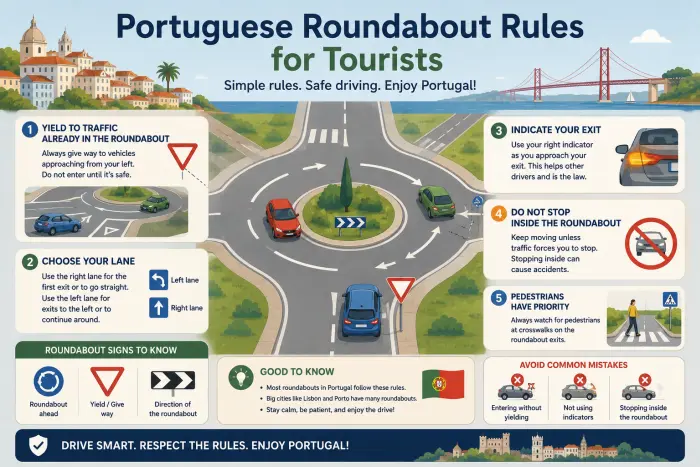
Traffic already circulating inside a Portuguese roundabout has the right of way over traffic entering it. You yield before entering, not while already inside, and once you’re in, you have priority over anyone waiting to join. This single rule underlies nearly everything else about navigating them confidently.
The Core Rule: Yield Before You Enter
This is the rule that resolves most of the uncertainty for a nervous first-time driver. As you approach a roundabout, your job is to look left, since traffic circulates counterclockwise on Portugal’s right-hand-drive roads, and wait for a safe gap before entering. Once you’re in the roundabout, you have priority over vehicles waiting to enter, and it’s their responsibility to yield to you, not the other way around. The confusion for many visitors comes from overthinking this: the rule doesn’t change based on which exit you’re taking or how many lanes are involved, it’s consistently “yield before entering, priority once inside.”
Multi-Lane Roundabouts: Choosing the Right Lane
| Situation | Lane Guidance |
|---|---|
| Taking the first exit (roughly right turn equivalent) | Stay in the outer (right) lane |
| Continuing straight through (roughly the middle exits) | Either lane generally works, outer lane often simpler |
| Taking a later exit or going nearly all the way around | Inner (left) lane, then signal and move outward before your exit |
| Uncertain which exit you need | Default to the outer lane, which keeps your options simpler even if not the most efficient line |
Larger, multi-lane roundabouts at major junctions can have three or more lanes, which is where visitor confidence drops the most. The core lane logic scales the same way regardless of exact lane count: outer lane for earlier exits, inner lane for later ones, moving outward as you approach your actual exit.
What If You Miss Your Exit?
This is worth normalizing rather than treating as a crisis: simply continue around the roundabout and take the same exit on your next pass. Roundabouts are specifically designed to make this recoverable without needing to reverse, cut across traffic, or make any sudden unsafe maneuver. Slowing down excessively or stopping mid-roundabout to correct course is considerably more dangerous than calmly going around again, so treating a missed exit as a minor, expected inconvenience rather than a problem to panic over is the right mindset.
Signaling Correctly Through a Roundabout
Proper signaling helps other drivers, including those waiting to enter, understand your intentions and reduces the friction of merging traffic. The general pattern: signal right just before taking your exit, and if you’re going most of the way around a multi-lane roundabout, signal left while circulating in the inner lane to indicate you’re not taking an early exit, then switch to a right signal as you approach your actual exit. This isn’t universally practiced by every local driver, but following it consistently yourself makes you more predictable to everyone else on the road, which is the actual goal.
Roundabouts at Motorway Junctions vs Town Centers
Roundabout behavior varies somewhat by context, worth anticipating rather than being surprised by. Motorway junction roundabouts tend to be larger, faster-moving, and more clearly marked, since they’re designed for higher-speed through traffic. Town center roundabouts are often smaller, slower, and can involve more unpredictable local traffic, including pedestrians, cyclists, or double-parked vehicles near the roundabout’s edge. Adjusting your speed and attention level based on which type you’re approaching, rather than treating every roundabout identically, helps match your driving to the actual conditions.
Are Portuguese Drivers Aggressive at Roundabouts?
Local driving style at roundabouts, like much of Portuguese city driving, particularly in Lisbon, can feel assertive and fast-paced to a visitor used to more cautious norms elsewhere. This is worth expecting rather than being unsettled by: locals tend to commit to gaps confidently and move through roundabouts briskly, which can feel intimidating but isn’t inherently more dangerous than a slower approach, provided you’re following the same core right-of-way rule everyone else is. Staying calm, following the rules consistently, and not letting a confident local driver behind you pressure you into an unsafe gap is the right response rather than trying to match their exact pace.
What If There’s a Minor Incident at a Roundabout?
Roundabouts, precisely because of the merging and lane-changing they involve, are a common location for minor scrapes and fender-benders, particularly involving a hesitant visiting driver and a confident local one. If this happens, having clear documentation matters, similar in principle to the general habit covered in our guide on avoiding a rental car damage dispute in Lisbon. Some visiting drivers specifically consider a dash cam for their Portugal rental for exactly this scenario, since roundabout incidents often involve a dispute over which vehicle actually had the right of way at the moment of contact, and clear footage resolves that question far more reliably than two conflicting accounts afterward.
💸 Don’t Overpay at the Airport
Compare real-time rental deals with no hidden fees or credit card needed.
Roundabouts Near Parking Areas
Worth noting specifically since it compounds with another common source of visitor stress: roundabouts often sit near dense parking areas in town centers, meaning you may be navigating an unfamiliar roundabout while also watching for a parking entrance or trying to read signage for a nearby garage. Slowing your overall pace and giving yourself extra buffer time when a roundabout and a parking search coincide, rather than trying to do both simultaneously under time pressure, reduces the compounded stress of handling two unfamiliar tasks at once.
Watching for Motorcycles and Scooters
Portugal has a genuinely high volume of motorcycles, scooters, and mopeds sharing the road, and roundabouts are a specific point where these smaller, faster-moving vehicles can appear in your blind spot or filter between lanes in ways a driver from a car-dominant market might not anticipate. Checking mirrors and blind spots more deliberately than usual specifically when approaching and circulating a roundabout, rather than assuming the roundabout only contains vehicles of a similar size to your own, is worth building into your general awareness while driving in Portugal.
Roundabout Checklist for Driving in Portugal
- Remember the core rule: yield before entering, priority once you’re inside
- Default to the outer lane if uncertain which exit you need
- Treat a missed exit as routine, simply continue around rather than making an unsafe correction
- Signal your exit clearly, and signal left if continuing around a multi-lane roundabout
- Match your speed and attention to context, motorway junctions versus slower town-center roundabouts
See our complete guide to Portugal’s driving laws for the rest of what applies to a visiting driver.
Frequently Asked Questions
Who has the right of way at a roundabout in Portugal, entering or already-circulating traffic? Traffic already inside the roundabout has priority. You yield before entering and gain priority yourself once you’re circulating.
Which lane should I use on a multi-lane roundabout in Portugal if I’m unsure which exit to take? The outer lane is the simpler default, generally suited to earlier exits, though it’s worth moving to the inner lane if you know you need a later exit.
What should I do if I miss my exit on a Portuguese roundabout? Simply continue around and take the same exit on your next pass. This is a normal, safe correction, not something to panic over or attempt to fix with a sudden maneuver.
Are roundabouts in Lisbon more difficult than elsewhere in Portugal? They can feel more intense due to faster, more assertive local driving style, but the underlying right-of-way rules are the same everywhere in the country.
What should I do if there’s a minor collision at a roundabout in Portugal? Document the scene clearly, including any dash cam footage if you have it, since roundabout incidents often come down to a dispute over which vehicle had the right of way at the moment of contact.
Do roundabouts near parking areas add extra difficulty for visiting drivers? Yes, since you may be navigating an unfamiliar roundabout while also searching for a parking entrance. Slowing down and giving yourself extra time when both coincide reduces the compounded stress.
For the broader picture of road rules across Portugal, see our driving rules in Portugal guide. If you’re specifically navigating Lisbon’s historic center, our restricted zones driving guide covers the access issues that sit alongside general road navigation there.