Radar detectors have been illegal in Portugal for a long time, and most travelers already know to leave a dedicated detector unit at home. What catches people off guard is how far the rule reaches beyond physical hardware — into a feature sitting quietly enabled on the same navigation app they’ve used without issue in half a dozen other countries, mounted on the dashboard of a rental car without a second thought given to it.
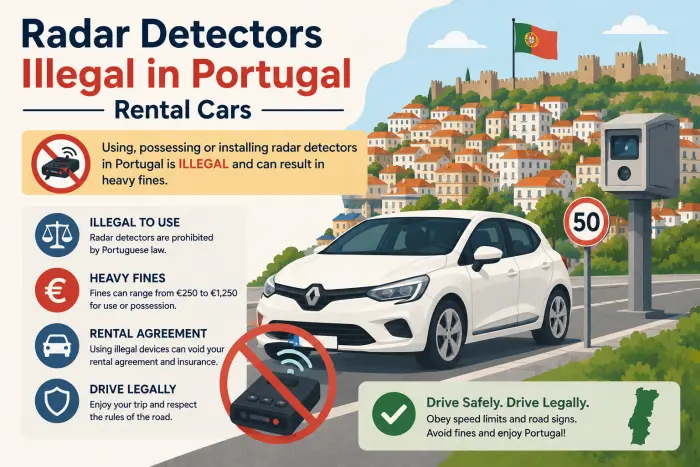
| Dedicated radar detector hardware | Banned outright, regardless of whether it’s in use |
| Navigation apps with speed camera alerts enabled | Falls under the same restriction |
| Simple speed limit display (no camera warning) | Generally fine |
| Fine if caught | Confiscation of the device plus a fine |
| Applies to | Both owned and rental vehicles equally |
Why this rule exists, and why it’s stricter than drivers expect
Portuguese law treats any equipment or software designed to detect or warn of speed enforcement as the same category of violation, whether that’s a purpose-built radar detector unit or a phone app doing the equivalent job through crowdsourced camera locations. The logic is straightforward from the regulator’s side: the tool being physical hardware or a software feature doesn’t change what it does, which is help a driver evade speed enforcement rather than simply drive within the posted limit — a rule that sits alongside Portugal’s other general driving regulations as one more area where assumptions carried over from home don’t necessarily hold here.
This matters more than it might seem because some of the most widely used navigation apps worldwide build speed camera alerts in as a standard, often default-enabled feature. A driver who’s used the same app the same way across several other European countries without any issue can cross into Portugal and unknowingly be carrying a restricted feature on their phone, mounted right on the dashboard, with no indication anything about their normal setup has become a problem.
Why this matters more for a rental than a car you own
A driver in their own car has usually already configured their navigation setup around wherever they normally drive, and any camera-alert feature has typically been on for years without a second thought. A rental car trip is different — you’re often setting up navigation fresh for the trip, sometimes for the first time in a new country, which is exactly the moment a default-enabled feature like this slips through unnoticed. It’s also the moment when a fine or confiscation would land hardest, disrupting a trip you’ve already spent time and money planning rather than a minor inconvenience folded quietly into ordinary life at home.
This connects to the wider pattern of Portuguese traffic fines that visiting drivers occasionally run into — most are avoidable with a small amount of advance awareness, and this specific rule is one of the least obvious ones precisely because it involves a software feature rather than a piece of hardware you’d consciously decide to pack for the trip.
What counts, and what doesn’t
The distinction that matters is between a simple speed limit display — showing the posted limit for the road you’re on, which is fine — and an active warning specifically flagging the location of speed cameras or police enforcement, which isn’t. Most major navigation apps let you toggle this specific feature separately from general navigation, and it’s worth checking your settings before driving in Portugal rather than assuming the app’s default configuration is automatically compliant everywhere it works, since the same app can behave differently depending on regional settings or a version update you haven’t noticed.
Static, built-in car GPS units generally don’t carry this feature the way phone apps often do, which is part of why the modern version of this rule catches out phone-based navigation users more than anyone using a simple in-car system without live camera data. This is a relatively recent shift — the rule itself predates smartphone navigation by years, originally written with dedicated radar detector hardware in mind, but the practical way it trips people up today has moved almost entirely onto phones as dedicated detector units have become less common among everyday travelers.
Community-reported speed traps within an app — sometimes labeled as user reports of “police” or “hazard” rather than an official camera database — fall into a genuine gray area that’s worth treating cautiously rather than assuming is automatically exempt just because the data comes from other drivers rather than a built-in camera map maintained by the app developer itself.
What to actually do about it
Before your first drive in Portugal, open your navigation app’s settings and look specifically for anything labeled speed camera alerts, radar warnings, or police reports, and turn it off — this takes under a minute and removes the issue entirely without giving up turn-by-turn directions or general GPS navigation, which remain completely fine to use. If you’re not certain whether a specific app’s feature crosses this line, disabling anything camera or enforcement-related is the safer default rather than assuming it’s probably fine, since the downside of turning off a feature you didn’t need is nothing, while the downside of leaving on a restricted one is a fine and a confiscated device.
💸 Don’t Overpay at the Airport
Compare real-time rental deals with no hidden fees or credit card needed.
If your rental car came with its own built-in navigation system rather than relying on your phone, the same principle applies — check its settings for an equivalent feature before assuming a manufacturer-installed system is automatically compliant just because it came with the car. Rental fleets rotate between markets and vehicle configurations, and it’s not guaranteed that every built-in system has been specifically adjusted for the country it’s currently operating in.
What happens if you’re caught
Being found with active radar-detection functionality — hardware or software — in Portugal can result in confiscation of the device and a fine, applied regardless of whether you were actually speeding at the time, following a similar administrative path in terms of how the paperwork gets processed. This is a separate violation from a speeding fine itself; having the capability to evade detection is treated as its own offense independent of your actual driving behavior in that moment. In practice, this means a driver who was scrupulously observing the speed limit the entire trip can still be fined for simply having the feature enabled, since the violation is about the capability rather than any specific instance of misuse.
For a rental car specifically, this adds a layer most travelers don’t think about: if caught, the fine and any related paperwork trace back to the vehicle first and then to you as the renter, following a similar pattern to other traffic fines that end up routed through the rental company before reaching your card, sometimes weeks after the trip has already ended and been mostly forgotten.
See our complete guide to Portugal’s driving laws for how this fits alongside speed limits and fines generally.
Frequently asked questions
Is a dedicated radar detector illegal in a Portugal rental car? Yes, radar detection equipment is banned outright in Portugal, regardless of whether it’s actively in use — simply having it in the car is the violation, whether or not you’ve turned it on at any point during your trip.
Is Waze’s speed camera alert feature illegal in Portugal? The specific feature that warns of speed camera and police enforcement locations falls under the same restriction as physical radar detectors, so it’s worth disabling that particular setting before driving in Portugal, even if you’ve used it without issue elsewhere.
Can I still use GPS navigation in Portugal? Yes, standard turn-by-turn navigation and posted speed limit display are completely fine — only the specific speed camera and enforcement warning feature is restricted, so there’s no need to avoid navigation apps altogether.
What’s the fine if I’m caught with radar detection equipment or an app feature enabled? Typically confiscation of the device plus a fine, applied independent of whether you were actually speeding at the time you were caught — the violation is about having the capability, not about your actual speed that day.
Does this rule apply differently to rental cars versus a car I own? No, the restriction applies equally regardless of vehicle ownership — a rental car offers no exemption from this rule, and the fine still attaches to whoever was driving at the time regardless of who owns the vehicle.
How do I check if my navigation app has this feature enabled? Look in the app’s settings for anything labeled speed camera alerts, radar warnings, or police reports, and disable it specifically before driving in Portugal — a quick check that takes less time than reading this sentence.
Do built-in car navigation systems have the same speed camera warning issue as phone apps? Less commonly, since many built-in systems don’t include live crowdsourced camera data the way phone apps often do — but it’s still worth checking the settings rather than assuming, especially with a rental fleet that rotates between markets and configurations.