The workable way to handle a rental car in Porto is to treat parking as the first decision, not the last: central streets are steep, cobbled and one-way, on-street spaces are metered from 9:00 to 19:00 on weekdays, and five central zones now use automated, registration-only access, so most visitors do best leaving the car in a garage (roughly €15 to €30 a day in the centre) or on the edge of town and covering the old core on foot.
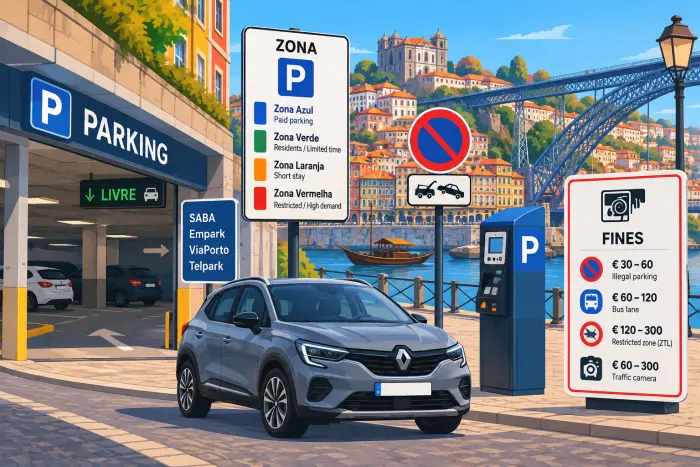
That sounds like a lot of rules for one city, but they shrink to a handful of habits. This guide walks through what the streets feel like from behind the wheel, how the colour-coded parking zones and the ZAACPorto restricted areas work, what a day of parking really costs, and the small mistakes that turn into charges on a rental agreement weeks after you fly home.
Park-first cheat sheet
- Metered hours: Monday to Friday 9:00–19:00, plus Saturday 11:00–16:00 in Zone I only
- Maximum street stay: between 2 and 10 hours, depending on the signs at your spot
- Payment apps that work: Telpark, Via Verde Estacionar and EasyPark
- Central garages: about €15 a day at the cheaper end, close to €30 near the Ribeira waterfront
- Registration-only zones: Carmelitas, Cedofeita, Flores, Ribeira and Santa Catarina
- Best default: garage or edge-of-town lot first, then walk
What the streets feel like from behind the wheel
Porto is built on a granite hillside above the Douro, and the old centre was laid out long before anyone imagined a rental compact. Expect gradients that make a manual car stall at the wrong moment, kerbs that sit hard against the wheel arch, and one-way systems that send you in a loop you did not plan. Tram tracks cross some of the central streets, and bus and tram priority lanes are enforced, so drifting into one while reading a sign is an easy way to collect a fine or an angry horn.
Cobblestones add a second layer. Wet stone is slippery, and a low-speed scrape against a high kerb in a tight lane is exactly the sort of mark that shows up later on a damage report, which is why the habits we describe for cobbled streets and rental car damage in Lisbon apply just as well here: photograph all four corners before you leave the pickup bay, and drive the narrow lanes at walking pace.
Size matters more in Porto than almost anywhere else in the country. A compact car fits the lanes, the older garages and the awkward bays outside small hotels; a large SUV turns every parking attempt into a negotiation. If you are choosing a category, the smallest car that holds your luggage is usually the right one.
Five zones where you can’t simply drive in
The part that catches visitors off guard is the city’s system of restricted-access areas, known as ZAAC (Zonas de Acesso Automóvel Condicionado). Porto now runs five automated ones, called ZAACPorto: Carmelitas, Cedofeita, Flores, Ribeira and Santa Catarina. Access to these areas is managed remotely rather than by a barrier or a guard, and entry is reserved for users registered on the ZAACPorto platform, which has an app and a website run by the city council.
The newest addition shows how fast the map changes. When six streets around Rua das Carmelitas joined in April (the stretch that includes the street outside Livraria Lello, plus Rua de Avis and Rua Conde de Vizela), the Carmelitas area became the fifth zone, and Santa Catarina was extended at the same time. The council describes the goal as protecting the busiest parts of the historic centre for the crowds of people on foot.
Visitors are not banned outright. Reporting on the Carmelitas rules says visitors can enter but pay a stay fee depending on their profile, and the city’s own FAQ describes the first two quarter-hours as free for visitors who enter within the permitted hours of that zone. The practical lesson is that a rental car should not wander into one of these areas on the strength of a navigation app alone; if your hotel is inside a zone, ask the hotel how to register your plate before you arrive.
The rental angle matters because enforcement is by plate. A penalty notice for a rental car goes to the rental company first, which typically forwards the cost with an administrative fee on top, a pattern we explain in detail in our piece on parking fines on a Portuguese rental. These access zones are also separate from the emissions-based rules covered in our guide to the Porto low-emission zone for rental cars, so passing one check says nothing about the other. Treat the city’s mobility page as the final word, because the list of zones has grown more than once.
How on-street parking works in the rest of the city
Outside the restricted areas, paid street parking runs on colour-coded limited-duration zones. Zone I is the most expensive and Zone IV the cheapest, with Zones II and III in between. Payment is required from Monday to Friday between 9:00 and 19:00, except public holidays, and Zone I also charges on Saturdays between 11:00 and 16:00. Outside those windows, street parking is free, which makes Sunday and weekday evenings the easiest times to park.
Each space carries a maximum stay of between 2 and 10 hours depending on the sign, so a long lunch can quietly turn into an overstay. You can pay at the meter by pressing the green button and following the prompts, or digitally with Telpark or Via Verde Estacionar; EasyPark is also accepted in the city. Lisbon’s ePark app is Lisbon-only, so installing it for Porto is wasted effort, and our comparison of Lisbon parking apps is a useful way to decide which of the shared ones is worth setting up before the trip.
Be realistic about availability. In Baixa, Ribeira, Boavista and Cedofeita, free spaces are rare and paid ones are often full by mid-morning. Genuinely free street parking starts in residential districts further from the centre, such as Campanhã, Ramalde or Antas, which means a walk or a metro ride into town.
💸 Don’t Overpay at the Airport
Compare real-time rental deals with no hidden fees or credit card needed.
Garages, lots and what a day really costs
For a visitor, the calmer choice is nearly always a garage. The listed rates below are rounded from published figures and move with demand, so check before you commit.
| Option | Typical cost | Best for | Catch |
|---|---|---|---|
| Street parking, Zones I–IV | Metered hourly, free outside regulated hours | Short stops, evenings, Sundays | 2–10 hour limit; spaces scarce |
| Central garage (Carregal, Palácio de Cristal area) | About €15 a day | A full day of sightseeing | Older ramps and tight bays |
| Garage near Ribeira or Praça de Lisboa | About €26–30 a day | Riverside dinners, short walks | Costliest end of the range |
| Municipal Trindade car park | Around €0.80 for the first hour (last published rate) | Short central visits | Rates change; confirm on site |
| Riverside lots in Vila Nova de Gaia | Roughly €1.25–1.60 an hour | Port cellars and the waterfront | Evening demand |
| Metro park-and-ride | Free lot plus a metro ticket at some stations | All-day city visits | Rules vary by station |
| Hotel garage | Often a daily supplement | Overnight stays | Space is limited, so book ahead |
Height and width are the hidden filters. Older garages have low ceilings and narrow ramps, and if you are carrying a roof box or driving a taller vehicle, check the clearance first, a problem we cover in our note on garage height limits for SUVs in Portugal. If you are choosing a hotel anyway, a property with its own garage or a contracted car park nearby is often the least stressful base for a car-based trip, and it is worth asking about that before you book, since central hotels have only a few spaces.
Crossing to Gaia and the bridge
Many drivers choose to cross the river and leave the car in Vila Nova de Gaia, then walk back over the Dom Luís I bridge. The bridge has two decks: cars use the lower one, while the upper deck is for the metro and pedestrians. That means you can drive across, park in a riverside lot, and walk back over the upper deck with the best view in the city as a reward. It also puts you beside the port cellars, which are the main reason many visitors come to Gaia, so the plan works well if your day includes a tasting. If it does, stick to the park-and-walk plan, since drink-driving limits apply to tourists exactly as they do to locals.
Timing the pickup and the return
The cheapest parking is the parking you never pay for. If you plan a few days of city sightseeing followed by a trip into the countryside, collect the car on the day you leave town rather than on arrival. Collecting at the airport is straightforward, as described in our guide to renting a car at Porto Airport, and the return rules and fuel stop details are in our walkthrough of how to return a rental car at Porto Airport.
Between the airport and the centre, you will meet electronic toll sections on the way in, so check how your rental handles them with our overview of toll roads in Portugal. Once you leave the city, driving gets easier: our northern Portugal rental guide maps the day trips, and the vineyard roads covered in our Douro Valley car rental guide are the classic reason to have wheels at all.
Match nights, festival nights and other closures
Some days make driving in the centre worse. Streets around the Estádio do Dragão close on FC Porto home matches, so free spaces nearby disappear that evening. On the night of São João in late June, large parts of the riverside are closed to cars and the surrounding streets fill early. If your visit overlaps a major match or a festival, plan to park outside the centre and use the metro.
Costly little mistakes
- Overstaying a space. The 2-hour or 10-hour limit applies even if you have paid for more time on the meter.
- Parking on yellow kerbs or in loading zones. Loading bays are enforced, and the fine goes to the rental company.
- Following the satnav into a restricted street. Routing apps do not always know about the ZAAC boundaries.
- Forgetting that Saturdays differ. Only Zone I charges on Saturday afternoon, so a free-looking street may sit in another zone.
- Skipping the walk-around. Photograph the car at pickup and again at return, because a scratch from a tight garage is easy to dispute only if you have proof.
Frequently asked questions
Is it hard to drive in Porto as a tourist? It is manageable but tiring in the old centre because of steep gradients, one-way streets, tram tracks and cobbles. Outside the historic core, driving is much easier, and most visitors do their sightseeing on foot.
Do I need a rental car in Porto city itself? Not for the city: the centre is compact, with metro, buses and trams. A car pays off for the Douro Valley, Braga, Guimarães and the northern coast.
How much does it cost to park in Porto per day? Expect about €15 a day in the cheaper central garages and close to €30 near Ribeira. Street parking is metered only during regulated hours, but the maximum stay is 2 to 10 hours.
When is parking free in Porto? Zones I to IV are paid from Monday to Friday, 9:00 to 19:00, except holidays, and Zone I is also paid on Saturdays from 11:00 to 16:00. Outside those hours, street parking is free.
Which parking app should I use in Porto? Telpark, Via Verde Estacionar and EasyPark all work. The Lisbon-only ePark app does not.
What are ZAAC zones, and can a rental car enter them? ZAAC areas are restricted-access zones where entry is reserved for users registered on the ZAACPorto platform. Visitors can enter with a stay fee depending on their profile, so register your plate or ask your hotel before driving in.
Can I park in Vila Nova de Gaia and walk to Porto? Yes. Riverside lots in Gaia are priced hourly, and you can walk back across the upper deck of the Dom Luís I bridge, which is reserved for the metro and pedestrians.
What if a parking fine reaches my rental company? The rental company normally pays or forwards the notice and charges the amount plus an administrative fee to your card. Keep your meter receipt or app confirmation as proof.