Tolls are the part of driving in Portugal that confuses visitors most, and the part that produces surprise charges weeks after the trip. The reason is simple: Portugal has two toll systems, and on one of them there is no booth at all, so you can drive a toll road without ever stopping to pay and not notice.
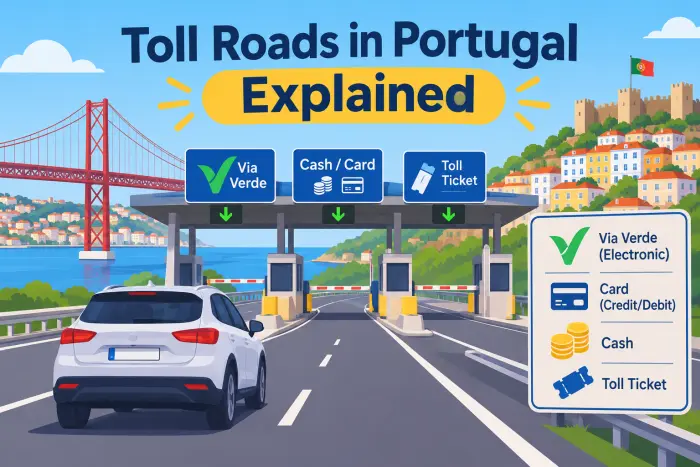
The good news is that a rental car makes this easy if you know how your supplier handles it, and the amounts are easier to plan than people fear. This guide shows what two suppliers that rent at Lisbon, Sixt and Enterprise, say in their published terms, what the main motorways cost in 2026 according to the operator Brisa, and how to read the bill that arrives afterwards. Supplier terms were checked on 11 November 2026.
This page sits inside our driving in Portugal guides, alongside speed limits and parking.
Two toll systems and one small device
Understanding the split is most of the job.
| Traditional motorways | Electronic-only roads (mostly former SCUTs) | |
|---|---|---|
| How it looks | Toll plazas with booths and barriers | Overhead gantries, no booth, no barrier |
| How you pay | Take a ticket, pay on exit by cash or card, or drive through a Via Verde lane | Automatically, through a device in the car, or the plate is recorded |
| Where the risk is | A wrong lane at the plaza | Driving through without a registered method, because nothing tells you a charge has started |
Via Verde is Portugal’s electronic toll system. A small device on the windscreen is read by the gantries and the plaza lanes, and the toll is charged to an account. Rental companies fit this device to their cars, so you rarely buy a separate one. What differs is how they bill you for it, which is the next section.
What changed on 1 January 2025
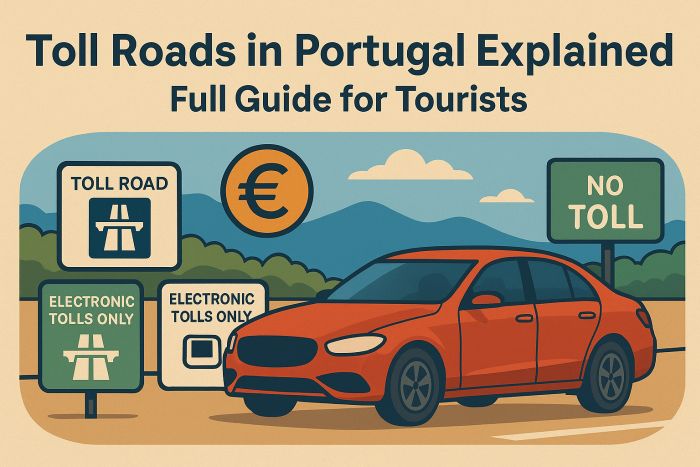
Many older guides, and some supplier pages, still describe a long list of electronic toll roads. Since 1 January 2025, under Law 37/2024, tolls have been abolished on most of them. The roads that became free are:
- A4 (Transmontana and the Marão Tunnel)
- A13 and A13-1 (Pinhal Interior)
- A22 (the Algarve motorway, Via do Infante)
- A23 (Beira Interior), A24 (Interior Norte) and A25 (Beiras Litoral and Alta)
- A28 (Minho), only on the sections between Esposende and Antas and between Neiva and Darque
The A22 matters most for visitors, because it runs along the whole Algarve and used to charge electronically. Infraestruturas de Portugal states that nothing has been charged on it since 1 January 2025. Electronic charging remains on the rest of the A28 and on the A29 (Vila Nova de Gaia), the A41 and the A42, which are mostly in the Porto area. One travel source also lists the A17 on the coast between Marinha Grande and Aveiro as an electronic-only road, so check it if your route goes that way.
In practice: the traditional motorways run by Brisa, such as the A1 and the A2, still charge, and a handful of electronic-only roads around Porto still charge. Most of the country’s former SCUT network no longer does.
What the rental companies say
Both suppliers bill the tolls separately from the rental price, and both fit a device. One caution: Enterprise’s wording still speaks of SCUT roads, a category that has shrunk since 2025. Their terms differ in the details that decide your bill.
| Sixt | Enterprise (Lisbon Airport) | |
|---|---|---|
| Device | Mandatory Via Verde membership through Sixt’s own toll service, which is part of every rental | All vehicles are equipped with a toll device |
| Service charge | €2.23 per day, with a maximum of €22.30 per rental month | You are billed only for the days you use the device |
| If you never use a toll lane | The amount charged is credited back within 30 days of the rental ending | The device is activated only when you drive through a toll, traditional or electronic |
| How tolls are billed | Sixt debits the tolls from your credit card within 30 days of the end of the rental | Charged at the end of the rental for the recorded movements |
| Warning | The card must allow international transactions until then | A charge can appear up to 4 weeks after you return the car |
Two consequences follow. The first is that the toll bill reaches you after you have gone home, so keep the card you rented with active for at least a month and do not cancel it the day you fly. Sixt makes this explicit, because it requires the card to allow international transactions up to the debit date. The second is that the device charge differs by supplier. A week at Sixt can carry up to about €15.61 in daily device charges if they apply to every day of the rental, while Enterprise charges only for days with device use. Check which one applies to your quote.
If you want the mechanics of the Via Verde account itself, see how the Via Verde toll transponder works. The timing of the charges is covered in our piece on the Via Verde billing timeline.
What the main routes cost in 2026
Brisa, the company that runs most of the long-distance motorways, raised its tolls on 1 January 2026 by an average of 2.29%, following the inflation formula in its concession contract. Of the 93 toll rates for Class 1 vehicles, which covers ordinary passenger cars, 40 changed. The rest, including many short urban stretches, stayed the same.
| Route (full length, Class 1) | One way in 2026 | Return trip |
|---|---|---|
| A1, Lisbon to Porto | €25.05 | €50.10 |
| A2, Lisbon to the Algarve | €23.80 | €47.60 |
| A2/A6, Marateca to the Spanish border at Caia | €15.40 | €30.80 |
The A22 along the Algarve coast, which used to charge electronically, has been free since 1 January 2025, so the A2 figure above is the main motorway cost of getting to the Algarve. The return trip column is simple arithmetic on Brisa’s published prices. It leaves out bridge crossings, local gantries and the device charges above. A loop that takes in Lisbon, Porto and the Algarve and returns to Lisbon costs about €97.70 in motorway tolls, which is the sum of the two return trips.
The comparison that surprises people is how the toll sits against the rest of the cost. On a week of driving in Portugal, tolls are a real line item, but a predictable one. What hurts is not the amount but a charge arriving unexpectedly. Check your own route against the official calculator of the road operator Infraestruturas de Portugal if you want an exact figure, because the cost depends on the route and the class of vehicle.
💸 Don’t Overpay at the Airport
Compare rental offers for your dates. Many include free cancellation, and some don’t require a credit card.
Reading the bill that arrives
Your final toll cost has three parts, and it helps to know which is which:
- The tolls themselves, recorded by the device on the roads you used.
- The supplier’s device or service charge, which for Sixt is the daily value above and for Enterprise depends on the days you used the device.
- Timing, which means the bill can come weeks later and can arrive as a separate charge from the rental payment.
If a charge looks wrong, compare the dates and routes against your trip before disputing it. Keep your rental agreement until everything has settled. A toll recorded after you returned the car, or on a day the car was not with you, is worth querying. The special case of a device switched off just before the end of the rental is explained in the last-days toll trap.
What happens if no valid method is in place
Drive one of the roads that still charges electronically, such as the A41 or A42 around Porto, without a registered method and nothing happens at the roadside. The toll is matched to the car’s plate, billed to the rental company, and passed on to you. Portugal is efficient at connecting a charge to a rental driver, as the way speeding fines follow rental customers home shows. Suppliers can also add their own fees when they have to deal with the authorities for you. Sixt’s terms, for example, set an administrative fee of €60 when it must identify the driver for a traffic or parking fine. That is why setting up the method at pickup matters more than the toll amounts themselves.
At the booths and the gantries
On the road the two systems feel different. At a traditional plaza, pick the right lane. Lanes marked for Via Verde are for registered devices, and your rental has one, so you can use them, but never drive through one in a car without a device. Lanes for cash or card are marked separately.
At an electronic gantry, you do nothing at all. You drive under it at normal speed, and the charge is recorded invisibly. That invisibility is why they catch people out without a device, since there is no moment that says a toll was just charged. With a fitted device, the gantries take care of themselves.
You can avoid tolls by choosing the national roads, but they are slower, and for most trips the saving does not repay the time. If you decide to avoid them for a particular leg, plan the extra drive time in advance. See also the practical rules in Portugal’s driving laws for rental drivers.
Crossing into Spain
If your trip crosses the border, Spain handles tolls differently, with a mix of free motorways and tolled ones, so do not assume your Portuguese setup covers them; ask the supplier. Sixt, for instance, allows travel abroad only to certain countries and only with prior authorisation, and charges a fee for it. The cross-border specifics are in our guide to renting in Lisbon and driving to Spain.
A short list for the pickup desk
- Ask whether the car has a Via Verde device fitted and active.
- Ask how the service is charged: a daily value, only days of use, or something else.
- Ask when the toll bill will be debited, and keep your card active until then.
- Confirm which card the supplier will charge, and that it allows international transactions.
- Keep a card handy for the traditional plazas, just in case.
- Keep your rental paperwork until every toll charge has settled.
Questions people ask
Do I need a transponder for tolls in Portugal? On the roads that still charge electronically, effectively yes, because there is no booth. Rental cars come with a device, and both Sixt and Enterprise fit one. Several former electronic roads, including the A22 in the Algarve, have been free since 1 January 2025.
How much are the tolls from Lisbon to Porto? Brisa’s 2026 price for a Class 1 car on the full A1 is €25.05 one way. Lisbon to the Algarve on the A2 is €23.80.
How do rental car tolls get charged? Through the device, recorded as you drive. Sixt debits the tolls from your credit card within 30 days of the end of the rental. Enterprise bills at the end of the rental, and a charge can appear up to four weeks after you return the car.
Does the device have a charge of its own? Sixt sets a daily value of €2.23, up to €22.30 per rental month, credited back if you never use a toll lane. Enterprise bills only for the days the device is used.
Can I just avoid toll roads? You can use the slower national roads, but for most trips some toll roads are hard to avoid, and the time lost usually outweighs the toll saved.
Is the Algarve motorway (A22) free? Yes. Infraestruturas de Portugal says nothing has been charged on it since 1 January 2025. The A2 from Lisbon to the Algarve is still a toll road, at €23.80 for a Class 1 car in 2026.
What happens if I drive an electronic toll road with no method set up? The toll is matched to the plate, billed to the rental company and charged to you later, possibly with fees added. Make sure the device is active at pickup.
Last updated: 14 November 2026.
Sources.Sixt Portugal rental information, Enterprise, Lisbon Portela Airport, Law 37/2024 and the end of the former SCUT tolls as reported by ECO and Observador, and Brisa’s 2026 toll update as reported by RTP and Portugal Resident. Tolls and supplier terms change, so confirm them on your booking.