A parking ticket in Portugal rarely causes trouble in the moment — it’s a slip of paper on the windshield, easy to set aside and deal with “later.” The trouble shows up weeks or months afterward, when a rental company charge appears on your card for a fine you’d half-forgotten about, often for more than the original ticket was worth, typically showing up as its own line item on the final invoice long after you’ve assumed the rental was fully settled.
How it typically plays out
| Stage | What happens |
|---|---|
| Ticket issued | Left on windshield or, less often, mailed later based on plate lookup |
| Grace period | Often 5 days to pay at a reduced rate before it doubles |
| If unpaid at return | Rental company receives the fine notice, tied to the car’s plate |
| Rental company’s move | Charges your card, usually adding an administrative fee |
| Timeline | Can take weeks to months after your trip ends |
Why parking tickets in Portugal are easy to miss
Blue-zone paid parking, found in most Portuguese town and city centers, works on a pay-and-display or app-based system rather than a barrier gate — see our Lisbon parking guide and rundown of parking apps like ePark and Telpark for how the paid system actually works — which means overstaying or parking without paying doesn’t trigger an obvious, immediate consequence the way a parking garage would. A ticket left on the windshield is the most common form, but tow-away and camera-based enforcement also exist in some areas, particularly around historic centers with restricted access.
The ticket itself usually gives a short window — often five days — to pay at a reduced, “early payment” rate before the fine roughly doubles. For a tourist mid-trip, five days can pass quickly, especially if the ticket is misplaced, left in a rental car returned days later, or simply not fully understood if the payment instructions are only in Portuguese and the traveler doesn’t speak the language.
What happens if you don’t pay before leaving
If a parking ticket goes unpaid by the time you return the rental car, it doesn’t disappear — the fine is tied to the vehicle’s license plate, and the issuing authority eventually traces that plate back to the rental company as the registered owner. The rental company then becomes responsible for either paying the fine or, more commonly, passing the cost and identifying details on to whoever was driving at the time, using the rental agreement on file.
This process isn’t instant. It can take anywhere from a few weeks to a few months for a parking authority to process and forward a fine, which means the charge on your card sometimes arrives well after your rental deposit has already been released and you’ve forgotten about the trip entirely. Rental companies almost universally add their own administrative fee on top of the original fine when they process this — a reasonable cost for them to recoup the effort of handling it, but one that can roughly double the total compared to what paying directly and promptly would have cost.
How enforcement actually works
Most blue-zone enforcement in Portugal relies on periodic checks by parking attendants walking a route rather than continuous camera monitoring, though camera-based systems are becoming more common in some cities, particularly around historic centers with vehicle access restrictions. A ticket typically gets left under the windshield wiper on the spot when an attendant finds an unpaid or expired display, rather than mailed after the fact — which is part of why it’s easy to return to a car and find a ticket already waiting, with no advance warning that anyone was checking.
Camera-based systems, where they exist, work differently: the fine gets mailed later based on a plate lookup, which for a rental car routes to the rental company rather than directly to you, adding another layer to the delay before it eventually reaches your card. This is more common around restricted-access zones in historic centers than in standard blue-zone street parking, but worth being aware of if your itinerary includes driving through any of Portugal’s more tightly restricted old towns, where access rules and parking enforcement often overlap in ways that aren’t obvious from street signage alone.
If you catch the ticket in time
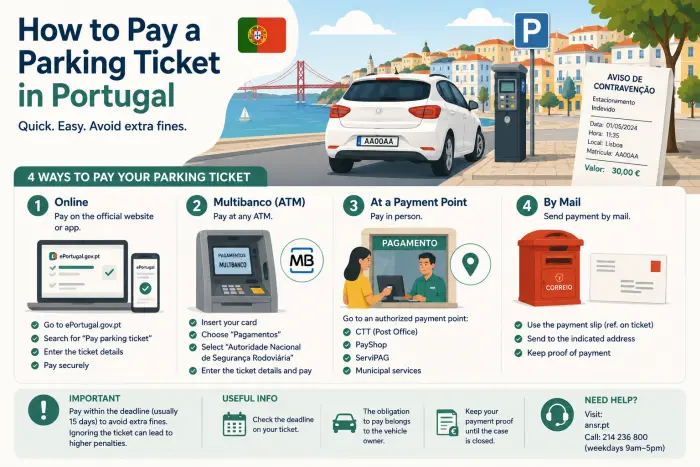
Paying directly, before returning the car, is almost always cheaper and simpler than letting the rental company handle it later. Most tickets specify a payment method — some can be paid at a post office (CTT) or Multibanco ATM using a reference number printed on the ticket, others require an in-person visit to the specific parking authority’s office (common in tourist-heavy areas like Cascais, which runs its own local parking enforcement separate from a general municipal system). If the payment method isn’t obvious from the ticket itself, a quick search for the specific town’s parking authority name, printed on the ticket, usually clarifies where and how to pay. This is a different process from a speeding fine, which typically arrives by mail through a different enforcement channel entirely rather than a ticket on the windshield.
💸 Don’t Overpay at the Airport
Compare real-time rental deals with no hidden fees or credit card needed.
If you’ve already left the country by the time you notice the unpaid ticket, some parking authorities offer online or bank transfer payment options, though this varies significantly by municipality and isn’t always straightforward for a foreign payer without a Portuguese bank account. In practice, most tourists in this position end up waiting for the rental company to process the fine rather than tracking down a foreign-payer workaround, accepting the added administrative fee as the cost of having missed the original window.
Disputing a ticket
Contesting a Portuguese parking fine as a visiting tourist is rarely worth the effort. The administrative process is designed around Portuguese residents with access to local bureaucracy, and successfully disputing a ticket from abroad — even a plausibly unfair one — is uncommon enough that most experienced visitors simply pay and move on rather than pursuing a challenge that eats far more time than the fine itself costs. This is a different calculation than disputing a damage charge with the rental company itself, where photo evidence from pickup and return genuinely does shift outcomes — a parking authority’s process simply isn’t built the same way, and treating the two situations the same tends to waste effort that would be better spent elsewhere.
For anyone driving through several towns on a longer Portugal road trip, it’s worth building the habit of checking for parking signage or payment machines by default in any town center, rather than assuming free parking based on what a previous town or city allowed — rules and enforcement intensity vary considerably from one municipality to the next, and what was free and unenforced in a small Alentejo town can be actively ticketed an hour away in a more tourist-heavy coastal center. See our complete guide to Portugal’s driving laws for how this fits alongside speeding fines and tolls.
Frequently asked questions
How will I know if I have an unpaid parking ticket after leaving Portugal? Usually only when the rental company charges your card, often weeks or months later, sometimes with little advance notice beyond the charge itself appearing on your statement — checking your card statement carefully for a month or two after any Portugal trip is a reasonable habit if you’re at all unsure whether every ticket got settled.
Is it cheaper to pay a parking ticket directly, or let the rental company handle it? Paying directly, before returning the car, is almost always cheaper — rental companies typically add their own administrative fee on top of the original fine, which the direct payment avoids.
How long do I have to pay a Portuguese parking ticket before it increases? Often around five days at the original rate before the fine doubles, though this varies by municipality and ticket type.
Can I pay a Portuguese parking ticket from outside the country? Sometimes, depending on the issuing authority — some offer bank transfer or online payment options, though this isn’t universal and can be difficult without a Portuguese bank account or fluency in the local payment portal.
Is it worth disputing a parking ticket I think was unfair? Generally not for a tourist — the process favors local residents with access to Portuguese bureaucracy, and the time cost of disputing usually exceeds the fine itself.
Does a parking ticket affect my rental car deposit? It can, if the fine arrives before your deposit is fully released — otherwise it’s typically charged separately once the rental company receives the fine notice, which may be well after your deposit has already been returned in full.
Are blue-zone parking rules the same across all Portuguese cities? The general concept is similar, but specific rates, hours, and enforcement authorities vary by municipality — Cascais, for example, runs its own parking authority separate from Lisbon’s, and rules that apply in one town center don’t necessarily carry over to the next stop on a road trip.