
Portugal’s speed limits are simple to follow — and expensive to ignore. The roads are good, the limits are logical, but the enforcement is camera-heavy and the fines have a habit of arriving on your card weeks after you’ve flown home, often with an admin fee from the rental company on top. Many visitors never even realise they were caught until the charge appears. This guide gives you the limits at a glance, explains how the fines actually reach you, and shows how to drive Portugal without ever opening that unwelcome email.
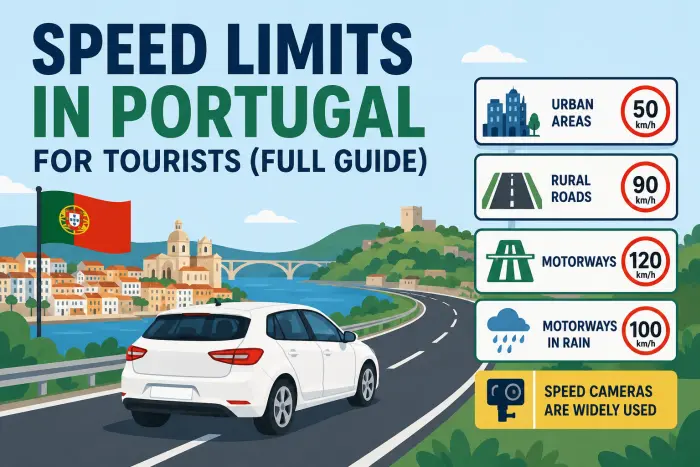
The standard limits are 50 km/h in towns, 90 km/h on normal rural roads, 100 km/h on main rural roads, and 120 km/h on motorways. Limits are camera-enforced, and fines for a rental are billed to the company, who charge your card later with a fee. Newly-licensed drivers and some vehicles have lower limits. When in doubt, follow the signs — they always override the defaults.
This is part of the driving in Portugal, alongside tolls, parking and the full road rules.
The speed limits at a glance
These are the default national limits for a standard car. Posted signs always take priority where they differ:
| Road type | Speed limit |
|---|---|
| Built-up areas / towns | 50 km/h |
| Normal rural roads | 90 km/h |
| Main rural roads (some) | 100 km/h |
| Motorways (auto-estradas) | 120 km/h |
| Residential / zona 30 | 30 km/h |
Motorway minimums exist too: you generally can’t drive below 50 km/h on an auto-estrada, which catches out nervous first-timers as much as speeders.
Lower limits you might not expect
A few situations quietly reduce your limit, and the cameras don’t care that you didn’t know:
- Newly-licensed drivers. Drivers who’ve held a licence under a year face lower maximums — relevant if a young member of your group is driving.
- Towing. Pulling a trailer or caravan drops your motorway limit.
- Rain and poor visibility. Some limits reduce in adverse conditions; signs may indicate this.
- School and residential zones. Often 30 km/h, sometimes with raised cameras.
The safe habit is to treat the posted sign as gospel and the national defaults as a fallback — never the other way round.
How speed cameras and fines actually work
Portugal uses a dense network of fixed and mobile speed cameras, plus average-speed checks on some stretches. As a tourist in a rental, here’s the chain that matters: the camera photographs the car, the fine goes to the registered keeper — which is the rental company — and the company then identifies you as the driver and charges your card, usually weeks or even months later, with an administration fee added on top of the official penalty.
So there’s no roadside drama and no officer waving you down for a camera offence. The bill simply appears after the trip, when you’ve long since forgotten the moment. That delay is exactly why prevention beats cure: contesting a foreign fine after the fact is slow and rarely worth it.
What the fines cost
Portuguese speeding fines scale with how far over you were, running officially from €60 up to €2,500 depending on the offense. For the full official table by km/h over, plus license points and driving ban details, see our complete breakdown of Portugal’s speeding fine amounts. For a tourist, the practical cost is the fine plus the rental company’s handling fee, which can sometimes rival the fine itself.
The rules that go with the limits
Speed limits don’t exist in isolation — they’re part of the wider road rules, and breaking the others (priority, drink-driving, phone use) carries its own penalties. The full set is in driving rules in Portugal. Two worth flagging alongside speed: Portugal’s drink-drive limit is lower than many countries’, and handheld phone use while driving is heavily fined. Cameras catch speed; police catch the rest.
💸 Don’t Overpay at the Airport
Compare real-time rental deals with no hidden fees or credit card needed.
Speed, tolls and the motorway
Most of your fast driving happens on the motorways, which is also where Portugal’s electronic tolls live. The two combine on a road trip: you want to hold 120 km/h legally and make sure your toll method is sorted so the gantries don’t generate a separate charge. How those tolls work is in toll roads in Portugal explained. Get both right and motorway driving in Portugal is genuinely relaxing — fast, smooth and predictable.
Where the cameras actually cluster
Cameras aren’t spread evenly — they concentrate where speeds tend to creep up, and knowing the pattern keeps you alert in the right places. The hotspots are the entrances to towns, where the limit drops abruptly from 90 to 50 and drivers don’t slow in time; motorway stretches near cities, where average-speed checks measure your pace between two points rather than a single snapshot; and descents and long straights, where it’s easy to drift over without noticing. Average-speed zones are the trickiest, because braking for the camera doesn’t help — they clock your time across the whole section, so you have to hold the limit throughout, not just at the gantry. Treat the approach to any town and any signed average-speed zone as the moments to glance at your speedo, and you’ll catch the offences that fine most tourists.
What to do if a fine email arrives
If a charge does land after your trip, don’t panic and don’t ignore it. The rental company will typically email to say they’ve received a penalty and will charge (or have charged) your card, often passing on your details to the authorities as the responsible driver. First, check it’s legitimate — the registration, date and location should match your trip; rental fee scams do exist, and the scam-avoidance guide linked above explains how to verify a charge before you pay it. If it’s genuine, the simplest path is usually to pay the official fine through the proper channel rather than letting it escalate, since unpaid penalties can grow. Keep every rental document and any photos until the matter is fully closed — they’re your evidence if the charge is wrong. The reassuring truth is that drivers who stick to the posted limits simply never reach this step, which is the entire point of the careful approach above.
How to never get a speeding fine here
It really is this simple:
- Follow the signs, not your assumptions. Limits change frequently; the sign is always right.
- Watch for the 50 zones. Town limits arrive suddenly and are the most-fined offence.
- Use your sat-nav’s limit display. Most apps show the current limit — covered in GPS and navigation tips for Portugal drivers.
- Don’t drift on the motorway. Cruise at 120, not “120-ish”, especially near average-speed zones.
- Brief every driver. If more than one person is driving, make sure they all know the limits — the fine lands on the booking either way.
Do these and the camera network becomes irrelevant — it’s only a threat to drivers who guess. For the fuller picture — fines, tolls, restricted zones — see our complete driving laws guide.
FAQ
What is the speed limit on Portuguese motorways? 120 km/h for a standard car, with a 50 km/h minimum. Posted signs can lower it in places, so watch for them.
What’s the speed limit in towns? 50 km/h in built-up areas, dropping to 30 in residential or school zones. Town limits are the most commonly fined, because they arrive suddenly.
How will I get a speeding fine in a rental car? The camera fines the rental company, who charge your card later — often weeks after the trip — and add an admin fee. There’s no roadside stop for camera offences.
Are speed cameras common in Portugal? Yes — fixed, mobile and average-speed cameras are widespread, especially on motorways and entering towns. Assume they’re everywhere.
Do new drivers have lower limits? Yes. Drivers licensed under a year face reduced maximums, which matters if a recently-qualified member of your group is driving.
Can I contest a speeding fine after I’ve gone home? You can, but it’s slow and rarely worth it for a camera offence. Prevention is far easier than disputing a foreign fine months later.
What are average-speed cameras and how do they work? They measure your speed across a whole stretch of road between two points, not at a single spot — so braking for the camera doesn’t help. You have to hold the limit for the entire signed section.

Where can I find the late fee charges for toll’s unpaid on my rental car.? This has been over 60 days, and I have waited to receive A notice to be sent by mail to my residence in the USA
If it has already been more than 60 days, you don’t necessarily need to wait for a letter. You can check for outstanding tolls directly on the official Ascendi Portal by entering the rental car’s license plate and the relevant dates: [Ascendi Toll Payment Portal](https://portal.ascendi.pt/en/apoio-a-clientes)
For foreign-registered vehicles, unpaid tolls may eventually be transferred to an overseas collection company, so the final notice may come separately. Since this was a rental car, it’s also worth contacting the rental company to check whether they have received or forwarded any toll-related notification.