If Portuguese police stop your rental car, pull over where you are signalled, hand over your driving licence, passport and the rental paperwork calmly, expect a possible breath test, and know that a fine issued to a foreign driver can be demanded on the spot or secured with a deposit; if you do neither, officers can hold your licence or the car’s registration document and, in the worst case, the vehicle itself.
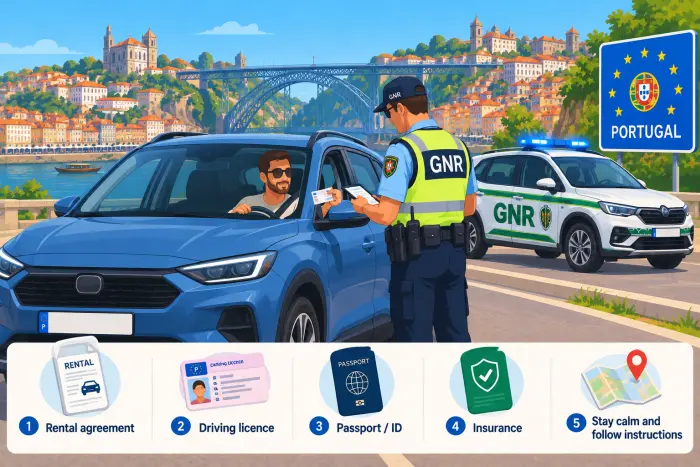
Most stops are routine and end in thirty seconds, but they feel very different when the officer speaks fast Portuguese and the car belongs to someone else. This guide explains who is doing the stopping, which documents to keep within reach, how the roadside payment rules work for visitors, what changes because the car is a rental, and the mistakes that turn a simple check into a problem.
Roadside quick answers
- Who stops you: GNR (mostly outside towns) or PSP (mostly in towns), often in a planned checkpoint called an Operação STOP
- Hand over: driving licence, passport or ID, vehicle registration, insurance certificate, rental agreement
- Alcohol limit for private drivers: 0.05% blood alcohol (0.5 g/l), lower for newly qualified drivers
- Refusing a breath test: treated as a criminal offence, not a fine
- Roadside fine: pay immediately or leave a deposit; otherwise documents can be held
- Always ask for: an official receipt for anything you pay or hand over
Who stops you, and why it usually isn’t personal
Portugal has two main police forces on the road. The GNR (Guarda Nacional Republicana) is the rural force and patrols motorways and country roads, while the PSP (Polícia de Segurança Pública) covers towns and cities. Either can run an Operação STOP, the planned checkpoint where officers wave cars into a lay-by and check licences, documents and sometimes alcohol levels. Stops are also made individually after a traffic violation, and a rental car is stopped for the same reasons as any other: a missed signal, a speeding camera or patrol reading, a worn tyre, or simply being the next car in line.
Language is the first practical issue. In cities and tourist areas many officers speak English; in rural areas fewer do, so a few phrases help. “Carta de condução” means driving licence, and “documentos do carro” covers the vehicle papers. Staying polite and unhurried matters more than any phrase: guides written for expatriates consistently note that a courteous driver makes the stop go more smoothly.
The documents officers expect to see
Carry the following in the car, not in a suitcase in the boot, because you may be asked for them within seconds of stopping.
| Document | What it proves | Rental-car note |
|---|---|---|
| Driving licence | You are entitled to drive | Original, not a photo; see below for licences in other alphabets |
| Passport or ID | Your identity | Officers often ask for a second form of ID, so carry the passport |
| Vehicle registration | The car is legally registered | Normally in the rental folder in the glovebox |
| Insurance certificate | The car is insured | Same folder; the policy number appears on the rental agreement |
| Rental agreement | You have permission to drive a car that isn’t yours | Keep the printed or digital copy where you can show it quickly |
| International Driving Permit | A translation of the licence | Only needed for some licences |
Licences issued in English, French, Spanish or Portuguese are generally accepted on their own for short visits, while other licences usually need an International Driving Permit, which our guide on whether you need an IDP to rent a car in Portugal explains. The paperwork you collect at the counter is also covered in the list of documents needed for Lisbon Airport car rental, and it is worth photographing each page before you leave the desk so you hold a copy if the originals go missing.
What happens during the stop
The sequence is predictable. You are signalled to a safe spot, you stop, switch off the engine, lower the window and keep your hands visible. The officer asks for your licence, then usually the vehicle documents, and may ask in Portuguese whether you have had any alcohol in the last few hours. Answer simply and truthfully, and do not get out of the car unless asked.
If a breath test is requested, it is done at the roadside with a handheld device. The officer may check other basics at the same time, such as whether the safety equipment is in the car; the items required are listed in our note on the warning triangle and reflective vest rules, and a rental car should already carry both. Radar detectors are a separate problem altogether, because they are illegal in Portugal, as explained in our article on speed camera apps and radar detectors, so leave any detector at home.
The alcohol test, and why you should never refuse it
The limit for private drivers is 0.05% blood alcohol, equal to 0.5 grams per litre, which is lower than in the UK. Newly qualified drivers and professional drivers face a stricter threshold. A positive reading brings a fine and a driving ban, and a vehicle can be confiscated in some cases.
Refusing the test is treated differently from failing it: guides written for visitors state that you will not be allowed to continue driving and will be prosecuted for a criminal offence. If you disagree with a reading, you can ask for a second breath test or a blood test, in which case you are driven to the nearest hospital. The thresholds, bans and fines are covered in our drink-driving guide for wine regions, and it is worth reading before any trip that includes a tasting.
💸 Don’t Overpay at the Airport
Compare real-time rental deals with no hidden fees or credit card needed.
Roadside fines: what foreign drivers should expect
This is the part that surprises visitors most. Under the Portuguese highway code, a fine can be paid voluntarily at the moment the offence is recorded. If you do not want to pay immediately, you are asked to leave a deposit instead, and the deposit is converted into payment if you do not file a defence in time. If neither is done, the officer can provisionally seize your driving licence or the vehicle’s registration documents. Guides for foreign motorists add that refusing both can lead to the vehicle being held until the matter is settled.
| Your choice | What happens | The catch |
|---|---|---|
| Pay the fine on the spot | The case is usually closed, unless a ban is also involved | You give up the chance to contest it later |
| Leave a deposit | The deposit secures your right to contest | The amount is tied to the fine for the offence; it can be larger than the fine you end up owing |
| Pay neither | Licence or registration papers can be seized, and in the worst case the vehicle | You may be unable to drive on, and the rental company is dragged in |
Several practical rules apply whichever route you take. Payment is in euros, most patrol cars carry a portable payment terminal, and you should always ask for an official receipt that shows the amount. If anything feels informal, such as a demand for cash with no paperwork, decline politely and ask for the official document. The size of the fine itself depends on the offence, and the tiered amounts for speeding are laid out in our speeding fine table, including the 15 working days you have to appeal.
What changes because the car is a rental
A private motorist who loses the registration papers has a problem; a rental driver has someone else’s problem. If an officer keeps the vehicle’s registration document or insurance paperwork, tell the rental company at once using the roadside number on your contract, because they may need to supply copies or arrange an alternative.
The second complication comes later. Fines that arrive by post or camera go to the registered keeper, which is the rental company, and a notice is forwarded to you with an administrative fee, as we describe in our guide to parking fines on a Portuguese rental. Keep any roadside receipt, because it is your proof that a fine was already paid if a second notice follows.
When the stop turns out to be something else
Occasionally a stop is the start of a longer incident, for example after a collision. In that case call 112 and follow the steps in our guide on what to do after a rental car accident in Portugal, and keep the national numbers listed in our page on emergency numbers for drivers in your phone. For the wider rules behind all of this, our overview of car rental driving laws in Portugal is the best starting point.
A short checklist before you drive
- Keep the licence, passport, registration, insurance certificate and rental agreement together, within reach of the driver.
- Photograph the rental paperwork at pickup.
- Do not drink and drive, and never refuse a breath test.
- If fined, ask for the amount in writing and an official receipt.
- If any document is retained, call the rental company’s roadside number straight away.
Frequently asked questions
Do Portuguese police stop tourists at random? Officers run planned checkpoints, called Operações STOP, where cars are stopped in sequence, and they also stop individual vehicles after a violation. A rental car is treated like any other.
Which documents do I need to show in a rental car? Your driving licence, passport or ID, the vehicle registration, the insurance certificate and the rental agreement. Add an International Driving Permit if your licence is not in English, French, Spanish or Portuguese.
Can I refuse a breath test in Portugal? No. Refusal is treated as a criminal offence rather than a minor fine, and you will not be allowed to continue driving. You can ask for a second test or a blood test if you disagree with the reading.
Do I have to pay a police fine immediately? Foreign drivers can be asked to pay immediately or to leave a deposit that secures the right to contest. If you do neither, officers can seize your licence or the car’s registration papers.
Can I pay a roadside fine by card? Many patrol cars carry portable payment terminals, so card payment is often possible. Whatever you pay, ask for an official receipt showing the amount.
What if the police keep the rental car’s papers? Contact the rental company on the roadside number in your contract straight away, tell them what was retained and ask what they need from you. Keep any receipt or slip the officer gives you.
Will the rental company find out about a roadside fine? Not necessarily from the stop itself, but fines issued later are sent to the registered keeper, the rental company, who forward them to you with an administrative fee.
Is it GNR or PSP who stop me? Either. The GNR mostly covers rural roads and motorways, while the PSP works in towns and cities, and both run checkpoints.