If you’re planning to rent a car and drive yourself between Douro Valley quintas for a day of wine tasting, it’s worth knowing this upfront: Portugal’s legal blood alcohol limit for driving is 0.5 grams per liter, low enough that a single average glass of wine can put an average adult over it, and for drivers with less than two years of licensed experience, the limit drops to just 0.2 grams per liter, where even one small glass is often enough. This isn’t a minor technicality in a region built entirely around wine tasting, hillside quintas, and generous pours at every stop — it’s worth genuinely planning your day around before you book anything.
The Real Deal
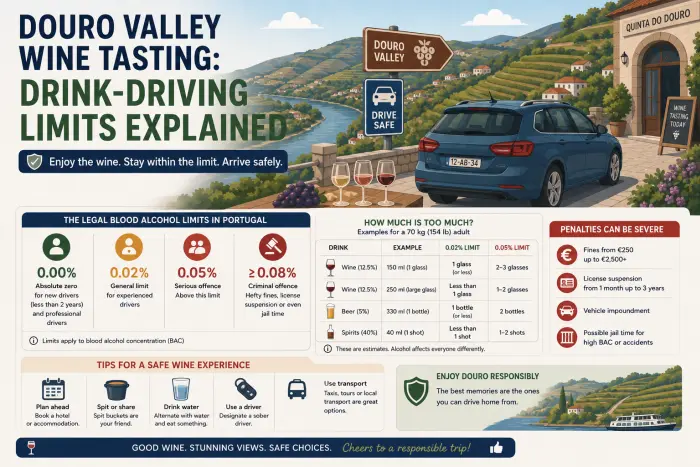
- Portugal’s standard drink-driving limit is 0.5 g/l blood alcohol; for drivers with under two years’ experience, it drops to 0.2 g/l
- One average glass of wine or beer is enough to put most people at or over the 0.5 g/l limit, and almost certainly over 0.2 g/l
- Fines scale with severity: roughly €250-1,250 for 0.5-0.8 g/l plus a 1-12 month driving ban, up to €500-2,500 for 0.8-1.2 g/l plus a longer ban, and criminal prosecution above 1.2 g/l
- GNR and PSP actively run breathalyzer checks, and wine regions like the Douro are a known enforcement focus, not an overlooked backroad
- The realistic options are: designate one non-drinking driver for the day, hire a driver or guided tour, or genuinely limit tasting to spitting rather than swallowing if you must drive afterward
Why This Matters More in the Douro Than Almost Anywhere Else
The entire premise of a Douro Valley day trip is visiting multiple quintas (wine estates) and tasting at each one, often several pours per stop across three or four properties, sometimes paired with a cellar tour and a full lunch as well. If everyone in the car is tasting at every stop, there’s a real chance nobody in the vehicle is legally fit to drive by the second or third quinta, regardless of good intentions or feeling “fine.” Portuguese authorities are aware of exactly this pattern, and enforcement in wine-tourism areas reflects it.
What the Fines Actually Look Like
| Blood Alcohol Level | Consequence |
|---|---|
| 0.5-0.8 g/l | Fine of roughly €250-1,250, driving ban of 1-12 months |
| 0.8-1.2 g/l | Fine of roughly €500-2,500, driving ban of 2-24 months |
| 1.2 g/l or above | Treated as a criminal offense, with possible imprisonment and a driving ban of 3-36 months |
Beyond the legal penalties, driving a rental car under the influence also typically voids your insurance coverage entirely, meaning any accident becomes a fully out-of-pocket problem on top of the criminal exposure.
The Simplest Fix: A Genuine Designated Driver
If you’re traveling as a couple or small group, the most straightforward solution is agreeing in advance on one person who won’t drink that day, full stop, not “just a small sip here and there.” It sounds obvious, but the honest reality is that quinta tastings are generous, hosts often pour more than a standard measure, and it’s easy to lose track across multiple stops when everyone’s relaxed and enjoying the scenery. Committing to zero alcohol for the designated driver, rather than “staying under the limit,” removes the guesswork entirely and means nobody has to do mental math about grams per liter halfway through a beautiful afternoon.
Hiring a Driver Instead of Self-Driving
For groups where everyone genuinely wants to taste at every stop, hiring a private driver for the day is worth serious consideration, and it’s more accessible than many visitors assume. It’s worth comparing the cost of a chauffeur-driven car rental against a standard self-drive rental plus the very real risk calculus of driving after tasting — for a full day of quinta visits, the math often favors hiring a driver once you account for what’s actually at stake, both financially and legally. Many local operators in the region specialize specifically in wine-tasting day trips and know the quintas well, which adds genuine value beyond simply removing the driving question.
If You’re Still Planning to Self-Drive
If your plan is to drive yourself and simply taste lightly or spit rather than swallow, know that this reduces but doesn’t eliminate alcohol absorption, since some alcohol is absorbed through the mouth’s mucous membranes even without swallowing anything at all. It’s a real technique used by wine professionals, but it’s not a guarantee of staying under 0.5 g/l, and it offers essentially no margin at all under the stricter 0.2 g/l limit for newer drivers. If you’re taking this approach, treat “very light tasting only, at just one or two stops” as the honest limit, not a full day of pours at every quinta on your itinerary.
The Roads Themselves Deserve Respect Too
Separate from the alcohol question, Douro Valley roads are genuinely demanding to drive under the best of circumstances: narrow, winding, and often hugging steep terraced hillsides with limited shoulder space and blind curves around vineyard walls. It’s worth reading our broader guide to Portugal’s more dangerous roads and general road safety and defensive driving advice before a Douro trip, since these roads punish impaired reactions and misjudged distances far more than a straight motorway would.
Navigating Between Quintas
Cell coverage can be inconsistent in parts of the Douro’s more rural stretches, and GPS routing between smaller quintas isn’t always reliable. It’s worth setting up mobile data for GPS use in Portugal before you head out for the day, particularly if your itinerary includes smaller, less-visited estates off the main road.
💸 Don’t Overpay at the Airport
Compare real-time rental deals with no hidden fees or credit card needed.
Speed Limits and Enforcement Along the Way
Beyond alcohol checks, it’s worth knowing Portugal’s speed limits generally, since Douro roads shift frequently between village limits and open countryside stretches, and cameras and patrols are active throughout wine country during peak tourist season.
Planning Your Douro Trip More Broadly
If you’re still working out logistics for a Douro Valley visit beyond the drink-driving question, our Douro Valley car rental guide covers routes, timing, and what to expect from the region overall. And if it’s your first time driving in Portugal, a quick read of general driving rules is worth doing before a wine country day trip specifically, since local road etiquette in small Douro villages differs meaningfully from city driving.
Practical Checklist for a Safe Douro Wine Tasting Day
- ✅ Agree on a genuine zero-alcohol designated driver before you start tasting, not partway through the day
- ✅ Seriously price out a private driver or guided tour if everyone in your group wants to taste freely
- ✅ If self-driving with light tasting, spit rather than swallow and keep it to one or two stops, not a full circuit
- ✅ Know that driving under the influence typically voids your rental car’s insurance entirely
- ✅ Set up reliable GPS/mobile data before heading into more rural stretches between quintas
- ✅ Respect the roads themselves — narrow, winding mountain terrain deserves full attention regardless of the alcohol question
Frequently Asked Questions
What is Portugal’s legal blood alcohol limit for driving? 0.5 grams per liter for most drivers, dropping to 0.2 grams per liter for drivers with less than two years of licensed experience.
Can one glass of wine really put me over the limit? Yes, for many people. A single average glass of wine or beer can bring an adult close to or over the 0.5 g/l limit, and it’s very likely to exceed the stricter 0.2 g/l limit.
What happens if I’m caught driving over the limit in Portugal? Penalties scale with your blood alcohol level, ranging from fines of roughly €250 up to €2,500 plus a driving ban, and levels above 1.2 g/l are treated as a criminal offense with possible imprisonment.
Is it worth hiring a driver for a Douro wine tasting day instead of renting a car? For groups where everyone wants to taste freely at multiple quintas, yes — it’s genuinely worth comparing the cost against the real legal and safety risk of self-driving after tasting.
Does spitting instead of swallowing during wine tastings keep me under the limit? It reduces alcohol absorption but doesn’t eliminate it, since some alcohol absorbs through the mouth even without swallowing. It’s not a reliable way to guarantee staying under the legal limit, especially the stricter 0.2 g/l threshold.
Are police checks common in the Douro Valley specifically? Yes. Wine regions are a known focus area for GNR and PSP alcohol enforcement, precisely because of the volume of wine tourism traffic.
Does driving under the influence affect my rental car insurance? Yes, typically. Most rental agreements void coverage entirely if you’re found to be driving under the influence, meaning any accident becomes your full financial responsibility.
What’s the safest way to plan a self-drive Douro trip if our group wants to taste at every stop? Designate one person to have zero alcohol for the entire day, or hire a private driver so nobody in the group needs to hold back on tasting.