The middle of a breakdown or an accident on an unfamiliar motorway is the worst possible moment to be scrolling through search results looking for a phone number. This is the page to save before you drive, not during — a short, practical list of exactly who to call in Portugal, in what order, and what happens once you do.
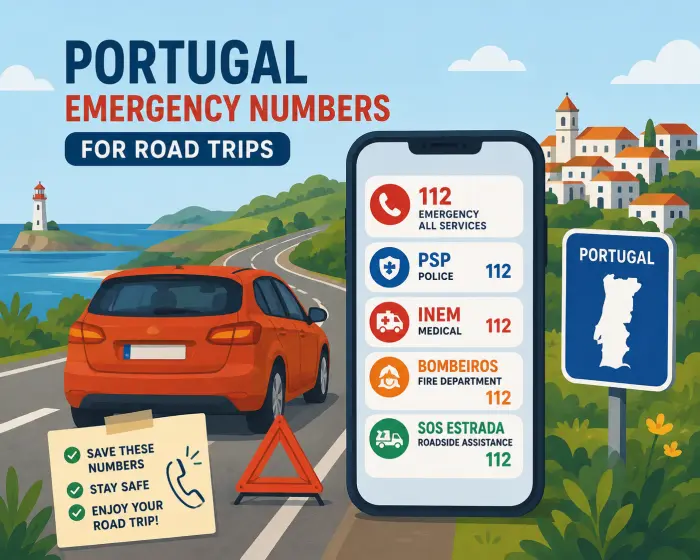
The one number that matters most: 112
For anything genuinely urgent — an accident with injuries, a fire, a medical emergency, or a situation where you feel unsafe — dial 112. It’s the single emergency number across the entire European Union, free from any phone, and it connects you to police, ambulance, and fire services in one call. Operators in Portugal can generally assist in English, though if you’re worried about the language barrier, say “English, please” as soon as the call connects and you’ll typically be transferred to someone who can help. The operator will ask for your location, so glance at the nearest motorway marker, exit sign, or a road name before you call if you can — it speeds everything up.
One thing worth knowing in advance: 112 is for genuine emergencies requiring police, fire, or ambulance response, not for general questions or non-urgent situations. A minor fender-bender with no injuries and no dispute over fault doesn’t need a 112 call — more on that below.
What to do first, before any call
Portuguese traffic law requires two things to be inside every car’s passenger cabin, not the trunk: a high-visibility reflective vest and a warning triangle. If you’re stopped on a road or shoulder, put the vest on before you get out of the car — this is a legal requirement, not just good practice — and place the warning triangle at least 30 meters behind the vehicle to warn oncoming traffic. Move yourself and any passengers to a safe spot away from moving traffic, ideally behind a barrier, before making any calls.
💸 Don’t Overpay at the Airport
Compare real-time rental deals with no hidden fees or credit card needed.
When to call 112 vs. when you don’t need to
Call 112 if anyone is injured, however slightly; if there’s a serious disagreement with the other driver about what happened; if the other driver refuses to share their details, appears to be under the influence, or leaves the scene; or if the accident is blocking traffic and the vehicles can’t be moved. In any of these situations, calling 112 also brings the police automatically.
If it’s a minor accident, no one is hurt, and both drivers agree on what happened, Portuguese practice doesn’t require a police report — you and the other driver fill out and sign a Declaração Amigável de Acidente Automóvel (European Accident Statement, also called the DAAA), a standard form that should be in your rental car’s glovebox. Take photos of both vehicles, the damage, license plates, and the road position before moving anything, then exchange insurance and contact details. Driving away without doing this is illegal in Portugal, regardless of how minor the accident seems.
After any accident: call your rental company
Whatever else happens, contact your rental company as soon as you’re safe — this is a requirement of your rental agreement, not optional paperwork. The number will be on your rental contract and often on a sticker inside the car itself. They’ll tell you how to handle the damaged vehicle, whether a replacement is available, and how their insurance process works. Skipping this step or delaying it can leave you liable for damages that would otherwise have been covered — treat it as the second call after 112, not something to sort out once you’re back at the hotel.
Breakdown and roadside assistance
If your car breaks down rather than being in an accident, the same first steps apply: hazard lights on, reflective vest on before exiting, warning triangle placed behind the vehicle, everyone moved to safety. From there, your rental company’s assistance number takes priority over any general breakdown service — it’s usually the fastest route to getting a replacement vehicle rather than just a tow. Portugal’s national breakdown service can be reached at 707 509 510 as a general option, and drivers with a European auto club membership (from organizations like ADAC, ANWB, or the AA) can often access assistance through Portugal’s own club, ACP, at 213 472 472, under reciprocal arrangements — but for a rental car specifically, the number on your contract should be your first call.
Other numbers worth having
| Situation | Number |
|---|---|
| Any emergency (police, ambulance, fire) | 112 |
| Non-emergency medical advice (SNS 24) | 808 24 24 24 |
| National breakdown service | 707 509 510 |
| ACP roadside assistance (auto club) | 213 472 472 |
| GNR Transit SOS (rural roads, traffic hazards) | 808 201 855 |
| Forest fire reporting | 117 |
A note on the language barrier
English support on 112 is generally available and most Portuguese emergency operators can switch to English without much friction, especially in areas with heavy tourist traffic like Lisbon, Porto, and the Algarve. Tourist police stations in Lisbon and Porto specifically have English-speaking officers trained to help visitors with theft reports and similar issues, which can be a better first stop than a standard station if your situation isn’t urgent enough for 112. If you’re driving somewhere more remote and worried about being understood, having a translation app ready as a backup — alongside your saved emergency numbers — costs nothing and takes the pressure off finding the right words under stress.
The bottom line
Save 112 in your phone before you start driving in Portugal, know that your rental company’s number takes priority right after it for anything involving the vehicle, and keep the reflective vest and warning triangle where you can reach them, not buried in the trunk. For a fuller breakdown of what to do specifically in a rental car accident — including how insurance and excess typically get handled — see our rental car accident guide, and if a breakdown rather than a collision is your concern, our what happens if your rental car breaks down guide covers the process in more detail.