The N222 road trip works best as an early start from Porto, a drive to Peso da Régua, then the famous stretch along the river to Pinhão, which is roughly 25 km, about 93 bends and around 40 minutes without stopping, but six to eight hours with viewpoints, a quinta visit and lunch. Do it in one long day if you must and in two if you can, and book any tasting before you leave, because the driver cannot taste and the best estates fill up.
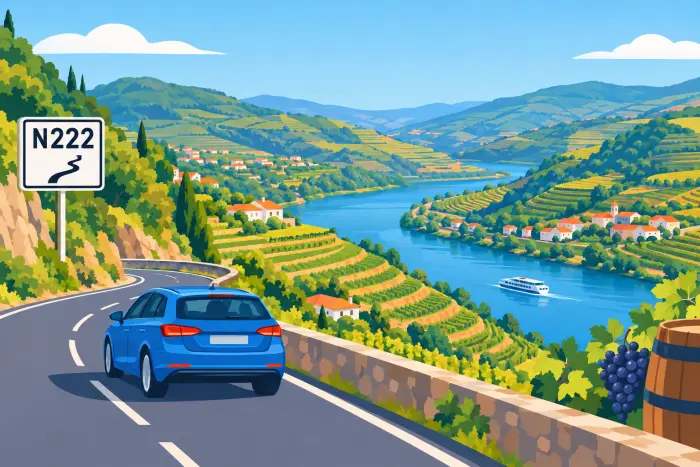
The reputation is earned. Drivers describe the N222 between Régua and Pinhão as one of the best driving roads in Portugal, and it has been ranked among the best in the world, which is why a tiny stretch of road draws people from across the country. It also has the rough edges of a road built for the valley and not for visitors: narrow, winding, busy at the wrong times and not the place to be tired or thirsty. This guide covers how to reach it from Porto, a one-day loop and a two-day version, and what to arrange before you go.
Quick plan. Porto to Régua takes about 1.5 hours by motorway. The N222 between Régua and Pinhão is roughly 25 km. Allow a full day for it, book quintas ahead, and let someone other than the driver do the tasting.
What the N222 actually is
The N222 is a long national road that follows the Douro for more than 200 km, from the outskirts of Porto to the Spanish border area, but when people say “the N222” they mean the stretch between Peso da Régua and Pinhão. It is roughly 25 km long (sources give figures from 21 to 27 km), hugs the river at water level and winds through terraced vineyards with about 93 bends, and it can be driven without stopping in 35 to 45 minutes.
Nobody does that. The reason is the viewpoints, the quintas and the villages, and the real planning question is how many of them you want. Six to eight hours is the realistic range for a full day on a 25 km road, which is a good measure of how it feels.
Getting from Porto
There are two ways to reach the valley, and they suit different moods.
- The motorway. The A4 from Porto to Régua takes about an hour and a half and carries tolls of roughly €5 to €8 each way according to published guides. It is quick, and it leaves your energy for the valley. Our guide to how toll roads work in Portugal explains the transponder most rental cars carry.
- The scenic road. The N108 along the north bank of the river, then the N222 after crossing, takes two to two and a half hours with no tolls. It is a lovely drive, but it eats the morning.
The practical choice for most visitors is the motorway out and the river road on the way back, or the other way round if the light suits you. Porto Airport is the usual pickup, and our guide to renting a car at Porto Airport covers the desks. If you are staying in the city, remember that the car is a burden there, and our note on driving and parking in Porto explains why collecting it only on the day you leave is usually the smarter plan.
One day: a loop that works
The timings below are rough and assume an early start.
| Stop | What it is | Time cue |
|---|---|---|
| Peso da Régua | Wine museum, the old iron bridge and the start of the N222 | Arrive by mid-morning |
| N222, Régua to Pinhão | The 93-bend stretch along the river | Allow two to three hours with stops |
| Quinta visit | A tasting, booked in advance | Late morning or early lunch |
| Pinhão | Riverside town with a station covered in blue tiles | Lunch and a walk |
| Casal de Loivos | Viewpoint about 7 km above Pinhão | Mid-afternoon |
| São Leonardo de Galafura | Viewpoint on the way back, about 19 km from Régua | Late afternoon if energy allows |
Start at Régua and its Douro museum if you want context, then take the N222 east to Pinhão. Pinhão is the valley’s main hub, with a promenade, the tiled station and boat trips for anyone who prefers to see the vineyards from the water. Above it, the road to Casal de Loivos climbs to one of the best panoramas in the valley, though the streets in the village are narrow. On the return leg, a detour to São Leonardo de Galafura gives a last view, and local writers rate it as one of the best in the region.
If you still have energy, a longer loop heads north from Pinhão through Vale de Mendiz toward Tua and returns by the Valeira dam, adding scenery and time.
Two days: where to sleep
Two days is the comfortable version, and it changes the shape of the trip. Drive to the valley on the first day, take your time on the N222 and sleep in Pinhão or Régua. On the second day, visit Casal de Loivos and the small wine village of Provesende, cross to São Leonardo de Galafura, and add a short detour to Lamego if you want a historic town on the way back to Porto.
Staying overnight also solves the tasting problem: a booked room near the quinta means the person who drinks is not the person who drives. If your plans include more of Portugal’s north, our overview of car rental in northern Portugal shows what else fits within reach of Porto, and our Portugal road trip itinerary places the Douro inside a longer route.
💸 Don’t Overpay at the Airport
Compare rental offers for your dates. Many include free cancellation, and some don’t require a credit card.
Tastings, bookings and who is driving
Treat the quinta visit as a reservation and not a walk-in. Even mid-sized estates ask for pre-booking, and in the harvest season, roughly September to early October, popular dates sell out months ahead. Two visits in a day is a comfortable limit, because more means rushing the road or the tasting.
The driving rule is simple and strict: do not drive on the N222 after several tastings. The limits and the penalties are set out in our guide to drink-driving rules in wine regions, and the advice is to agree on a designated driver before you leave Porto. A second option is to split the day, doing the road in the morning and the tasting after you have parked for the night.
Seasons, traffic and the road itself
The valley changes with the calendar. March to May is green and mild, June to August can be very hot, sometimes above 35 degrees inland, and the harvest in September and early October brings tractors, busy cellars and slow traffic. The road is narrow, winding and often has no room to pass, so patience is part of the trip, and the GPS estimate is usually optimistic. Our notes on GPS navigation for Portugal drivers are worth reading before you rely on it in the valley, where signal can drop.
Public transport in the valley is limited, with only a few trains a day, which is exactly why a car makes sense here. It is also why fuel matters: top up in Régua before heading east, and read our note on refuelling before you return the car so you do not hand the car back on a low tank.
The car
A small or compact car is ideal for the bends and the village lanes. Larger SUVs offer comfort and seating height, but you do not need off-road ability, and a big vehicle is harder to place on the narrow stretches. If hairpins and hill starts worry you, our guide to automatic car hire in Portugal explains how to book one, and our overview of car rental for the Douro Valley covers the rental side in more detail.
Frequently asked questions
How long does it take to drive the N222? Between Peso da Régua and Pinhão, about 35 to 45 minutes without stopping. A full day is a realistic allowance with viewpoints, a quinta and lunch.
How far is the N222 from Porto? The valley starts about an hour and a half from Porto by motorway, with Pinhão roughly an hour and three-quarters away.
Is the N222 dangerous to drive? Not for careful drivers, but it is narrow and winding with around 93 bends and little room to pass. Drive slowly and avoid it when tired or after drinking.
Can I do the Douro Valley in one day from Porto? Yes, with an early start, but it is a long day. Two days is more relaxed and lets you stay overnight near a quinta.
Do I need to book a quinta visit? Yes. Even mid-sized estates ask for reservations, and harvest dates sell out months ahead.
What are the best viewpoints on the N222? Casal de Loivos above Pinhão and São Leonardo de Galafura near Régua are the two most often recommended.
When is the best time to drive the Douro? Spring is green and quiet, summer can be very hot, and September to early October is harvest, which is atmospheric but busy.
Do I need a big car? No. A small or compact car is easier on the narrow, winding roads, and an automatic helps on hill starts.