The Douro Valley is one of the few regions in this series where a car isn’t just convenient — it’s the only way to reach most individual wine estates, which are scattered across steep terraced hillsides with no meaningful public transport between them. The train and river cruise both cover the main towns beautifully, but neither gets you to the smaller quintas that make the region worth visiting in the first place.
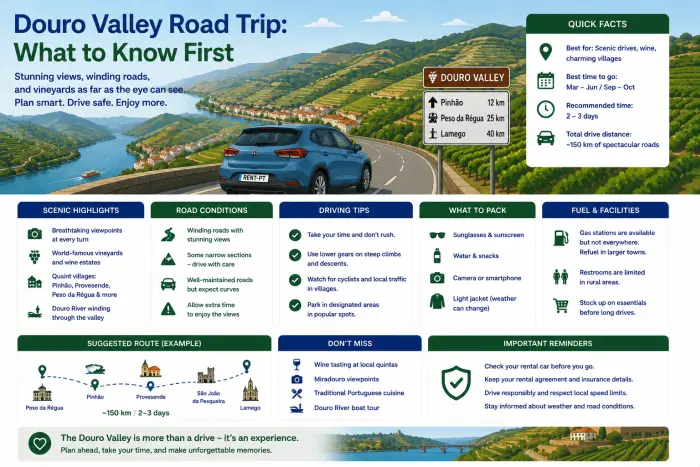
Portugal’s Douro Valley is one of the world’s oldest demarcated wine regions, a UNESCO-listed landscape of steep river-carved terraces that’s genuinely spectacular from a car window — and genuinely difficult to explore any other way once you’re past the main towns.
Porto to the Douro: Picking Up Your Car
Most Douro Valley trips start with a rental picked up in Porto — either at Porto Airport if you’re flying in directly, or a city-centre office if you’re spending time in Porto first. From central Porto, it’s roughly 100-110 km to Peso da Régua, generally 1h30 to 1h45 depending on your route, mostly via the A4 motorway before the roads narrow into the valley itself.
Train or River vs. Car: What Each Actually Covers
| Factor | Rental car | Train (Porto–Pinhão) | River cruise |
|---|---|---|---|
| Reaches individual quintas | Yes, directly | No — main towns only | No — riverside towns only |
| Scenery | Excellent, especially the N222 | Excellent, different angle | Excellent, from the water |
| Flexibility | Full control of pace and stops | Fixed schedule, fixed stops | Fixed schedule, fixed stops |
| Best for | Multi-estate tasting trips | A scenic day trip without driving | A relaxed, no-driving day out |
| Wine tasting logistics | Requires a designated driver | Fully open to drink | Fully open to drink |
If your priority is visiting two or three specific wine estates by name, a car is close to essential — most quintas sit well off the main road, up estate driveways that no train or boat comes near. If you’d rather sit back with a glass in hand and let the scenery come to you, the train to Pinhão or a river cruise both deliver a genuinely excellent Douro experience without needing to plan around a designated driver.
For how a Douro Valley day fits into a longer northern Portugal itinerary, see our regional guide.
The N222: One of the World’s Best Driving Roads
The stretch of the N222 between Peso da Régua and Pinhão has picked up international recognition in driving and travel circles as one of the best scenic roads anywhere, tracing the river’s edge beneath terrace after terrace of vineyards. It’s also narrow, winding, and shared with local traffic, tour vans, and the occasional tractor — driving it well means going slower than you might expect and pulling over at the frequent viewpoints rather than treating it as a route to cover quickly.
Peso da Régua vs. Pinhão as a Base
Peso da Régua is the larger, more practical base — better lodging options, easier parking, and a natural stopping point on the way in from Porto. Pinhão is smaller and more atmospheric, sitting closer to some of the valley’s most photographed terraces, but with a more limited choice of accommodation and services. Many visitors base themselves in Régua and drive out to Pinhão and the surrounding quintas for the day, rather than trying to find a base directly in the smaller town.
Wine Estate Etiquette When Driving
If tasting is the point of your Douro trip — and for most visitors, it is — this is the region where a genuine designated driver matters most. Estates here are often 20-40 minutes apart along winding roads, and the temptation to “just have a small taste at each stop” adds up fast over a full day of estate-hopping. Many quintas offer non-alcoholic grape juice tastings alongside their wine programs specifically for drivers, which is worth asking about if you’re behind the wheel for the day.
Driving the Terraces: What to Expect
Beyond the N222 itself, many individual estate access roads climb steeply up the terraced hillsides on narrow, occasionally unpaved surfaces. A standard rental car handles the main routes without issue, but tight switchbacks and blind corners are common — this is not the region for driving fast or for someone still building confidence with manual transmission on hills. Reading through driving rules in Portugal beforehand is useful preparation, though the Douro’s estate roads go beyond what standard road rules cover — local caution and patience matter more here than anywhere else in this series.
💸 Don’t Overpay at the Airport
Compare real-time rental deals with no hidden fees or credit card needed.
Why the Douro Rewards a Slower Trip Than You’d Plan
It’s tempting to treat the Douro like any other day trip from Porto — drive out, see the view, taste some wine, drive back. The region doesn’t really work that way. The terraces that make the valley famous were shaped by centuries of hand-built stone walls, and the estates built around them run on a similarly unhurried rhythm: tastings that take an hour rather than fifteen minutes, lunches that stretch into the afternoon, views that are genuinely better appreciated from a parked car at a viewpoint than glimpsed through a windscreen at speed. Planning slack into your schedule here isn’t a luxury — it’s closer to the only way to actually experience what the region is known for, rather than just driving through it.
How Many Days the Douro Actually Needs
A day trip from Porto is possible and common, but it’s a long one — roughly three hours of round-trip driving on top of whatever time you spend at estates, which leaves less room than most visitors expect for actually lingering at a quinta rather than rushing between them. An overnight stay in Peso da Régua or Pinhão turns the trip from a tiring loop into something closer to what the region deserves: an unhurried afternoon at one or two estates, a relaxed dinner overlooking the terraces, and a second day to explore further without the return drive hanging over the afternoon.
Automatic Transmission and Seasonal Booking
Rental availability in the Douro region itself is limited — most visitors pick up in Porto rather than locally, which sidesteps the issue, but it’s worth knowing that whatever car you book should be comfortable on hills before you arrive rather than something you discover on a steep estate driveway. Harvest season, roughly September into October, brings a distinct visitor surge on top of the general summer season, and rental demand in Porto climbs accordingly — booking a few weeks ahead for an autumn Douro trip is a reasonable precaution, particularly if an automatic transmission matters to you. This seasonal pattern is worth planning around specifically if your trip dates are flexible: the shoulder months of May, June, and early October often combine good weather with noticeably calmer roads and easier estate bookings than the peak of summer or the harvest rush itself.
Toll Roads on the Way In
The A4 motorway from Porto toward the Douro is tolled for its early stretches before the road narrows into the valley proper. As with other toll corridors in Portugal, it’s worth understanding how Via Verde tolls work before this drive, since Portugal’s electronic-only toll system on some motorway stretches easily catches out visitors unfamiliar with it.
📋 Douro Valley Car Rental Checklist
- Decide whether estate-hopping or scenic relaxation is your priority — it determines car vs. train vs. river cruise
- Pick up in Porto, either at the airport or a city-centre office, before heading into the valley
- Budget extra time on the N222 — it rewards slow driving, not quick coverage
- Choose Peso da Régua as a practical base, or Pinhão for atmosphere with fewer services
- Appoint a genuine designated driver if wine tasting is the day’s plan
- Expect narrow, winding estate access roads beyond the main N222
- Check your rental has a Via Verde transponder before the A4
FAQ
❓ Do I need a car to visit the Douro Valley? Only if you want to reach individual wine estates directly. The train to Pinhão and river cruises both cover the main towns and scenery well without driving.
❓ Is the N222 difficult to drive? It’s narrow and winding with frequent tight corners, but manageable at a moderate pace — the road rewards driving slowly and stopping at viewpoints rather than trying to cover it quickly.
❓ Should I base myself in Peso da Régua or Pinhão? Peso da Régua offers more practical services and easier parking; Pinhão is smaller and more atmospheric but has fewer accommodation options.
❓ How far is the Douro Valley from Porto? Roughly 100 to 110 km to Peso da Régua, about 1 hour 30 minutes to 1 hour 45 minutes by car depending on your route.
❓ Can I wine taste if I’m driving? Many quintas offer non-alcoholic grape juice tastings for designated drivers, but if you plan to drink, appoint one dedicated non-drinking driver for the day rather than relying on “just a small taste.”
❓ Is a rental car necessary if I only want to see the scenery? Not necessarily — the train to Pinhão and river cruises both offer excellent views of the terraced landscape without requiring anyone to drive.
The Douro rewards patience behind the wheel more than any other region in this series — pair your trip with one-way car rental in Portugal if your loop doesn’t return to Porto, and toll roads in Portugal explained before setting off from the city.