There’s a particular kind of stress that shows up in the last twenty minutes of a Portugal road trip: you’re circling for a petrol station near the airport, the tank needle is somewhere you’d rather it wasn’t, and the rental return desk closes in half an hour. It’s a genuinely common way for an otherwise smooth trip to end on a sour note, and almost all of it is avoidable with a little planning about where — not just when — to make that last stop.
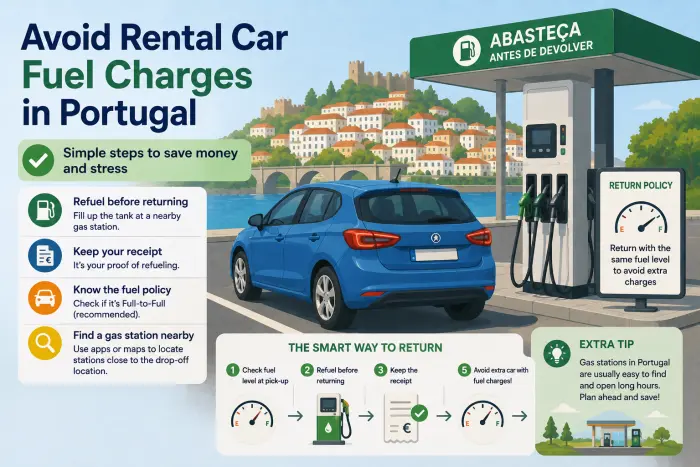
Most Portuguese rental agreements use a full-to-full fuel policy: you receive the car with a full tank and are expected to return it the same way. Miss that, and the company fills it themselves and charges you — usually at a price well above whatever you’d have paid at a pump yourself, plus a service fee on top that can run anywhere from €15 to €35 depending on the supplier, typically showing up as its own line item on the final invoice. It’s not a scam exactly; it’s built into the contract you signed at pickup. But it’s an expensive mistake to make out of poor timing rather than any real difficulty with the task itself.
The trap is proximity, not scarcity
Portugal isn’t short on fuel stations — it’s one of the more densely served countries in Western Europe for this. The problem is that the stations closest to airports and major rental return points know exactly who’s pulling in during the last few kilometers of a trip, and price accordingly. A station literally on the airport approach road can run 10–15 cents per liter higher than one just a few kilometers further out, simply because it’s catching people with no time left to shop around.
The fix is almost embarrassingly simple: fill up before you’re in that final stretch, not during it. If you’re driving into Lisbon or Faro from any distance, plan your fuel stop for somewhere along the motorway or in whatever town you pass through 20–30 minutes before the airport, rather than treating “somewhere near the airport” as good enough. Motorway service stations tend to be priced fairly consistently with everywhere else in Portugal — it’s specifically the last-mile stations immediately surrounding airports and city-center return points that carry the premium.
This isn’t unique to Portugal, to be fair — the same pattern shows up around airports across most of Europe. What makes it worth flagging here specifically is how often it catches travelers who’ve otherwise handled every other part of a Portugal rental smoothly: correct fuel type, no damage disputes, tolls sorted out along the way, and then a rushed, overpriced fill-up in the last twenty minutes undoes some of that careful planning for no good reason.
What “full” actually means on your contract
Worth reading closely at pickup, because “full tank” policies aren’t universal — a supplier might instead use a pre-purchased fuel option (you pay for a full tank upfront, return it any level, no refund for what’s left) or, less commonly, a same-level policy where you’re only responsible for returning roughly what you received. Full-to-full is the most common in Portugal and, done right, is also the cheapest option for you — you’re paying pump prices rather than the rental company’s marked-up rate embedded in a pre-purchase option.
If your paperwork does say full-to-full, the receipt from your last fill-up is worth keeping until you’ve cleared the return inspection — around the same window your deposit hold takes to release. It’s not usually needed, but on the occasions where a dispute comes up about whether the tank was genuinely topped off, a timestamped receipt from a station 20 minutes before drop-off settles it faster than an argument at the counter.
Diesel or petrol — get this one right
This deserves its own mention because it’s a different, more expensive mistake than simply forgetting to fill up: putting the wrong fuel type in the tank. Portugal’s rental fleet mixes diesel and petrol cars more than some markets do, and the fuel cap or dashboard sticker doesn’t always jump out at you if you’re not looking for it. Wrong fuel typically means the car can’t be driven at all until it’s professionally drained, and that cost — plus the inconvenience of arranging alternate transport to your flight — dwarfs anything you’d lose on a rushed, overpriced fill-up. Check the fuel type printed on your rental agreement or the small label near the fuel cap before you approach the pump, every single time, even on day three of a trip when it feels like second nature already.
A rough sense of the numbers
| Scenario | Approximate cost |
|---|---|
| Filling up yourself, 20+ min from airport | Standard pump price |
| Filling up yourself, airport-adjacent station | 10–15 cents/liter above standard |
| Rental company fills it for you | Marked-up fuel price + €15–35 service fee |
| Wrong fuel type put in tank | Draining/towing cost, often €150+, plus lost travel time |
For a typical 45–50 liter tank, that gap between filling up yourself a bit earlier and letting the rental company handle it usually lands somewhere between €25 and €50 — not catastrophic, but a genuinely avoidable addition to your overall fuel cost for a five-minute detour earlier in the drive. Multiply that by however many rental legs a longer Portugal trip involves, and it’s easy to see why frequent visitors tend to build the earlier fill-up into their routine without thinking twice about it.
💸 Don’t Overpay at the Airport
Compare real-time rental deals with no hidden fees or credit card needed.
A scenario worth avoiding
Picture the last hour of a two-week trip: bags packed, flight in three hours, and a rental return desk that closes tighter to departure than you’d like. The GPS says the airport is 25 minutes away, so the plan is simple — drive, drop the car, check in. Except the fuel gauge has been sitting closer to a quarter tank than anyone noticed during the last day of sightseeing, and the only stations visible from the motorway in that final stretch are the two sitting directly across from the rental return lot, both pricing well above anywhere passed twenty minutes earlier.
This is the exact situation the full-to-full policy is designed to catch, and it’s also the single most common way travelers end up paying more than they needed to — not because fuel in Portugal is expensive by European standards, but because the stations positioned to catch last-minute travelers know there’s no time left to look elsewhere. The fix isn’t complicated, but it does require treating the fuel stop as a planned part of the return route rather than an afterthought squeezed in wherever’s convenient once the tank light comes on.
Building it into the return drive
A useful habit: as soon as the return date is roughly a day out, glance at the fuel gauge and decide then whether a stop is needed, rather than leaving that decision for the drive itself. If a fill-up is likely, look for a station somewhere along the planned route that isn’t obviously catering to airport traffic — a supermarket-affiliated station in a town you’re passing through, or one of the larger motorway service areas, both tend to price close to the national average rather than charging a last-mile premium.
This matters more on longer return drives — coming back from the Algarve to Faro, or from the Douro region into Porto after a Lisbon-then-Porto trip — where there’s naturally more opportunity to fill up well before the final stretch. On shorter city-return trips, where the pickup and return points sit close together to begin with, the margin for error is smaller, which is exactly why it’s worth deciding on the fuel stop in advance rather than reacting to the gauge in the moment.
Frequently asked questions
How full does the tank need to be at return? Under a standard full-to-full policy, completely full — to the same level you received it. Even a partially full tank typically triggers the rental company’s fill-up fee, not a prorated charge.
Is it worth buying the pre-paid fuel option instead of filling up myself? Usually not, unless you’re certain you’ll return the car with a very low tank regardless. Pre-paid fuel is priced to cover the rental company’s margin, and you don’t get a refund for unused fuel — filling up yourself at a fair-priced station almost always costs less.
How far from the airport should I plan my last fuel stop? Roughly 20–30 minutes out, or whenever you pass a station that isn’t visibly catering to airport traffic. Motorway service stations along the route are usually a safe, fairly priced choice.
What happens if I put the wrong fuel in the tank? The car typically can’t be driven and needs professional draining before it runs safely again — a costly and time-consuming problem, and a much bigger issue than simply forgetting to top up.
Do all Portuguese rental companies use the same fuel policy? No. Full-to-full is the most common, but pre-paid and same-level policies both exist — check your specific agreement at pickup rather than assuming.
Should I keep the fuel receipt after filling up before returning the car? It’s a good habit. It’s rarely asked for, but it resolves any dispute about the tank level quickly if one comes up during the return inspection.
Are fuel stations near Lisbon and Faro airports really more expensive? Often yes, by a noticeable margin — stations in the immediate approach to major airports tend to price higher than ones a short distance further out, simply because travelers there have little time to shop around.