The route that works best for a Portugal road trip is north to south over ten days: Porto, the Douro Valley, Coimbra, Óbidos and Nazaré, Lisbon and Sintra, then Évora and the Algarve, with roughly 1,200 km of driving, a toll bill in the tens of euros, and the car kept out of Lisbon and Porto while you are in the cities. If you only have seven days, cut it at Lisbon and skip the south.
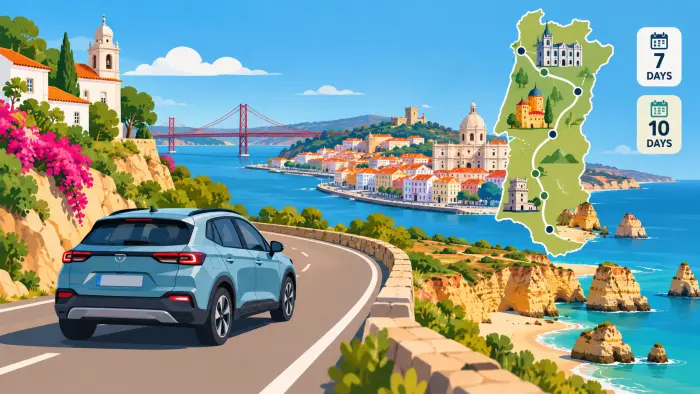
Portugal is small enough that a road trip feels easy on paper, and long enough that a bad route wastes two days on motorways. This guide gives the ten-day route with drive times, shows where to trim it to seven, and covers the things that make or break a Portugal drive: how a one-way rental changes the plan, how tolls actually work, and where a car is a burden and not a help.
The route in one line. Porto (2 nights), Douro Valley (1), Coimbra (1), Óbidos and Nazaré (1), Lisbon and Sintra (2), Évora (1), Algarve (2). Fly into one end, out of the other, and take a one-way rental.
Why north to south
Direction matters less than people think, and the real rule is to avoid backtracking. A route that starts in Porto and ends in the Algarve, or the reverse, uses every kilometre once, but it needs a one-way rental, and some suppliers charge for that, as we explain in our guide to one-way car rental in Portugal. The alternative is a loop that returns to the start, which avoids the fee and costs you one long motorway day at the end.
North to south has one more advantage: the trip builds from cities to coast. The north has the most walking, wine and cold stone, and the south finishes with beaches, which suits a trip that gets tiring around day eight. Reverse it if you would rather end in a city.
The ten-day route
Drive times below are rough and come from published itineraries and distance tables, so add time for stops, traffic and the occasional wrong turn.
| Day | Stay | Drive that day | Notes |
|---|---|---|---|
| 1–2 | Porto | None | Collect the car only when you leave |
| 3 | Douro Valley | About 130 km to Pinhão, with the valley starting about an hour out | Slow river roads, plan for stops |
| 4 | Coimbra | About 1h30 to 2h via Lamego, depending on where you start | University town, steep old centre |
| 5 | Óbidos and Nazaré | About 1h30 to Óbidos, then 35 to 45 minutes to Nazaré | Walled village, then the big-wave cliff |
| 6–7 | Lisbon and Sintra | About 65 minutes from Óbidos to Lisbon | Park the car, use trains in the city |
| 8 | Évora | Roughly 1.5 hours from Lisbon | Alentejo plains, Roman temple |
| 9 | Algarve (Lagos) | 2.5 to 3 hours from Évora via the A2 | Cliffs, coves, Benagil |
| 10 | Algarve and Faro | Short | Return the car at Faro |
Porto, days one and two. You do not need a car in Porto, and parking is the main reason. Spend two days on foot and collect the car as you leave, which saves money and a lot of stress. Our guide to driving and parking in Porto explains the street zones and the restricted areas in the centre.
The Douro, day three. The valley is the best drive of the trip, and the riverside road is slow on purpose. It is about 130 km from Porto to Pinhão at the heart of the valley, and wine tastings are the obvious hazard, so read our notes on renting a car for the Douro Valley before you plan a day around cellars.
Coimbra and the coast, days four and five. From the valley, a route through Lamego to Coimbra takes roughly an hour and a half to two hours, and the university town rewards an afternoon and an evening on foot; our guide to car rental in Coimbra covers the steep centre. Next day, head west to Óbidos, about an hour and a half from Coimbra, then on to Nazaré for the cliff viewpoint. Our overview of car rental on the Silver Coast has the parking details for both.
Lisbon and Sintra, days six and seven. Óbidos to Lisbon is about 65 minutes. In Lisbon the car is a burden, and the smart move is to park it at the hotel and use trains and taxis. Sintra is the exception: with a car you can reach the palaces and the coast, but parking near the main sites is restricted, so read our note on Sintra parking restrictions at Pena Palace before you go.
Évora and the Algarve, days eight to ten. Évora is roughly a 90-minute drive east of Lisbon and a good place to see the Alentejo’s slower side, with more in our guide to car rental in Évora. From there, Lagos is 2.5 to 3 hours by car via the A2, and the drive down is the longest of the trip. The details of the Lisbon to Algarve run, including tolls and timing, are in our guide to the drive from Lisbon to the Algarve. Spend the last two days on the coast, drop the car at Faro, and fly home.
The seven-day cut
If you have a week, finish in Lisbon and skip the south: Porto for two nights, the Douro for one, Coimbra for one, Óbidos and Nazaré for one, then Lisbon and Sintra for the last two. That is roughly 600 km of driving at a comfortable pace. It also needs a one-way rental from Porto to Lisbon, and our guide to one-way car hire between Lisbon and Porto explains how the fee is usually calculated. The same trip in reverse works just as well.
💸 Don’t Overpay at the Airport
Compare real-time rental deals with no hidden fees or credit card needed.
Tolls, in plain terms
Most of the motorways on this route are tolled, and many have no booths, only gantries that read your number plate. The A1 between Lisbon and Porto costs roughly €20 to €25 for a car, and the A2 from Lisbon toward the Algarve is in the same range. Over ten days, a total of a few tens of euros is a reasonable expectation, and the number depends heavily on how many motorway legs you take. Whether the Algarve motorway is currently free of tolls differs between sources, so check the current status before you drive it.
The easy way to pay is a transponder, which most rental cars carry. The rental company then bills the tolls to your card after the trip, and our explainer on how toll roads work in Portugal covers the rules, the fees and the traps. Without a payment method, an unpaid gantry can lead to a fine passed on by the rental company with an admin fee, so sort it out at the desk before you leave.
Where this plan bends
No itinerary survives contact with the weather and your own energy, so it helps to know which days can flex. The Douro day and the Algarve days are the most forgiving, because a slow river road or a lazy beach afternoon can absorb an extra hour. The days most likely to overrun are the ones with a long drive and a famous stop at the end of it, such as Évora to Lagos, where a late start means arriving at the coast after the light has gone.
If you need to cut, drop Coimbra before anything else: it is the stop that sits between two bigger days, and going straight from the Douro to Óbidos saves a night and a morning. If you want to add, the Serra da Estrela or the Alentejo coast are the two natural extra days, and neither needs a change to the rest of the route. Whichever way you go, leave one day with no fixed plan, because a delayed breakfast or a long lunch is usually where a Portugal trip stops feeling rushed.
The car for this trip
Pick the smallest car that carries your luggage. It makes the old towns, the hill lanes and the car parks easier, and it uses less fuel on a trip that adds up to 1,200 km. Add an automatic if you dislike steep hill starts in Coimbra, Sintra and the Douro. You do not need a 4×4 on this route.
Two practical habits make a long trip smoother. Photograph the car at pickup and at return, because a one-way rental involves two desks and two sets of paperwork. And use the car as a way between places, not as a way to see cities: Lisbon and Porto are better on foot.
Frequently asked questions
What is the best route for a Portugal road trip? Drive north to south: Porto, the Douro Valley, Coimbra, Óbidos and Nazaré, Lisbon and Sintra, Évora, then the Algarve. It uses every kilometre once and finishes on the coast.
How many days do you need for a Portugal road trip? Seven days covers Porto to Lisbon comfortably, and ten days adds Évora and the Algarve. Two weeks lets you slow down and add the Serra da Estrela or the Alentejo coast.
How far is it to drive from Lisbon to Porto? About 313 to 325 km, roughly three hours on the A1, with tolls of around €20 to €25 each way. With stops at Óbidos, Nazaré and Coimbra, plan for six to eight hours.
Do I need a one-way car rental? If you fly into one end and out of the other, yes. Some suppliers add a one-way fee, so compare the total before you book, or choose a loop that returns to the start.
Are there tolls on a Portugal road trip? Yes. Many motorways are tolled, often through electronic gantries, and most rental cars carry a transponder. Expect a few tens of euros over ten days.
Should I drive in Lisbon and Porto? Not in the old centres. Park at the hotel and use trains, taxis and your feet, and collect the car when you leave.
How long does it take to drive from Évora to Lagos? Roughly 2.5 to 3 hours via the A2, with a toll of around €15 to €20 each way according to published itineraries.
What size of car is best? A small or compact car, with an automatic if hill starts worry you. It makes narrow streets and car parks far easier.