Good navigation is the difference between a relaxed Portugal road trip and a stressful one. 🧭 The roads are well signposted and the country is easy to get around — but tight medieval city centres, rural dead zones with no signal, and the all-electronic toll roads each reward a driver who’s set up properly before pulling away. This guide covers the best way to navigate Portugal in a rental car: which apps work, how to handle areas with no signal, whether to bother renting a GPS, and the small habits that keep you on route and out of trouble.
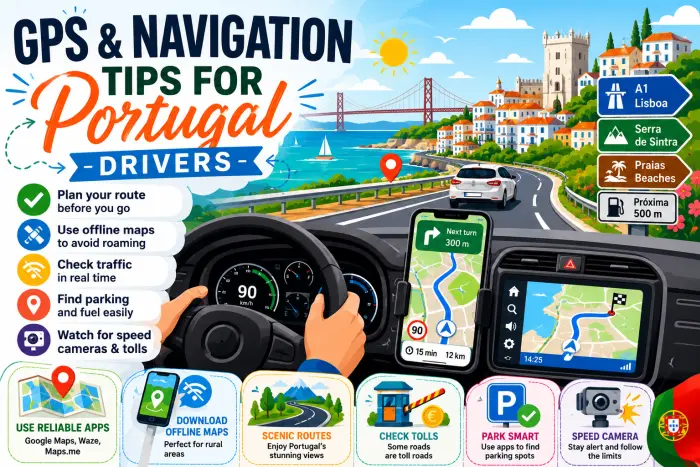
Your phone with a good navigation app is all most visitors need — but download offline maps before you travel so you’re covered in rural dead zones, and bring a phone mount since handheld use is illegal. A rental company’s GPS device is optional and usually not worth the daily fee. Set up your app, offline maps and mount before you drive off, and navigation becomes effortless.
This is part of our driving in Portugal guides, alongside the road rules and tolls.
Your phone is usually all you need
For the vast majority of visitors, a smartphone with a mapping app handles everything. The popular navigation apps cover Portugal well, with live traffic, lane guidance and speed-limit displays that help you stay legal — useful given the camera enforcement covered in speed limits in Portugal for tourists. The two things to sort: a way to mount the phone (handheld use is illegal and fined), and mobile data or offline maps so the app actually works where you’re going.
A windscreen or vent mount is cheap and transforms the experience — glancing at a fixed screen is safe and legal, fumbling with a phone in your hand is neither.
Download offline maps before you travel
This is the single most useful tip. Portugal’s cities have good mobile coverage, but rural areas — exactly where you’re most likely to get lost — can have patchy or no signal. If your navigation depends on a live connection, you can be left stranded at the worst moment.
The fix is simple: download offline maps of Portugal before your trip, while you’re on wifi at home or your accommodation. Most major apps let you save whole regions for offline use, so navigation keeps working with no signal at all. Do this once and the rural dead zones stop being a worry — a five-minute job that prevents the most common navigation headache.
Should you rent a GPS device?
Rental companies offer a dedicated satnav unit for a daily fee, and the honest answer for most people is: skip it. Your phone does the same job better and for free, with more up-to-date maps and live traffic. The daily charge adds up over a trip and rarely justifies itself.
There are a couple of exceptions where a rental GPS makes sense: if you don’t want to use your phone’s data or battery for navigation, if you’re not comfortable with phone-based maps, or if you’d otherwise have no working device at all. Otherwise, the money is better kept in your pocket — put it toward the kind of savings discussed in cheap car rental in Lisbon.
Navigating tight cities and old towns
Where navigation gets genuinely tricky is the historic centres. Lisbon’s older districts, and the cores of towns like Sintra and Óbidos, have narrow, steep, sometimes restricted streets that a satnav may route you into unwisely. The app doesn’t always know a lane is barely car-width or tram-only.
The smart approach: use navigation to reach the edge of the old town, then park and walk in, rather than trusting the app to thread you through alleys. This avoids the white-knuckle moments and the risk of entering a restricted zone. It pairs with the parking strategy in the Lisbon parking guide for tourists — park at the perimeter, explore on foot.
Navigation and the toll roads
Your navigation app can usually tell you when a route uses toll roads, and many let you see or avoid tolls. This matters in Portugal because of the all-electronic toll roads with no booths — knowing when you’re on one helps you understand your charges, explained fully in toll roads in Portugal explained. You don’t navigate the tolls differently, but being aware of them prevents confusion when the charge appears later. Set your app to show tolls if you want full visibility of your route’s costs.
💸 Don’t Overpay at the Airport
Compare real-time rental deals with no hidden fees or credit card needed.
Practical setup habits
A few habits keep navigation smooth all trip:
- Mount the phone before you drive — never navigate handheld.
- Download offline maps at home, covering all regions you’ll visit.
- Bring a charging cable — navigation drains the battery fast.
- Set your destination before moving, not at the wheel.
- Enable speed-limit display if your app offers it, to stay legal.
- Have a backup — a paper map or a second device for peace of mind.
None of these are essential individually, but together they mean you never have a navigation crisis at 100 km/h on an unfamiliar motorway.
Your navigation options compared
It helps to see the choices side by side before you decide what to rely on:
| Option | Cost | Best for | Watch out for |
|---|---|---|---|
| Phone + app (online) | Free | Most visitors, cities | Needs signal & data |
| Phone + offline maps | Free | Rural areas, dead zones | Download before you go |
| Rented GPS device | Daily fee | No phone / data concerns | Older maps, added cost |
| Paper map backup | Cheap | Emergencies, big-picture | Slow for turn-by-turn |
For nearly everyone the winning combination is the first two together: your phone running a good app, backed by offline maps so it never fails when the signal does. The rented device and the paper map are fallbacks, not the main plan. Decide this before you collect the car, so you’re not improvising navigation in an airport car park.
Navigation mistakes to avoid
A handful of slip-ups cause most navigation trouble in Portugal, and all are easy to dodge:
- Relying on live maps with no offline backup. The moment you lose signal in the hills, you lose your route — download offline maps first.
- Navigating handheld. It’s illegal, fined, and dangerous; a cheap mount solves it permanently.
- Trusting the app into old-town alleys. Satnavs route into lanes too narrow or restricted to drive — use your eyes and park at the edge.
- Letting the battery die. Navigation is power-hungry; without a charging cable you can be left blind mid-journey.
- Setting destinations while moving. Enter your route before you pull away, not at the wheel.
Avoid these five and navigation stops being something you worry about. The technology is excellent in Portugal; the only real risk is using it carelessly. A few minutes of setup turns your phone into a reliable co-pilot for the whole trip, from the motorway to the last cobbled mile.
Don’t switch off your own judgement
One last point: navigation apps are tools, not oracles. They occasionally suggest an odd route, send you down a road that’s closed, or misjudge a restricted lane. Keep half an eye on the signs and use common sense — if the app wants you to turn into what looks like a pedestrian alley, trust your eyes over the screen. Portugal is well signposted, so the road signs are a reliable backup. The best navigation is the app plus your attention, not the app instead of it.
FAQ
Do I need a GPS to drive in Portugal? Not a dedicated device — a smartphone with a navigation app does the job better and free. Just bring a phone mount and download offline maps before you travel.
Should I rent the GPS unit from the car company? Usually no. It carries a daily fee and your phone does more for free, with newer maps and live traffic. Only consider it if you can’t or won’t use your phone for navigation.
Will my navigation app work without signal in Portugal? Only if you download offline maps first. Cities have good coverage, but rural areas can have none — saving offline maps at home keeps navigation working anywhere.
What’s the best way to navigate Lisbon’s old streets? Navigate to the edge of the historic centre, then park and walk in. The narrow, steep, sometimes restricted lanes aren’t worth driving, and a satnav may route you into them unwisely.
Can my navigation app show toll roads? Most can show or avoid tolls. This is handy in Portugal because of the all-electronic toll roads, helping you understand charges that appear after your trip.
Is it legal to hold my phone for navigation while driving? No — handheld phone use while driving is illegal and fined in Portugal. Use a windscreen or vent mount so you can glance at a fixed screen legally and safely.