Portugal’s wildfire season runs roughly from June through September, peaking in August and September, and it’s not a minor seasonal footnote for anyone driving through the interior — official road closures happen, fines for entering restricted fire zones can reach up to €2,500, and insurance generally won’t cover accidents in areas you weren’t supposed to be driving through in the first place. If your route takes you inland, away from the coast, this is genuinely worth planning around rather than discovering on the road.
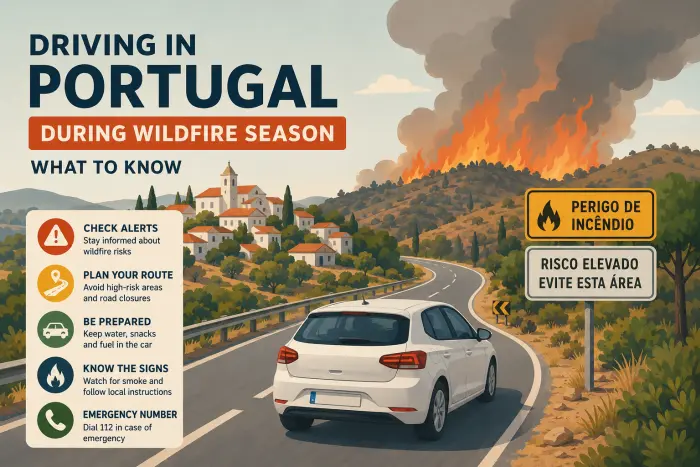
Safety Snapshot
- Wildfire season peaks roughly June through September, with the highest risk typically in August and September
- Real-time fire tracking is available through free public tools like fogos.pt and IPMA’s fire risk maps
- Road closures during active fires are enforced by GNR checkpoints, and driving past a barrier can mean serious fines and voided insurance coverage
- If you encounter smoke while driving, close windows, switch to air recirculation, and never drive forward if visibility drops too low to see clearly
- Avoid parking on dry grass or vegetation — a hot exhaust or catalytic converter can genuinely start a roadside fire
- Coastal routes and major cities are far less affected than inland regions like the Centro, Alentejo interior, and parts of the north
Where and When This Actually Matters
Most visitors driving Portugal’s coastal highlights, Lisbon, Porto, the Algarve coast, Sintra, Cascais, never encounter serious wildfire risk directly. This is much more relevant if your route heads inland: through the Centro region, the Alentejo’s drier interior, or northern areas like Viseu, Guarda, and the Douro’s more remote stretches. These are the regions that consistently show up on Portugal’s fire risk maps during peak season, and they’re also popular for scenic countryside drives, which is exactly why it’s worth knowing about before you plan a route through them in July or August.
How to Check Risk Before You Drive
This takes about two minutes and is genuinely worth doing before any inland day trip during summer. IPMA (Portugal’s meteorological institute) publishes a daily rural fire risk map, and fogos.pt offers real-time tracking of active fires across the country, updated frequently with official data from ANEPC and ICNF. Both are freely accessible and don’t require an account. If you’re heading somewhere specific inland, a quick check the morning of your drive tells you whether that area is flagged at elevated risk that day.
What Road Closures Actually Look Like
This isn’t a vague advisory system — closures are physically enforced. GNR (Portugal’s national guard) sets up checkpoints and barriers at affected junctions when a fire threatens a route, and attempting to drive around or past one isn’t a gray area; it’s a genuine traffic violation with real financial consequences. Reports from affected regions describe fines for non-compliance reaching into the thousands of euros, and critically, insurance providers are generally not obligated to cover accidents that happen in an area you were told not to enter. If a road you planned to take is closed, the right move is always to reroute via a major highway rather than look for a way around the barrier.
| Situation | What to Do |
|---|---|
| Route shows elevated fire risk on IPMA/fogos.pt | Consider an alternate route or delay the trip if possible |
| You reach a GNR checkpoint or barrier | Turn around and reroute via a major motorway — never attempt to pass |
| Smoke is visible but road is still open | Close windows, switch to air recirculation, reduce speed |
| Visibility drops significantly due to smoke | Stop safely rather than continue driving blind |
| You’re already on a road when a closure is announced | Follow official signage and GNR instructions immediately |
What to Do If You Actually Encounter Smoke on the Road
If you find yourself driving through an area with visible smoke, the guidance from Portuguese civil protection authorities is specific and worth remembering: close your windows and air vents, and switch your car’s ventilation to recirculation mode so outside smoke doesn’t fill the cabin. If visibility becomes genuinely poor, don’t keep driving forward hoping it clears, pull over safely once you can and wait, since driving blind through smoke is far more dangerous than a short delay. Avoid sudden braking, sharp turns, or U-turns, which become considerably riskier with reduced visibility and other drivers reacting to the same conditions.
The Parking Detail Almost Nobody Mentions
Here’s a genuinely practical tip that surprises a lot of visitors: don’t park your rental car on dry grass or dense roadside vegetation during summer, even briefly. A hot exhaust system or catalytic converter sitting against dry vegetation can realistically ignite a small fire, and this has been flagged repeatedly by Portuguese authorities as a real, preventable cause of roadside ignitions during the driest months. Stick to paved shoulders, designated parking areas, or gravel when you’re stopping anywhere near dry countryside in summer.
Staying Informed While You Drive
Having reliable data on hand matters more during wildfire season than on a typical sightseeing drive, since conditions and closures can change over the course of a single day. It’s worth setting up mobile data for GPS use in Portugal before an inland trip specifically so you can check fogos.pt or reroute quickly if needed. Google Maps also tends to reflect civil protection closure data within a reasonably short window once a closure is officially registered, which helps as a secondary check alongside official sources.
Tolls, Detours, and Why Via Verde Matters More Here
If a closure forces an unplanned reroute onto a different highway, you don’t want to be fumbling for cash at an unfamiliar unmanned toll booth. Confirming your rental car has a working Via Verde transponder before you set off removes one more variable from what’s already an inconvenient detour.
💸 Don’t Overpay at the Airport
Compare real-time rental deals with no hidden fees or credit card needed.
If Your Car Breaks Down in an Affected Area
Wildfire season adds one more reason to know your plan in advance for a roadside breakdown. It’s worth reading through our guide on what to do if your rental car breaks down in Portugal before an inland summer trip, since being stopped on the shoulder of a rural road during high fire risk is a situation where you’ll want to know your emergency contacts and next steps immediately rather than figuring them out under pressure.
Which Roads Deserve Extra Caution Anyway
Some of Portugal’s more rural routes already carry general caution advice independent of wildfire season, and it’s worth being doubly aware of these during summer specifically. Our guide to Portugal’s more dangerous roads and our broader look at road safety statistics and defensive driving both cover ground that becomes even more relevant when reduced visibility or unexpected rerouting enters the picture. If your inland trip runs late and stretches into the evening, it’s also worth reading up on night driving in Portugal, since reduced visibility from smoke and low light can compound each other on unfamiliar rural roads. Getting comfortable with Portugal’s general driving rules beforehand also makes it easier to react calmly if you do encounter an unexpected closure or diversion.
Practical Checklist for Summer Inland Driving
- ✅ Check IPMA’s fire risk map or fogos.pt before any inland day trip during June through September
- ✅ Never attempt to pass a GNR checkpoint or barrier at a road closure — always reroute
- ✅ Close windows and switch to air recirculation if you encounter smoke while driving
- ✅ Pull over and wait rather than continue driving if visibility drops significantly
- ✅ Never park on dry grass or vegetation, even for a short stop
- ✅ Confirm your rental car has a working Via Verde transponder in case of an unplanned reroute onto a different toll road
- ✅ Save the ANEPC emergency number (112) and consider installing a fire-tracking app before an inland trip
Frequently Asked Questions
Does wildfire season affect coastal areas like Lisbon, Porto, or the Algarve coast? Generally not directly — the highest risk is concentrated in inland regions like the Centro, the Alentejo interior, and parts of the north. Coastal and major city driving is largely unaffected.
How can I check wildfire risk before driving somewhere in Portugal? IPMA publishes a daily rural fire risk map, and fogos.pt offers real-time active fire tracking using official ANEPC and ICNF data, both free and accessible without an account.
What happens if I accidentally drive past a road closure during a wildfire? This carries real consequences, including significant fines, and insurance generally won’t cover accidents that occur in an area you were instructed not to enter. Always reroute rather than attempt to pass a checkpoint.
What should I do if I see smoke while driving? Close your windows, switch to air recirculation, and reduce speed. If visibility drops significantly, pull over safely and wait rather than continuing to drive.
Is it really dangerous to park on grass during summer in Portugal? Yes, genuinely. A hot exhaust or catalytic converter against dry grass or vegetation can start a fire, and this has been documented as a real cause of roadside ignitions during Portugal’s driest months.
What’s the actual peak of wildfire season in Portugal? Risk typically climbs through the summer and peaks around August and September, though conditions can vary year to year depending on rainfall and temperature.
Should I avoid renting a car for an inland trip during summer entirely? Not necessarily. Most inland trips proceed normally; the key is checking risk levels before you go and having a flexible plan if a specific route shows elevated risk or an active closure that day.
Are rental car companies in Portugal prepared for wildfire-related disruptions? Most major companies are generally aware of seasonal risk and can advise on route alternatives if you contact them, but the responsibility for checking real-time conditions before setting out rests with the driver.