A mechanical breakdown is one of the least likely but most stressful scenarios on a Portugal road trip, precisely because it’s rare enough that most travelers never think through the actual process until they’re standing on the shoulder of an unfamiliar road wondering who to call first. Knowing the sequence in advance turns a genuinely stressful moment into a manageable, if annoying, inconvenience rather than a full-blown crisis you’re navigating for the first time under pressure.
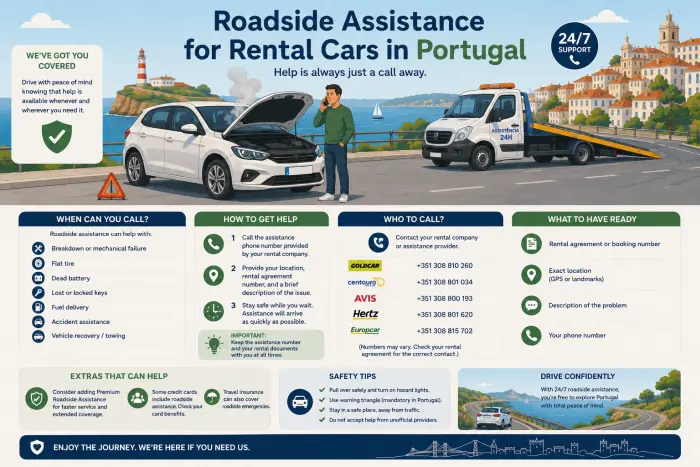
Quick answer: call the roadside assistance number on your rental agreement first, not a generic emergency number, since your rental company’s own assistance line is set up specifically to handle exactly this situation and typically arranges towing, a replacement vehicle, or a repair at no additional cost if the breakdown isn’t your fault.
The First Call: Your Rental Company, Not a Generic Tow Service
Every rental agreement includes a specific roadside assistance or emergency contact number, usually printed on the paperwork given at pickup and often also visible somewhere on the vehicle itself, a sticker inside the glovebox or on the sun visor being common locations worth checking as soon as you collect the car. This number connects you directly to a service set up specifically to handle your exact situation, coordinated with your specific rental company, rather than a generic towing service that might not know your rental terms or contract details. Calling this number first, rather than a general emergency line or a random local mechanic, is the correct first step for anything short of an actual medical emergency requiring urgent services.
What Roadside Assistance Typically Covers
| Breakdown Cause | Typical Response |
|---|---|
| Mechanical failure not caused by the renter | Towing, repair, or replacement vehicle at no additional cost |
| Flat tire | Often covered, sometimes with a callout fee depending on your specific coverage tier |
| Running out of fuel | Usually a chargeable service, since this is considered renter responsibility |
| Damage from driver error (collision, curb strike) | Handled under your damage/excess coverage terms rather than roadside assistance specifically |
Documenting the Breakdown Itself
As soon as it’s safe to do so, taking photos of the vehicle, any dashboard warning lights, and the general situation is worth doing the same way you would for a damage dispute, since this documentation can matter if there’s any later question about what happened or when. Our guide on avoiding a rental car damage dispute in Lisbon covers the broader documentation habit worth building into every stage of a rental, including an unplanned breakdown.
Safety First: Pulling Over Correctly
Before making any calls, getting the vehicle safely off the active roadway, onto the hard shoulder or a genuine pull-off area rather than simply stopping in a live lane, is the actual first priority, followed by activating hazard lights and, if you’re carrying one, a warning triangle placed behind the vehicle at a safe distance. This matters more on Portugal’s faster motorway sections specifically, where traffic speed makes a poorly positioned stopped vehicle a genuine hazard rather than just an inconvenience.
Does a Breakdown Affect Your Trip Itinerary?
Realistically, yes, and it’s worth building some flexibility into tightly-scheduled plans for exactly this reason, even though a breakdown itself is uncommon. A tow and vehicle swap can take a few hours depending on your specific location and how far the nearest service point or replacement vehicle is, which is worth factoring into how tightly you schedule connecting flights, ferry crossings, or other fixed-time commitments during your trip, since a breakdown at the wrong moment can genuinely disrupt a schedule with no slack built in.
What If You’re in a Remote Area?
Rural and remote breakdowns take longer to resolve simply due to distance from service points, worth being realistic about if your itinerary includes genuinely remote stretches, particularly in parts of the Alentejo or more isolated coastal areas. Having your accommodation’s contact information handy, in case a significant delay affects your arrival time there, and a reasonable amount of water and basic supplies in the car for a longer road trip through less populated regions, are sensible precautions worth taking regardless of how unlikely a breakdown actually is.
Does This Work Differently for an Electric Rental Car?
Somewhat, and it’s worth understanding the distinction if you’re driving an EV specifically. A genuine mechanical failure in an EV follows the same roadside assistance process as a petrol or diesel vehicle, but running out of charge, distinct from a mechanical breakdown, is generally treated similarly to running out of fuel: a renter-responsibility situation rather than a covered breakdown, though specific policies vary by supplier and are worth confirming if you’re renting electric. This is one more reason realistic range planning matters specifically for an EV road trip, since an empty battery in a remote area isn’t automatically covered the same way a genuine mechanical fault would be.
💸 Don’t Overpay at the Airport
Compare real-time rental deals with no hidden fees or credit card needed.
If a Collision Caused the Breakdown
If the vehicle is undriveable specifically because of a collision rather than a mechanical fault, the process shifts toward your insurance and excess coverage rather than standard roadside assistance alone, since this becomes a damage claim as much as a breakdown. Having clear documentation, ideally including dash cam footage if you have it, matters considerably more in this scenario than for a straightforward mechanical failure, since fault and circumstances become relevant to how the claim is processed rather than simply arranging a tow.
Who Pays for What
For a genuine mechanical failure unrelated to anything you did, standard rental terms place the cost of resolution, towing, repair, replacement vehicle, on the rental company rather than you, since you’re renting a vehicle warranted to be in working order. Costs shift toward you specifically when the issue stems from renter error or neglect, running out of fuel, using the wrong fuel type, or damage from a collision, which falls under your excess or insurance coverage rather than free roadside assistance. Confirming which category your specific situation falls into, calmly and directly with the roadside assistance operator, avoids assuming a charge applies when it might not, or vice versa.
Staying Connected If You Need to Call for Help
A breakdown is one of the moments where having reliable mobile data or a working phone connection matters most, since coordinating a tow, communicating your exact location, and staying in touch with roadside assistance all depend on it. If you’re relying on a local eSIM or a specific data plan for your trip, confirming it works reliably in the general area you’re driving through, particularly for a longer road trip into more remote regions, is worth doing before you need it in an actual emergency rather than discovering a coverage gap at the worst possible moment. Knowing your exact location, whether through GPS coordinates, a nearby motorway marker post, or a recognizable landmark, speeds up the roadside assistance response considerably compared with a vague description of where you are.
📋 Breakdown Checklist for Portugal Car Rental
- Locate your rental agreement’s roadside assistance number before you start driving, not after something goes wrong
- Prioritize safely pulling off the active roadway before making any calls
- Photograph the situation and any warning lights as soon as it’s safe to do so
- Build some flexibility into tightly-scheduled connections in case a breakdown causes a delay
- Keep basic supplies in the car for longer drives through more remote regions
❓ Frequently Asked Questions
Who should I call first if my rental car breaks down in Portugal? The roadside assistance number on your rental agreement, not a generic emergency line, since it connects you directly to a service coordinated with your specific rental company and contract terms.
Do I have to pay for roadside assistance if my rental car breaks down in Portugal? Generally not for a genuine mechanical failure unrelated to anything you did. Costs typically shift to you if the issue stems from renter error, like running out of fuel or using the wrong fuel type.
How long does it typically take to resolve a rental car breakdown in Portugal? It varies by location, a few hours is common, though remote areas take longer simply due to distance from service points, worth factoring into tightly-scheduled travel plans.
Should I document a breakdown the same way I would document damage? Yes. Photographing the vehicle, warning lights, and general situation as soon as it’s safe to do so is worth doing for the same reasons pickup and return documentation matters for a rental generally.
Does running out of charge in an electric rental count as a covered breakdown? Generally not. It’s typically treated similarly to running out of fuel, a renter-responsibility situation, rather than a covered mechanical breakdown, though specific policies vary by supplier.
What’s different if a collision caused my rental car to become undriveable? The process shifts toward your insurance and excess coverage rather than standard roadside assistance alone, since it becomes a damage claim where documentation, including dash cam footage if available, matters more.
To compare suppliers generally known for responsive support, our best car rental companies at Lisbon Airport roundup is a useful starting point.