Portugal’s national road safety authority, ANSR, publishes regular reports identifying specific “black spot” roads based on documented accident concentration, using consistent criteria applied year after year. Across many separate years of this reporting, two roads come up repeatedly, sometimes trading the top position between them but consistently appearing near the top: the EN125 running through the Algarve, and the IC19 connecting Lisbon and Sintra.
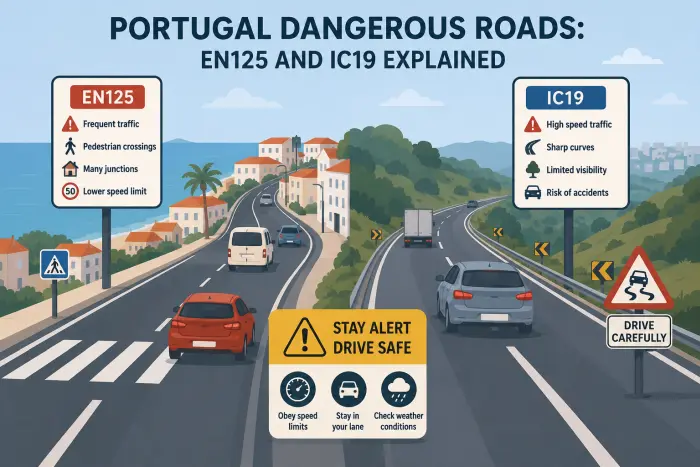
Quick picks: if your itinerary includes the EN125 (a common route for Algarve travelers) or the IC19 (a common route between Lisbon and Sintra), it’s worth applying extra deliberate caution on these specific roads, given their consistent, officially documented presence on Portugal’s black spot reporting over many years. This doesn’t mean avoiding them entirely, since both are commonly used, practical routes, but genuine extra attention is warranted specifically here.
The Two Roads Worth Knowing About
| Road | Route | Why It’s Flagged |
|---|---|---|
| EN125 | Runs through the Algarve, Vila do Bispo to Vila Real de Santo António | Repeatedly cited as one of Portugal’s most dangerous roads across multiple ANSR reports, particularly earlier years |
| IC19 | Connects Lisbon and Sintra | Repeatedly cited with multiple documented “black spots,” described in some reports as Portugal’s single most dangerous road in more recent years |
Both roads share a common thread worth remembering: heavy, sustained traffic volume combined with route characteristics that make sudden hazards harder to anticipate and react to in time, a pattern that has held consistently across many separate years of independent official reporting rather than reflecting a single anomalous year’s data.
Why These Specific Roads Keep Appearing
Official commentary from Portuguese road safety organizations points to a consistent underlying pattern: these roads combine very intense traffic volume with route characteristics that increase accident probability, rather than any single simple cause explaining the pattern on its own. The EN125 serves as a major artery through a heavily tourist-trafficked region, while the IC19 handles dense commuter traffic between Lisbon and Sintra, both patterns that concentrate high volumes of vehicles, including many tourists and rental drivers unfamiliar with the specific route, onto roads that weren’t necessarily designed for that level of sustained traffic in the first place.
What Official Sources Say About the Underlying Cause
Representatives from Portuguese road safety advocacy organizations have specifically pointed to a lack of comprehensive audits and inspections across the majority of Portuguese roads more broadly, suggesting the issue isn’t confined to just these two named routes but reflects a broader infrastructure and oversight challenge that happens to concentrate most visibly on these particular high-traffic corridors. This context is worth understanding, since it frames the issue as systemic rather than something unique to any single road’s specific design flaw.
What This Means If Your Trip Includes Either Road
This isn’t a reason to avoid the Algarve or Sintra, both genuinely worthwhile destinations that most visitors’ itineraries reasonably include regardless of these documented statistics. It’s a reason to apply the general defensive driving principles covered in our guide on Portugal road safety statistics and defensive driving with particular deliberateness specifically on these two named roads, rather than treating every road in your itinerary as carrying identical risk regardless of what the actual data suggests. Extra following distance, heightened attention, and avoiding any temptation to match locally assertive driving speeds matter more here than on an average, unremarkable stretch of road elsewhere in your trip.
Considering Alternative Routes Where Practical
For some specific trips, an alternative route exists that avoids the most heavily flagged sections, sometimes a slightly longer but less risk-concentrated path, worth researching specifically if your navigation app offers a route option that bypasses the most notorious stretch entirely. This isn’t always practical or meaningfully safer once genuinely accounted for, since alternative routes carry their own trade-offs and sometimes introduce different risks of their own, but it’s worth at least considering for a specific leg of your trip if a documented alternative genuinely exists and doesn’t add excessive time to your overall journey.
Staying Alert to Local Warning Signage
Portuguese authorities do post warning signage for particularly hazardous stretches, worth taking seriously rather than treating as generic boilerplate you’d see on any road anywhere throughout your trip. If you notice unusually frequent or emphatic warning signage on a specific stretch of the EN125 or IC19, this is worth interpreting as a genuine, locally-informed signal to slow down and increase your attention specifically at that point, rather than a formality that applies uniformly and can be safely ignored throughout your drive without any real consequence.
Combining This With Your Broader Trip Planning
Ultimately, this awareness is meant to inform how you drive, not whether you visit specific destinations at all, given how central both the Algarve and Sintra typically are to a well-rounded Portugal itinerary. Treating this documented information as one more useful input into your overall driving approach, alongside general defensive habits, appropriate rest, and reasonable trip pacing, gives you a genuinely well-informed foundation for navigating these specific roads confidently rather than either ignoring the data entirely or letting it create unnecessary anxiety about an otherwise manageable and worthwhile part of your trip.
💸 Don’t Overpay at the Airport
Compare real-time rental deals with no hidden fees or credit card needed.
Does Time of Day Matter More on These Specific Roads?
Yes, worth combining with our broader guide on night driving in Portugal, since reduced visibility compounds specifically with roads already documented as higher-risk. If your itinerary allows flexibility in timing a drive on either the EN125 or IC19 specifically, favoring daylight hours for these particular roads is a reasonable additional precaution beyond the general night-driving caution that already applies everywhere.
Documentation Matters More on Higher-Risk Roads Too
Given the documented accident concentration on these specific routes, having a dash cam is worth considering more seriously if your itinerary includes significant EN125 or IC19 driving specifically, since objective footage becomes considerably more valuable in exactly the kind of dense, unpredictable traffic these roads are documented to carry, compared with a quieter, less-flagged stretch elsewhere in your itinerary.
Does Vehicle Category Matter on These Specific Roads?
Worth a brief consideration, given the dense, fast-moving traffic these roads are documented to carry. A smaller, more maneuverable vehicle can feel more manageable in genuinely congested, unpredictable traffic than a larger SUV or van, though this is a minor factor compared with driving behavior itself, following distance, attentiveness, and avoiding matching aggressive local driving patterns matter considerably more than vehicle size alone in actually reducing your risk on these specific routes.
📋 High-Risk Road Awareness Checklist for Portugal
- Know that the EN125 (Algarve) and IC19 (Lisbon-Sintra) have repeatedly appeared on official ANSR black spot reports
- Apply extra deliberate caution specifically on these roads rather than uniform attention everywhere
- Consider an alternative route for a specific leg if one genuinely exists without excessive added time
- Favor daylight hours for these specific roads where your itinerary allows flexibility
- Combine this awareness with the general defensive driving principles worth applying throughout Portugal
❓ Frequently Asked Questions
Is the EN125 or IC19 currently Portugal’s single most dangerous road? The specific ranking has shifted across different years of official reporting, with each road holding the top position at different times, so both are worth treating as consistently high-risk rather than fixating on a single current ranking.
Should I avoid the Algarve or Sintra because of these road warnings? No, both remain genuinely worthwhile destinations most visitors reasonably include. The warning is about applying extra caution on these specific roads, not avoiding the destinations themselves.
Why do these specific roads keep appearing on official danger lists? Officials point to intense traffic volume combined with route characteristics that increase accident probability, a pattern that has persisted across many years of separate reporting.
Does driving these roads at night carry extra risk beyond the general danger? Yes, worth combining this awareness with general night driving caution, since reduced visibility compounds specifically with roads already documented as higher-risk.
Is a dash cam worth having specifically for these documented high-risk roads? Worth considering more seriously if your itinerary includes significant EN125 or IC19 driving, since objective footage becomes more valuable in the dense, unpredictable traffic these routes are known to carry.
Does the size of my rental car matter on these specific high-risk roads? Only as a minor factor. Driving behavior, following distance and attentiveness, matters considerably more than vehicle size alone in actually reducing your risk on these routes.
To compare general supplier options for your Algarve or Sintra trip, our best car rental companies at Lisbon Airport roundup is a useful starting point.