General impressions about how a country’s drivers behave can be unreliable, colored by a single bad experience or a handful of anecdotes rather than actual data collected systematically over time. Official statistics from European road safety monitoring bodies give a considerably clearer picture, and for Portugal specifically, that picture shows a fatality rate meaningfully above the broader EU average, worth understanding factually rather than dismissing as stereotype or overreacting to as alarmism.
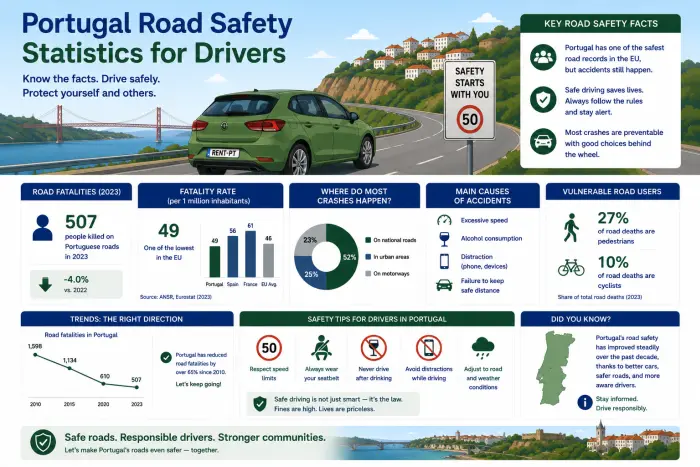
Quick answer: official EU data places Portugal’s road fatality rate above the bloc-wide average, and separate reporting has ranked Portugal among the highest for urban road mortality specifically within the EU. This doesn’t mean every road or every driver poses elevated risk, but it does support adopting genuinely defensive driving habits as a sensible baseline, particularly in urban areas and on unfamiliar roads.
The Statistics Worth Knowing
| Metric | What Official Data Shows |
|---|---|
| Road fatality rate (per million inhabitants) | Portugal cited in the range of roughly 60-67, versus an EU average commonly cited around 44-46 |
| Urban road mortality ranking within the EU | Portugal reported among the highest specifically for urban fatalities in recent reporting |
Why This Matters for a Rental Driver Specifically
A tourist driving unfamiliar roads, adjusting to local traffic patterns, and potentially dealing with jet lag or fatigue faces a genuinely different risk profile than a confident local driver navigating routes they know well from years of daily experience. Combining this general adjustment period with a country-wide fatality rate above the EU average is a reasonable basis for adopting more deliberately cautious habits than you might default to on home turf, rather than assuming your general driving competence automatically transfers without any adjustment period at all.
What This Data Doesn’t Tell You
Worth being fair and balanced about the limits of this statistical context: national-level fatality data doesn’t break down risk by specific road type, time of day, or driver demographic in a way that lets any individual traveler calculate their own precise personal risk. Treating this data as supporting a general baseline of increased caution, rather than as a precise predictor of what will happen on your specific trip, is the appropriately calibrated way to use this information without either dismissing it or overreacting to it beyond what the data actually supports.
What “Defensive Driving” Actually Means in Practice
This isn’t about driving unusually slowly or timidly, which can itself create friction with local traffic patterns; it’s about specific, practical habits: maintaining greater following distance than feels strictly necessary, being especially cautious at urban intersections and crosswalks given the urban mortality statistics specifically, and avoiding any temptation to match locally assertive driving styles you might observe, since matching an unfamiliar aggressive pattern in an unfamiliar environment compounds rather than reduces risk.
Urban Areas Specifically Deserve Extra Attention
Given the specific data point about Portugal’s urban road mortality ranking, it’s worth being particularly deliberate in city driving specifically, Lisbon, Porto, and other urban centers, rather than assuming rural or motorway driving carries the primary risk. Pedestrian awareness, careful attention at crosswalks and intersections, and reduced speed in dense urban areas are worth prioritizing specifically given this data point, distinct from the general caution worth applying everywhere.
Does This Connect to Night Driving Specifically?
Yes, worth combining with related guidance. Our guide on night driving in Portugal covers additional precautions worth taking after dark, particularly relevant given that reduced visibility compounds with the general caution these statistics already support, making evening and night driving worth an extra layer of deliberate care beyond what daytime driving already warrants.
Rural Roads Carry Their Own Distinct Risk Profile
Beyond the urban-specific data, it’s worth remembering that rural roads carry a different risk profile entirely, narrower roads, less lighting, and potentially less predictable local traffic patterns. Our guide on driving rules in Portugal covers the legal framework worth understanding alongside this statistical context, since knowing both the rules and the broader safety picture together gives a more complete foundation for confident, appropriately cautious driving throughout your trip.
Being Prepared for the Unexpected Matters More Given This Context
Given the general safety context covered throughout this guide, it’s worth being genuinely prepared for an unexpected roadside situation rather than assuming it won’t happen to you. Our guide on rental cars without a spare tire covers a specific practical preparation worth checking, since knowing your actual backup options in advance matters more when you’re already factoring in a somewhat elevated general risk environment compared with driving in a lower-statistic country.
💸 Don’t Overpay at the Airport
Compare real-time rental deals with no hidden fees or credit card needed.
Specific High-Risk Roads Worth Extra Attention
Beyond general statistical caution, certain specific routes have been documented as carrying disproportionately higher accident concentration than the average Portuguese road, worth knowing about if your itinerary includes them. Being aware that a specific stretch has a documented history of elevated incidents, rather than treating every road as statistically equivalent, helps you apply extra caution precisely where it matters most rather than spreading vigilance evenly across roads that don’t actually carry the same elevated risk.
Staying Calm If You Witness Assertive Local Driving
If you observe driving behavior that feels genuinely aggressive or unfamiliar, tailgating, sudden lane changes, or impatient horn use, the appropriate response is staying calm and maintaining your own defensive habits rather than reacting emotionally or attempting to match that energy. Reacting defensively to someone else’s assertive driving, rather than becoming assertive yourself in response, keeps you in a considerably safer position given everything the general statistics covered throughout this guide already support as a sensible baseline approach.
Building These Habits Into Your Very First Drive
Given everything covered above, it’s worth deliberately establishing your defensive driving approach from the very first minutes behind the wheel, rather than easing into local driving patterns gradually and adjusting your caution level only after something concerning happens. Combining this statistical awareness with the general pre-drive functional check worth doing before you even leave the rental lot sets a genuinely cautious tone for your entire trip from the outset, rather than treating safety as an afterthought you’ll address only once you’re already comfortable with the vehicle and roads.
📋 Defensive Driving Checklist for Portugal
- Maintain greater following distance than feels strictly necessary, particularly in unfamiliar traffic
- Pay extra attention at urban intersections and crosswalks, given Portugal’s specific urban mortality data
- Avoid matching locally assertive driving styles you might observe as a visitor
- Combine general caution with the specific night-driving precautions covered in our related guide
- Treat rural roads and urban areas as carrying distinct risk profiles worth different specific attention
❓ Frequently Asked Questions
Is Portugal’s road fatality rate actually above the EU average? Yes, according to official European road safety monitoring data, Portugal’s rate has been cited meaningfully above the broader EU-wide average in recent reporting.
Does this mean driving in Portugal is generally dangerous? Not necessarily in an absolute sense, but the data supports adopting genuinely defensive driving habits as a sensible baseline, particularly for an unfamiliar visitor still adjusting to local conditions.
Should I be more cautious in cities or on rural roads specifically? Both deserve attention, though recent data specifically highlights elevated urban road mortality in Portugal, worth prioritizing particular care at city intersections and crosswalks.
Does jet lag or fatigue make this statistical risk more relevant to tourists? Yes, worth factoring in, since a combination of unfamiliar roads, adjustment to local patterns, and travel fatigue compounds with the general statistical context covered here.
Should I be more prepared for roadside issues given this safety context? Worth doing, since knowing your actual backup options, like your specific vehicle’s tire equipment, matters more when factoring in a somewhat elevated general risk environment.
Are certain specific roads worth extra caution beyond general statistics? Yes, some specific routes carry documented higher accident concentration than average, worth being aware of if your itinerary includes them, so you can apply extra caution precisely where it matters.
To compare general supplier options for your trip, our best car rental companies at Lisbon Airport roundup is a useful starting point.