Every modern road trip navigation strategy, whether Google Maps, Waze, or Apple Maps, depends entirely on a working mobile data connection, and it’s easy to overlook this dependency until you’re driving through an unfamiliar area with a spinning loading icon instead of directions. Sorting out reliable data before you land, rather than figuring it out reactively once you’re already driving, removes one of the more avoidable sources of road trip stress.
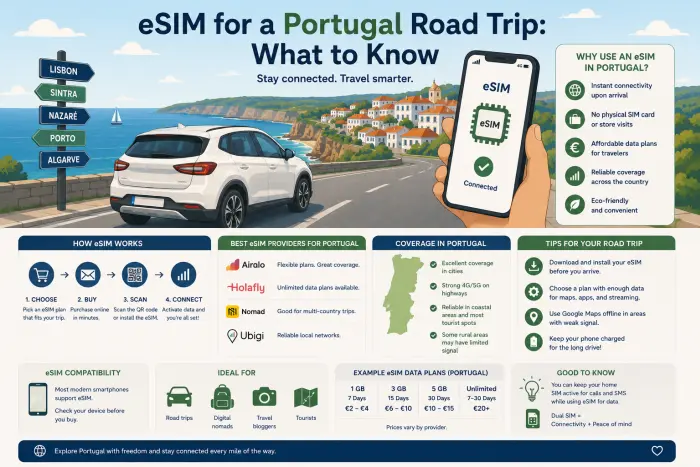
The essentials: an eSIM purchased before your trip is generally the simplest option for most travelers, activating instantly without needing to find and visit a physical shop, while a local physical SIM card can be cheaper for a longer stay if your phone doesn’t support eSIM. International roaming through your home carrier is the least effort but often the most expensive option, worth comparing directly against the alternatives rather than defaulting to it purely for convenience.
Comparing Your Three Main Options
| Option | Trade-Offs |
|---|---|
| eSIM purchased in advance | Instant activation, no physical shop visit needed, requires an eSIM-compatible phone |
| Local physical SIM card | Often cheapest for a longer stay, requires finding a shop and physically swapping SIMs |
| International roaming via home carrier | Zero setup effort, but frequently the most expensive option for meaningful data use |
Why an eSIM Is Often the Simplest Choice
For most modern smartphones, an eSIM purchased and set up before you even leave home activates the moment you land, or even before, without needing to locate a phone shop, communicate in an unfamiliar language, or physically handle a SIM card tray. This is particularly valuable for a road trip specifically, since you want working navigation from the moment you leave the airport rather than after tracking down a SIM vendor first. Confirming your specific phone model supports eSIM before relying on this option is worth checking in advance, since older or budget phone models sometimes lack this capability.
When a Physical Local SIM Makes More Sense
For a longer stay, or if your phone doesn’t support eSIM, a physical Portuguese SIM card purchased at the airport or a local shop often works out cheaper per gigabyte than an eSIM aimed at shorter-term travelers. This requires slightly more effort, locating a vendor and physically completing the swap, but the cost difference can be worth it specifically for a multi-week trip where data needs add up considerably more than a standard week-long visit.
Is International Roaming Ever the Right Call?
Occasionally, mainly for travelers who genuinely won’t use much data and value zero setup effort over cost savings. If your navigation needs are minimal, a short city-based stay with light driving, or you’re primarily relying on downloaded offline maps rather than live data, roaming’s typically higher cost may not matter much in absolute terms. For any road trip involving sustained live navigation across multiple destinations, though, the cost gap between roaming and either SIM alternative usually becomes significant enough to be worth the modest extra setup effort.
Offline Maps: A Genuine Backup Worth Having Regardless
Regardless of which data option you choose, downloading offline map regions for your planned route before you start driving is worth doing as a backup, since it provides basic navigation even during a temporary coverage gap in a rural area. This isn’t a full substitute for live data, since real-time traffic and rerouting depend on an active connection, but having offline maps downloaded removes the worst-case scenario of having zero navigation at all if your data connection drops unexpectedly during a drive.
Coverage Gaps in Rural Portugal
Similar to the charging network challenges covered in our guide on EV charging on a Portugal road trip, mobile data coverage isn’t perfectly uniform across the country, with more remote rural stretches occasionally showing weaker signal than motorways and major towns. This is worth factoring into route planning for a genuinely remote itinerary, where having offline maps downloaded in advance matters more than it would for a trip staying closer to Lisbon, Porto, or the Algarve’s main tourist corridors.
Why Reliable Data Matters Beyond Navigation Alone
Mobile data isn’t only about getting driving directions; it’s also what makes parking apps, translation tools, and communication with your rental supplier or accommodation actually work while you’re on the move. If you’re relying on Lisbon parking apps specifically, a working data connection at the moment you park is essential for the app to function at all, making reliable connectivity a genuine practical necessity rather than a nice-to-have convenience layered on top of navigation.
Staying Connected in an Emergency or Breakdown
Beyond the everyday convenience of working navigation and apps, reliable mobile data matters considerably more in an actual emergency or vehicle breakdown, when coordinating with roadside assistance and communicating your exact location depends entirely on a functioning connection. This is one more reason setting up connectivity properly before your trip, rather than treating it as an afterthought, pays off specifically in the moments when it matters most, not just for everyday convenience during ordinary driving.
💸 Don’t Overpay at the Airport
Compare real-time rental deals with no hidden fees or credit card needed.
Battery Drain: The Overlooked Practical Detail
Continuous GPS navigation combined with active mobile data use drains a phone’s battery noticeably faster than normal use, which is worth planning around specifically for a longer driving day rather than discovering a dead phone at exactly the moment you need directions most. A car charger, ideally a genuine fast-charging one rather than a basic low-output cable, is worth having as standard equipment for any road trip relying on phone-based navigation, alongside a mount that keeps the phone visible and charging simultaneously rather than choosing between the two. For a full day of driving with the screen active and data running continuously, even a phone that started the day fully charged can run low well before evening without this simple precaution in place.
Does This Change If Your Trip Crosses Into Spain?
If your Portugal itinerary extends across the border into Spain, whether for a day trip or a longer stretch, most eSIM and local SIM plans marketed specifically for Portugal don’t automatically extend coverage there, worth checking before assuming your existing plan continues seamlessly. Some providers offer broader multi-country European plans specifically designed for exactly this kind of cross-border itinerary, worth considering from the outset if your route planning already includes a Spain crossing, rather than discovering a coverage gap once you’re already across the border.
Setting Up Before You Fly, Not After You Land
The practical lesson across all of this is the same: setup, whether purchasing and activating an eSIM, researching where to buy a local SIM, or confirming your roaming plan’s actual cost, is worth doing before you fly rather than treating it as a task for arrival day. Landing with working data already active means functional navigation from the moment you walk out of the terminal to your rental car, rather than losing the first hour of your trip figuring out connectivity while also managing jet lag and an unfamiliar airport.
📋 Mobile Data Checklist for a Portugal Road Trip
- Confirm your phone supports eSIM before relying on that option specifically
- Compare eSIM, local SIM, and roaming costs directly for your specific trip length rather than defaulting to whichever is most familiar
- Download offline map regions for your planned route as a backup regardless of your primary data option
- Set up and activate your chosen option before you fly, not after landing
- Expect weaker coverage in remote rural stretches and plan accordingly for longer road trips
❓ Frequently Asked Questions
Is an eSIM better than a physical SIM card for a Portugal road trip? For most shorter trips, yes, mainly for convenience, since it activates without needing to find a shop. A physical SIM can be cheaper for a longer stay if your phone doesn’t support eSIM.
Should I just use my home carrier’s roaming instead of getting a local SIM or eSIM? Only if your data use will be minimal. For sustained live navigation across a road trip, roaming is usually noticeably more expensive than either SIM alternative.
Do I still need offline maps if I have a working eSIM or local SIM? Yes, worth having as a backup regardless, since rural coverage gaps can temporarily interrupt live data even with an otherwise reliable connection.
Is mobile data coverage reliable across all of Portugal for driving? Generally good along motorways and major towns, but more remote rural stretches occasionally show weaker signal, worth factoring into route planning for a genuinely remote itinerary.
Do I need mobile data for anything besides navigation on a Portugal road trip? Yes. Parking apps, translation tools, and coordinating with your rental supplier or accommodation all depend on a working connection, not just turn-by-turn directions.
How important is mobile data if my rental car breaks down? Very important. Coordinating with roadside assistance and communicating your exact location depends entirely on a functioning connection, making reliable setup worthwhile beyond everyday convenience.
For general navigation strategy once your connectivity is sorted, our GPS navigation tips for Portugal drivers guide covers app usage and route planning in more depth.