The simplest Algarve road trip runs east to west over five days: pick up the car at Faro, spend the first two days around Tavira and Albufeira, take the third for Benagil and the cliffs, give Lagos a day on foot, then finish at Sagres and Cabo de São Vicente before the 1.5-hour drive back to Faro. From Faro to Sagres is only about 116 km, the A22 motorway across it is toll-free, and the only part that needs real planning is parking at the famous beaches in summer.
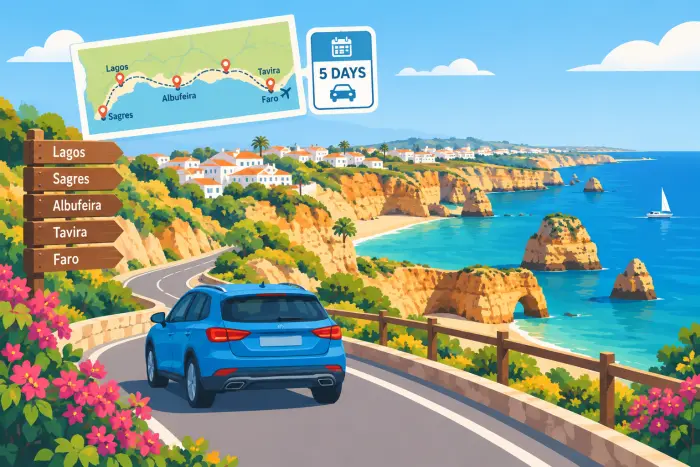
That is good news, because the Algarve is the part of Portugal where a car does the most for the least effort. The distances are short, the signs are clear, and the temptation is to cram too much in. This guide gives the route in the order that keeps driving short, explains how to deal with the beach car parks, and flags the small mistakes that make a short coast feel long.
The route at a glance. Day 1: Faro, Olhão and Tavira. Day 2: Falésia and Albufeira. Day 3: Benagil, Marinha and Carvoeiro. Day 4: Lagos on foot. Day 5: Sagres, the cape and back to Faro.
Why east to west
Most guides walk you from the lively centre toward the wilder west, and there is a reason for that: the coast gets more dramatic as you go. The east is lagoon country, with flat islands, salt pans and quiet towns near the Spanish border. The centre has the big resorts and cliff-backed beaches. The west ends at a lighthouse on the south-western corner of mainland Europe. Driving that way means the trip builds, and the last day is the best one.
It also fits the flight. You land at Faro in the east and fly home from the same airport, so a route that ends in Sagres leaves a final drive of about an hour and forty minutes, which is better than starting it in the dark. If you would rather have a relaxed finish, swap the order and drive west first, then spend the last two days in the east.
The five days, in order
The distances and times are rough, based on published itineraries, and every day has time built in for stops.
| Day | Where | Drive | Notes |
|---|---|---|---|
| 1 | Faro, Olhão, Tavira | About 40 minutes from Faro to Tavira | Pyramid roofs, a Roman bridge, lagoon boats |
| 2 | Falésia and Albufeira | About 45 minutes from Faro to Albufeira | Long cliff beach, busy old town |
| 3 | Benagil, Marinha and Carvoeiro | About 20 minutes west of Albufeira | Arrive before 9:00 in summer |
| 4 | Lagos | About 1 hour from Albufeira | Leave the car parked, walk |
| 5 | Sagres and Cabo de São Vicente | About 30 minutes from Lagos, 10 more to the cape | 1h40 back to Faro |
Day one, the east. Take the road east from the airport to Olhão and, if you like, a boat across the Ria Formosa lagoon, then on to Tavira, about 40 minutes from Faro. The old town is the most elegant in the Algarve, with its pyramid roofs, a Roman bridge over the river and plenty of churches, and it is a good place to sleep your first night. For the practical side of the area, our guide to car rental in Tavira covers parking and the surrounding beaches.
Day two, the centre. Head back west along the coast to Falésia, the long cliff-backed beach near Vilamoura, then to Albufeira, which is about 45 minutes from Faro. Albufeira is lively and crowded, and parking is the issue, so take a look at our guide to car rental in Albufeira for where to leave the car.
Day three, the cliffs. This is the day that rewards an early start. Benagil and Praia da Marinha are among the most photographed spots in Portugal, and published guides agree on the advice: the car park at Benagil fills by about 9:00 in summer, and both beaches are crowded by mid-morning even out of peak season. Go first, then use the rest of the day for Carvoeiro and the coast road. Boat trips to the sea cave leave from the beach and are best booked ahead in summer. Our note on driving and parking at the Benagil caves goes into detail. If you want a change from the beaches, a half-day inland to the old Moorish capital is easy, and our guide to car rental in Silves explains what to expect.
Day four, Lagos. Lagos is the one place where the best plan is to park and forget the car. The old town is a short walk from the waterfront, Ponta da Piedade is the clifftop highlight, and parking is cheap but scarce in summer, so a large riverside car park is more realistic than a space by the door. Our guide to car rental in Lagos has the options.
Day five, the far west. Sagres is about 30 minutes from Lagos, and Cabo de São Vicente is a further 10, a cape with 60-metre cliffs and a lighthouse where you can drive almost to the edge. Plan to catch the surf beaches on the way if the weather allows, and read our guide to car rental in Sagres for the area. Then turn east: Faro is roughly 116 km away, about an hour and forty minutes by road.
💸 Don’t Overpay at the Airport
Compare rental offers for your dates. Many include free cancellation, and some don’t require a credit card.
The motorway question
The A22 runs along the Algarve coast from near Lagos to the Spanish border, and the tolls on it have been abolished, so you can drive the length of the region without paying. Many older guides and some rental desks still talk about the A22 as a tolled road, and they are out of date. If a desk offers a daily toll service for an Algarve-only trip, you can usually decline it. The A2 between Lisbon and the Algarve is different and still charges, as we explain in our guide to how toll roads work in Portugal.
The practical choice is between the fast road and the coast road. The A22 takes about 50 minutes from Faro to Lagos, while the old EN125 takes roughly an hour and a half and passes through every market town. For this itinerary, use the motorway to cover distance and the EN125 when you want to stop.
Parking and the summer problem
The Algarve’s real traffic problem is not the road but the beach car park. A few habits help.
- Go early. Benagil’s car park fills by 9:00 in summer, and many beaches are full by mid-morning.
- Park once. In Lagos and Tavira, leave the car for the day and walk. Both centres are compact.
- Allow time for narrow streets. Some coastal roads near Carvoeiro and Benagil are narrow and steep in summer, so drive slowly and arrive early.
- Expect free parking at the cape. Cabo de São Vicente and Sagres are free, which makes the last day easy.
Choosing the car
A small car is the right size for old towns and cliff roads. If you have always wanted an open-top drive along the coast, the Algarve is the place for it, and our guide to convertible hire in the Algarve covers the trade-offs. For the pickup and return, see our guide to renting a car at Algarve Airport.
If you are arriving from Lisbon instead, the long drive south is worth planning, and our guide to the drive from Lisbon to the Algarve explains the time and the route.
Frequently asked questions
How many days do you need for an Algarve road trip? Five days is about right for the main stops, three days is the bare minimum, and seven lets you add Silves and a slower pace.
Are there tolls on the A22 in the Algarve? No. The A22 across the Algarve is toll-free, and older guides that mention tolls are out of date. Tolls still apply on the A2 between Lisbon and the Algarve.
How long does it take to drive across the Algarve? From Faro to Sagres is about 116 km, roughly an hour and a half by road. From Faro to Lagos it is about 50 minutes on the A22 and around an hour and a half on the EN125.
What time should I arrive at Benagil? Before 9:00 in summer. The car park fills early, and the beaches are busy by mid-morning even outside peak season.
Is it easy to park in Lagos? Parking is cheap but scarce in summer, and a large riverside car park is usually the realistic option. Leave the car there and walk.
Is parking free at Sagres and Cabo de São Vicente? Published guides report free parking in Sagres, including at the cape.
What is the best direction to drive the Algarve? East to west suits most trips: you start near the airport in the calm east and finish with the dramatic cliffs at Sagres.
Do I need a big car? No. A small or compact car is easier in old towns and narrow coastal roads, and a convertible is a fun choice for the coast.