Évora, Portugal’s UNESCO-listed Alentejo capital, sits about 130-140 km from Lisbon, roughly 1.5 to 1.75 hours by car via the A6, and while its medieval walled center is genuinely best explored on foot once you arrive, a rental car is exactly how most visitors get there and how they reach everything else the wider Alentejo has to offer once the city itself is done. Unlike Lisbon, Évora has no low emission zone to worry about, which simplifies things considerably for anyone who’s already read up on those restrictions elsewhere and is bracing for a similarly complicated driving experience.
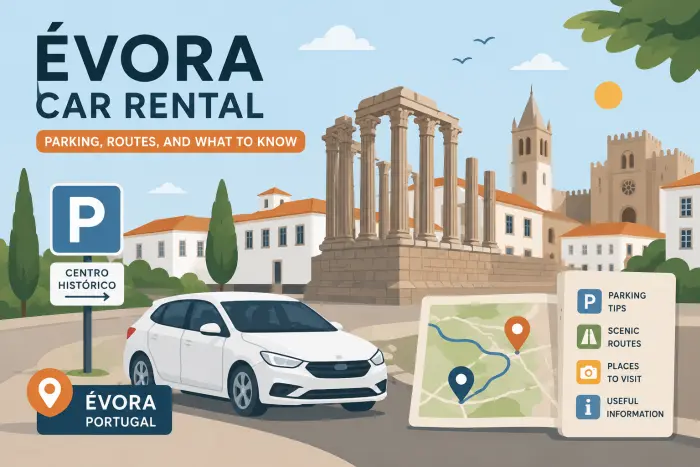
- Évora is roughly 130-140 km from Lisbon, about 1.5-1.75 hours via the A6 motorway
- The historic center’s narrow medieval streets are largely pedestrian and impractical to drive, so park outside the walls and walk in
- The largest free lot is Rossio de São Brás near the southern entrance; Porta da Lagoa on the north side sits close to the Roman Temple and Cathedral
- Paid, time-limited parking exists inside the walls, generally enforced Monday-Friday 8:30-19:30 and Saturday 9:00-14:00
- Spots marked with an “R” are strictly for local residents — tourists parking there risk fines or towing
- There’s no low emission zone in Évora, unlike Lisbon’s ZER, so vehicle emission class isn’t a concern here
Why a Car Matters Here, Even Though You’ll Walk Once You Arrive
This is the paradox of an Évora trip: the historic center itself is compact enough to see entirely on foot, but the drive there, and everything beyond the city walls, is where a rental car genuinely earns its cost. Évora sits at the heart of Alentejo, a region defined by cork forests, wineries, and scattered historic villages that aren’t realistically reachable without your own transport. Public transport connects Évora to Lisbon reasonably well, but it doesn’t get you to the Almendres Cromlech megalithic stone circle, the walled village of Monsaraz, or the countryside wineries that make Alentejo worth lingering in beyond a single afternoon, especially once you factor in how infrequent regional bus schedules tend to be outside the main routes.
For how Évora fits among the Alentejo’s other towns, see the regional guide covering Monsaraz, Marvão, Elvas, and the Costa Vicentina.
Where to Actually Park
This is the one genuinely tricky part of an Évora visit by car, and getting it right on arrival saves a lot of circling narrow one-way streets. The city’s medieval walls enclose an old town built centuries before cars existed, and driving inside them is neither practical nor, in many streets, actually possible.
| Parking Option | Location | Cost |
|---|---|---|
| Rossio de São Brás | Near the southern entrance to the old town | Free, largest lot in the city |
| Porta da Lagoa | Northern side, near the university | Free, close to the Roman Temple and Cathedral |
| Aqueduct-area lot | Northeast, beneath the old aqueduct | Generally free or low-cost |
| Inside the walls | Scattered street parking within the historic center | Paid and time-limited, enforced on a set schedule |
For most visitors, parking at one of the free lots just outside the walls and walking in is genuinely the simplest approach, and it also means you’re not worrying about a paid parking clock while you’re trying to enjoy the Cathedral or the Chapel of Bones.
The “R” Spots You Need to Avoid
Worth flagging specifically: parking spaces marked with a capital “R” (for “Residentes”) inside the old town are strictly reserved for local residents who live within the walls, and they’re actively enforced. Tourists who park in these spots risk a fine or having their vehicle towed, and the markings, painted on the ground or shown on nearby signage, are easy to miss if you’re focused on finding any open space rather than reading the fine print at the end of a long day of sightseeing.
No Low Emission Zone, Unlike Lisbon
If you’ve already read up on Lisbon’s low emission zone and its camera-enforced restrictions, here’s some good news: Évora currently has no equivalent ZER or ZFE, meaning any standard rental car can drive freely throughout the city without worrying about emission class restrictions. It’s a genuinely simpler driving experience than central Lisbon in that specific respect, even though the parking situation still requires some care.
What’s Actually Worth Seeing With Your Car
Évora’s headline sights, the Roman Temple of Diana, the Sé Cathedral, and the genuinely striking Chapel of Bones (Capela dos Ossos), are all within the walkable historic center once you’ve parked. Where the car comes back into play is everything beyond that: the Almendres Cromlech, one of the largest megalithic stone circle complexes in Europe, sits a short drive from the city and simply isn’t reachable without your own transport. The same goes for smaller Alentejo villages like Monsaraz and Montemor-o-Novo, both realistic add-ons to an Évora day if you’re driving rather than relying on infrequent regional buses that often run only once or twice daily outside peak season.
Getting There: The Drive From Lisbon
The A6 motorway route from Lisbon runs almost entirely on motorway, making it a relatively easy drive for a first day in Portugal or a straightforward add-on to a longer road trip. If you’re combining Évora with other stops, it’s worth thinking about it alongside our broader list of day trips from Lisbon by rental car, since Évora fits naturally into a wider central Portugal or Alentejo-focused itinerary rather than standing entirely alone.
Toll Roads and Fuel on the Way
The A6 includes tolled sections, so it’s worth understanding how Via Verde tolls work if you haven’t already, since most rental cars come with a transponder fitted and the charge bills automatically after your return, typically with some delay. For budgeting purposes, it’s also worth a quick look at realistic rental car fuel costs in Portugal, especially if you’re planning to range further into the Alentejo countryside beyond just the city itself.
💸 Don’t Overpay at the Airport
Compare real-time rental deals with no hidden fees or credit card needed.
One-Way Rentals Worth Considering
If your trip continues onward rather than looping back to Lisbon, whether toward the Algarve or further into the Alentejo interior, it’s worth checking whether one-way car rental makes more sense for your route than a standard round-trip booking, since several major rental brands offer one-way drop-off flexibility specifically for Évora.
Staying on Route With Reliable Navigation
Alentejo’s countryside roads between smaller villages sometimes have patchier cell coverage than the main motorway corridor, which matters if you’re navigating toward less-traveled sites like the Almendres Cromlech. It’s worth setting up mobile data for GPS use in Portugal before you head out into the wider region beyond Évora itself.
Getting the Basics Right Before You Go
If it’s your first time driving in Portugal, a quick read of general driving rules and roundabout etiquette is worth doing before you’re navigating Évora’s approach roads and the roundabouts that connect the A6 to the city itself.
Practical Checklist for Driving to Évora
- ✅ Park outside the medieval walls at Rossio de São Brás, Porta da Lagoa, or the aqueduct-area lot rather than trying to drive into the historic center
- ✅ Never park in a space marked “R” — these are strictly for local residents and are actively enforced
- ✅ Check paid parking hours if using street parking inside the walls, since enforcement follows a set weekday and Saturday schedule
- ✅ Plan at least a half-day beyond the city itself if you want to see the Almendres Cromlech or nearby villages
- ✅ Confirm your rental car has a working Via Verde transponder for the tolled A6 stretch
- ✅ Consider a one-way rental if your trip continues on from Évora rather than returning to Lisbon
Frequently Asked Questions
How far is Évora from Lisbon by car? Roughly 130-140 km, about 1.5 to 1.75 hours via the A6 motorway.
Can I drive into Évora’s historic center? It’s not practical. The medieval walled center has narrow, largely pedestrian streets, so the standard approach is parking just outside the walls and walking in.
Where’s the best place to park in Évora? Rossio de São Brás, the largest free lot near the southern entrance, and Porta da Lagoa on the northern side near the Roman Temple and Cathedral are both solid options.
Does Évora have a low emission zone like Lisbon? No. Évora currently has no ZER or equivalent low emission zone, so standard rental cars can drive freely without emission class restrictions.
What happens if I park in a spot marked “R” in Évora? These spaces are reserved for local residents and are actively enforced. Parking there as a tourist risks a fine or having your car towed.
Is a rental car necessary if I’m only visiting Évora’s historic center? Not strictly, since the center itself is walkable, but a car is genuinely useful for reaching it from Lisbon and for exploring the wider Alentejo region afterward, since public transport options into the surrounding countryside are limited.
What’s worth visiting near Évora if I have a car? The Almendres Cromlech megalithic stone circle, the walled village of Monsaraz, and Montemor-o-Novo are all realistic additions to an Évora day trip if you’re driving.
Are paid parking zones inside Évora’s walls enforced on weekends? Enforcement generally runs Saturday mornings until early afternoon, with different hours than the weekday schedule, so it’s worth checking posted signage for the exact times at your specific spot.