Rental car insurance terminology is genuinely confusing, not because the underlying concepts are complicated, but because the same idea gets described using several different words depending on which supplier, which country’s convention, or which specific listing you happen to be reading at the time. This quick-reference glossary sorts out which terms actually mean the same thing, and which describe genuinely different concepts worth distinguishing clearly from one another.
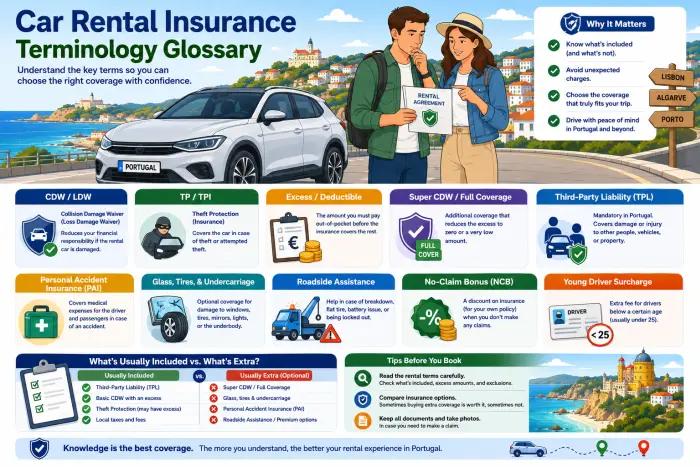
CDW and LDW are generally synonymous, both referring to the base collision/damage waiver most rentals include. Excess and deductible describe the same underlying concept, the amount you’re liable for, just using different regional naming conventions (excess is more common in UK/European English, deductible in American English). SCDW, “super cover,” and “zero excess” all describe enhanced coverage that reduces or eliminates that liability amount, though the exact scope varies by supplier.
The Core Terminology Map
| Term | What It Refers To |
|---|---|
| CDW (Collision Damage Waiver) | Base coverage reducing your liability for collision damage to a defined amount |
| LDW (Loss Damage Waiver) | Generally synonymous with CDW; some suppliers use this term instead |
| Excess | The amount you remain liable for even with CDW, common UK/European term |
| Deductible | Same concept as excess, common American term |
| SCDW (Super CDW) | Enhanced coverage further reducing or eliminating the excess/deductible amount |
| Zero excess / “full coverage” | Marketing terms describing coverage that reduces your liability to zero |
These six terms cover the vast majority of what you’ll actually encounter across different suppliers and platforms, and recognizing the pattern, base coverage terms clustering together and enhanced coverage terms clustering together separately, helps you navigate any new or unfamiliar term you might come across that isn’t explicitly listed here by fitting it into one of these two general categories.
Why This Confusion Happens So Consistently
Different suppliers, different countries’ insurance conventions, and different marketing teams all describe genuinely overlapping concepts using their own preferred terminology, without any single industry-wide standardization forcing consistency. A supplier based in the US market might default to “deductible,” while a European supplier defaults to “excess,” describing the exact same underlying concept. Understanding that these are often just regional naming conventions for the same thing, rather than genuinely different coverage types, removes a significant amount of unnecessary confusion when comparing listings across different suppliers or platforms.
CDW and LDW: Almost Always the Same Thing
These two terms cause particular confusion since they sound like they might cover different scenarios, collision versus some broader “loss” category, but in practice, most suppliers use them interchangeably to describe the same base coverage. It’s worth confirming with your specific supplier if the distinction genuinely matters to you, but treating them as functionally equivalent is a safe general assumption across the large majority of standard rental agreements you’ll encounter.
Excess vs Deductible: Same Concept, Different Regions
This is purely a naming convention difference rather than a substantive one. Both terms describe the amount you remain financially responsible for if damage occurs, even with standard CDW/LDW coverage in place. A traveler from the US might see “excess” on a European listing and wonder if it’s something different from the “deductible” concept they’re familiar with from home; it isn’t, it’s the identical underlying concept using the regional term more common in that market.
SCDW, Super Cover, and Zero Excess: The Enhanced Tier
These terms all describe essentially the same category of enhanced coverage, an upgrade beyond standard CDW that reduces or entirely eliminates your excess/deductible liability, though the exact terminology varies by supplier’s own marketing language. Our guide on what CDW doesn’t cover is worth reading alongside this glossary, since even an enhanced “zero excess” tier typically carries its own exclusions, glass, tyres, undercarriage, that a purely terminology-focused glossary like this one doesn’t cover in depth on its own.
Does This Terminology Affect Third-Party Insurance Too?
Yes, worth being aware of if you’re comparing a third-party policy against your rental company’s own coverage. Our guide on third-party excess insurance for Portugal car rental covers a separate purchasable product using this same overlapping terminology, worth reading with this glossary in mind so you’re comparing genuinely equivalent coverage levels between the rental company’s own tiers and any independent policy you’re weighing against them.
Credit Card Coverage Uses This Vocabulary Too
Worth checking specifically since your card issuer’s own benefits documentation likely uses the same overlapping terminology covered here. Our guide on credit card rental insurance coverage in Portugal covers this specific benefit, useful to read alongside this glossary since your card’s benefits guide might describe coverage using “primary CDW” or “collision waiver” language that maps directly onto the terms clarified here, even though it’s a genuinely different coverage source from either the rental company or a standalone third-party policy.
💸 Don’t Overpay at the Airport
Compare real-time rental deals with no hidden fees or credit card needed.
A Practical Approach: Ask What You’re Actually Liable For
Rather than trying to memorize every possible term and its exact synonym relationships, the single most useful question to ask any specific supplier is simple and terminology-agnostic: “if the car is damaged, what amount am I personally responsible for, and what specific damage types remain excluded regardless of which coverage tier I choose?” This cuts through whatever specific vocabulary a listing uses and gets directly at the information that actually matters for your decision.
A Few Other Terms You Might Encounter
Beyond the core damage-coverage vocabulary covered above, a few related terms occasionally show up worth briefly recognizing: personal accident insurance (PAI) covers medical costs for you and passengers rather than vehicle damage, a genuinely different category from everything else discussed here. Third-party liability, sometimes just called “liability coverage,” covers damage or injury you cause to others or their property, and is typically included as a legal minimum requirement rather than an optional add-on, distinct from the collision-focused terms covered throughout this glossary.
Why Reading the Actual Policy Still Matters
Even armed with this glossary, it’s worth emphasizing that terminology alone doesn’t guarantee identical coverage between two suppliers using the same word. Two different companies might both call their enhanced tier “zero excess,” yet structure the actual exclusions, glass, tyres, undercarriage, and specific claim procedures somewhat differently underneath that shared label. This glossary helps you understand what question to ask and what general category a term falls into, but it’s not a substitute for actually reading the specific policy terms for your chosen listing before assuming you know exactly what you’re getting based on terminology alone.
Insurance Terminology Checklist for Portugal Car Rental
- Treat CDW and LDW as generally synonymous unless a specific supplier indicates otherwise
- Understand excess and deductible describe the same concept, just different regional terms
- Recognize SCDW, super cover, and zero excess as variations on the same enhanced coverage category
- Check exclusions regardless of which terminology or tier a specific listing uses
- Ask directly what you’re liable for rather than relying purely on matching terminology across listings
See our complete insurance and deposit guide for how these terms connect in practice.
Frequently Asked Questions
Is CDW the same as LDW? Generally yes, most suppliers use these terms interchangeably to describe the same base collision/damage waiver coverage, though it’s worth confirming with your specific supplier if the distinction matters to you.
Is excess the same thing as a deductible? Yes, these describe the identical underlying concept, the amount you remain liable for, using different regional naming conventions rather than genuinely different coverage types.
Does “zero excess” mean the same thing as “super cover” or SCDW? Generally yes, these are variations in terminology for the same enhanced coverage category that reduces or eliminates your standard excess/deductible liability.
What’s the best question to ask instead of trying to compare terminology directly? Ask directly what amount you’re personally liable for and what specific damage types remain excluded, which cuts through varying terminology and gets at the information that actually matters.
Does my credit card’s insurance benefit use the same terminology as rental company coverage? Often yes, terms like “primary CDW” or “collision waiver” in a card’s benefits guide typically map onto the same concepts covered here, even though it’s a distinct coverage source.
Is personal accident insurance (PAI) the same as CDW or excess coverage? No, it’s a genuinely different category, covering medical costs for you and passengers rather than vehicle damage, distinct from all the collision-focused terminology covered in this glossary.
For the broader picture of how rental insurance tiers work generally, our Portugal car rental insurance explained guide covers that foundational topic.