Setúbal sits less than an hour from Lisbon, about 45 km via the A2 and A12, and it’s genuinely one of those places where a rental car changes what’s actually possible, since the Arrábida Natural Park’s best beaches, Figueirinha, Portinho da Arrábida, Galapinhos, are realistically only reachable by car, not by the public transport that gets you to Setúbal town itself well enough. Add in a resident dolphin colony in the Sado estuary, the Moscatel wine region, and the ferry crossing to Tróia and Comporta, and Setúbal works as either a relaxed day trip from Lisbon or a genuinely worthwhile overnight base for exploring this whole stretch of coast.
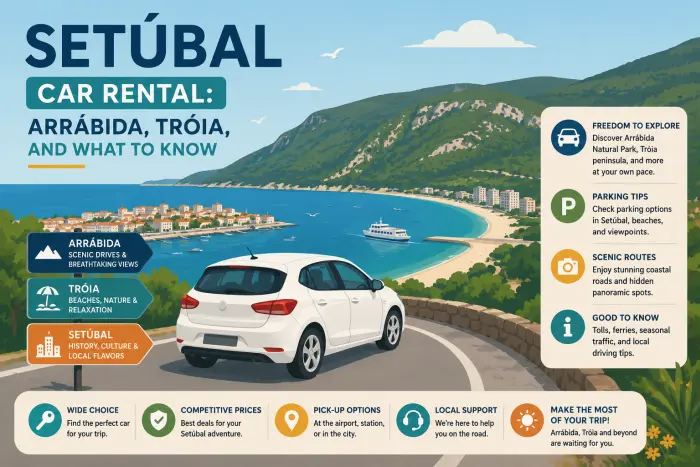
- Setúbal is roughly 45 km from Lisbon, about 45 minutes to an hour via the A2/A12 motorways
- Arrábida Natural Park’s best beaches are best reached by car; public transport gets you to Setúbal town but not easily into the park itself
- The Sado estuary hosts one of only three resident dolphin colonies living in a European estuary
- Setúbal is the departure point for the ferry to Tróia and onward to Comporta, either by fast catamaran (passengers only, about 15 minutes) or the slower car ferry (roughly 15-25 minutes with possible queues)
- The local specialty is choco frito, deep-fried cuttlefish, worth seeking out in the historic center
- Roads into Arrábida itself get narrow and winding, and beach parking is genuinely scarce in summer
Why a Car Matters More Here Than in Setúbal Town Itself
Setúbal town is walkable enough on its own, with a historic center along Avenida Luísa Todi and easy access to the ferry terminal. The real case for a rental car is what surrounds the town: the Arrábida Natural Park’s beaches are tucked into a mountainous coastal stretch with limited or nonexistent public transport, and reaching Figueirinha, Portinho da Arrábida, or the wilder Galapinhos and Coelhos beaches genuinely requires your own vehicle, since buses don’t run direct routes into the park and hiking in from Setúbal town takes a couple of hours each way, more if you’re carrying beach gear for the day.
For the wider picture of the coast south of Lisbon, see our regional guide.
Arrábida’s Beaches: What You’re Actually Driving To
The Serra da Arrábida is one of Portugal’s smaller protected natural parks, and it’s genuinely striking, forested limestone cliffs dropping into clear water more reminiscent of the Mediterranean than the Atlantic. Portinho da Arrábida in particular draws comparisons to Croatia or southern Italy for its clarity, and photos genuinely don’t oversell it the way travel marketing sometimes does elsewhere. The roads leading into the park are narrow and winding, which rewards a smaller car over anything oversized, and parking at the more popular beaches fills early in summer, similar to the pattern travelers run into around Ericeira and Peniche further north.
The Ferry to Tróia: Passenger Catamaran vs. Car Ferry
If your trip continues toward Tróia or Comporta, Setúbal is where you’ll catch the ferry across the Sado estuary. There are two real options here, and they suit different plans depending on whether your car needs to come along for the rest of the journey or whether you’re happy leaving it behind in Setúbal for the day.
| Ferry Option | Crossing Time | Best For |
|---|---|---|
| Passenger catamaran | About 15 minutes | Foot passengers, cyclists, or those leaving the car in Setúbal |
| Car ferry | Roughly 15-25 minutes, plus possible queues in summer | Those continuing onward with the vehicle, especially toward Comporta |
If you’re heading onward to Comporta specifically, our Comporta car rental guide covers this exact ferry route in more depth alongside the alternative direct highway route, worth reading together with this one if Setúbal is a stop rather than your final destination.
Dolphin-Spotting in the Sado Estuary
The Sado is home to one of just three resident bottlenose dolphin colonies living permanently in a European estuary, and boat tours departing from Setúbal’s harbor regularly spot them, often on the same crossing used for the Tróia ferry. It’s worth building a bit of flexible time into your schedule if this is part of the draw, since sightings, while common, aren’t guaranteed on every crossing, and the dolphins tend to range across a wide stretch of the estuary rather than staying near any single fixed point.
Wine Country Right Next Door
Setúbal gives its name to Moscatel de Setúbal, a distinctive fortified dessert wine produced in the nearby Azeitão area, home to José Maria da Fonseca, one of Portugal’s oldest table wine producers, with a history stretching back to the 19th century and cellars that are genuinely worth a visit even for casual wine tourists. If you’re already comparing this to a Douro Valley wine trip, the same drink-driving principles apply here just as seriously, Portugal’s strict blood alcohol limits don’t relax because you’re closer to Lisbon, so the same designated-driver planning is worth applying to a Setúbal wine stop too.
Toll Roads and Fuel on the Way
Both the A2 and A12 routes from Lisbon include tolled sections, so it’s worth confirming how Via Verde tolls work if you haven’t already, since most rental cars come with a transponder fitted and the charge bills automatically, generally with some delay after your return. It’s also worth a quick look at realistic rental car fuel costs in Portugal if Setúbal is one stop on a longer coastal loop rather than a standalone day trip, since the fuel budget adds up differently depending on how far your route ultimately extends.
Combining Setúbal With a Longer Lisbon-Area Trip
Setúbal fits naturally into a broader set of day trips from Lisbon by rental car, and given the ferry connection south, it also works well as the first leg of a longer coastal route toward Comporta and the Alentejo beyond, rather than a there-and-back visit on its own. Travelers with a full week or more in the Lisbon area often find Setúbal works better as an overnight stop partway through a longer loop than as a rushed single-day excursion squeezed between other Lisbon commitments.
💸 Don’t Overpay at the Airport
Compare real-time rental deals with no hidden fees or credit card needed.
Staying Connected on Arrábida’s Winding Roads
Cell coverage can be inconsistent along some of the more remote stretches of the Arrábida coastline, which matters if you’re relying on GPS to find specific beach access points that aren’t always well signposted, particularly the smaller, less-crowded coves that don’t show up prominently on standard map apps. It’s worth setting up mobile data for GPS use in Portugal before heading into the park specifically, so a dropped signal doesn’t turn into a wrong turn on a narrow cliffside road.
Getting the Basics Right First
If it’s your first time driving in Portugal, it’s worth a quick read of general driving rules and roundabout etiquette before tackling Arrábida’s narrower stretches, which behave differently from the wide motorways that get you to Setúbal in the first place, and where local drivers move with a familiarity that visitors simply won’t have on a first pass through.
Practical Checklist for a Setúbal Trip
- ✅ Rent a smaller car if Arrábida’s narrow coastal roads are part of your plan, rather than an oversized SUV
- ✅ Arrive at popular Arrábida beaches early in summer, since parking is genuinely limited
- ✅ Decide between the passenger catamaran and the car ferry to Tróia based on whether you’re continuing onward with the vehicle
- ✅ Build some flexibility into your schedule if dolphin-spotting is part of the plan
- ✅ Confirm your rental car has a working Via Verde transponder for the A2/A12 tolled sections
- ✅ Apply the same designated-driver planning to a Setúbal wine stop as you would in the Douro
Frequently Asked Questions
How far is Setúbal from Lisbon by car? Roughly 45 km, about 45 minutes to an hour via the A2 and A12 motorways.
Do I need a car to visit Setúbal, or is public transport enough? Setúbal town itself is reachable by train or bus, but Arrábida Natural Park’s best beaches genuinely require a car, since public transport doesn’t serve the park directly.
What’s the difference between the passenger catamaran and the car ferry to Tróia? The catamaran is faster, around 15 minutes, and carries foot passengers only. The car ferry takes roughly 15-25 minutes, can involve queues in summer, and lets you continue onward with your vehicle toward Comporta and beyond.
Are Arrábida’s beaches actually worth the drive? Yes, by most accounts. The park’s limestone cliffs and clear water are genuinely distinctive within Portugal, often compared to the Mediterranean rather than the typical Atlantic coastline.
Is dolphin-spotting in Setúbal reliable? Sightings are common but not guaranteed on every crossing, since the Sado estuary’s resident dolphin colony moves around within the wider estuary rather than staying in one fixed spot.
What local food should I try in Setúbal? Choco frito, deep-fried cuttlefish, is the city’s signature dish and worth seeking out in the historic center along Avenida Luísa Todi.
Can I combine a Setúbal trip with Comporta in the same day? It’s possible via the ferry to Tróia and onward drive, though it makes for a genuinely full day. Many visitors prefer treating Setúbal and Comporta as separate stops on a longer coastal trip instead.
Is parking difficult in Setúbal town itself? Generally manageable, unlike the more limited situation at Arrábida’s specific beach access points during peak summer season.
Is Setúbal worth an overnight stay, or is a day trip enough? A day trip covers the basics, but travelers with more time often find an overnight stay lets them fit in Arrábida’s beaches, the ferry crossing, and a proper wine stop without rushing any single part of the visit.