The daily rental rate is only part of what a Portugal road trip actually costs, and fuel is the variable most travellers underestimate when budgeting, since it depends on distance driven, vehicle type, driving style, and current market prices rather than a fixed figure quoted at booking. Working out a realistic fuel budget before you go avoids an unpleasant surprise partway through the trip.
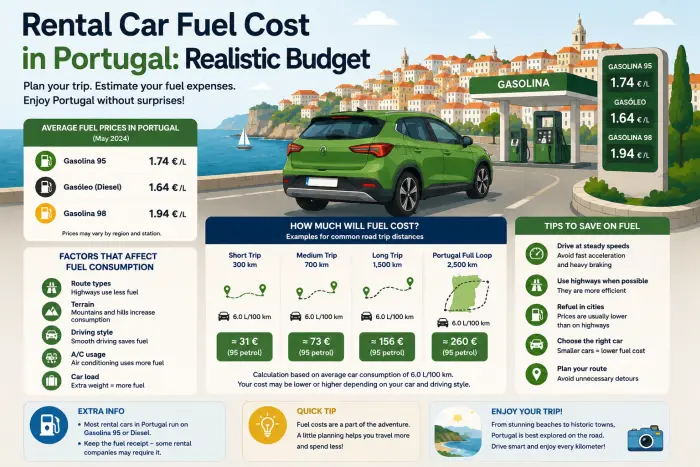
Quick answer: for a typical week-long Portugal road trip covering a few hundred kilometres, budget roughly €60-120 for fuel in a standard compact or mid-size car, more for an SUV or a longer, more ambitious itinerary. Prices and consumption vary enough that this is a planning estimate rather than a precise figure.
Current Fuel Price Landscape in Portugal
Portugal’s fuel prices sit in line with broader Western European norms, generally higher than North American prices but comparable to neighbouring Spain and similar EU countries. Prices fluctuate with global oil markets and can vary somewhat by region and specific station, with motorway service stations typically charging a premium over stations in towns just off the main routes. Checking current per-litre prices before your trip, rather than relying on a figure that might be months out of date, gives a more accurate starting point for your own budget calculation and helps avoid an unpleasant surprise at the pump.
Estimating Cost by Route
| Route | Approximate Distance | Rough Fuel Cost (Compact Car) |
|---|---|---|
| Lisbon to Porto (one way) | ~300 km | €25-35 |
| Lisbon to Algarve (one way) | ~280 km | €25-35 |
| Lisbon day trip to Sintra and Cascais loop | ~80-100 km | €8-12 |
| Porto to Douro Valley round trip | ~150 km | €12-18 |
These figures assume a standard compact or mid-size petrol vehicle and current typical pricing; an SUV or larger vehicle will run meaningfully higher, and diesel vehicles, common in the European rental fleet, often show different per-litre pricing and consumption than petrol equivalents.
Does Vehicle Category Change Fuel Cost Significantly?
Yes, and it’s worth factoring into your total trip budget alongside the daily rental rate itself. A larger vehicle category, particularly an SUV, consumes noticeably more fuel per kilometre than a compact or economy car, which compounds over a longer route like Lisbon to the Algarve or Porto in a way that can meaningfully close the gap between what looked like a modest daily rate difference at booking and the actual total trip cost. If fuel budget is a genuine priority, sticking to a smaller vehicle category isn’t just about the rental rate itself, it has a real secondary effect on total fuel spend across the trip.
Petrol vs Diesel: Does It Matter for Your Budget?
Somewhat, and it’s worth knowing which fuel type your specific rental takes before you’re at a pump guessing. Diesel vehicles are common in the European rental fleet and generally offer better fuel efficiency per litre than an equivalent petrol vehicle, though diesel’s per-litre price doesn’t always track petrol’s price movements identically, meaning the cost-per-kilometre advantage isn’t always as large as the efficiency figures alone suggest. Confirming your specific rental’s fuel type at pickup, rather than assuming, avoids the genuinely costly mistake of filling with the wrong fuel type entirely.
How Fuel Policy Interacts With Your Actual Cost
Beyond the raw price per litre, the specific fuel policy your rental carries changes how much you actually end up paying compared with your real consumption. Our guide on Lisbon Airport car rental fuel policy covers the difference between full-to-full and prepaid fuel structures in detail, worth reading alongside this cost estimate since a prepaid fuel option can mean paying for a full tank of fuel you don’t fully use, effectively increasing your real cost per kilometre above the raw price-per-litre calculation this article is built around.
Motorway Driving vs City and Rural Roads
Fuel consumption isn’t uniform across every type of driving a Portugal trip typically involves. Sustained motorway driving, like the A1 between Porto and Lisbon, generally delivers better fuel efficiency per kilometre than stop-start city driving in Lisbon’s traffic or winding rural roads through hillier regions. A trip mixing motorway transfers with more city-based and rural exploration will land somewhere between the most efficient and least efficient extremes, which is worth keeping in mind if your route estimate leans heavily on one type of driving over the others.
Electric Rental Cars: A Different Cost Structure Entirely
If you’re considering an electric vehicle instead of petrol or diesel, the cost comparison changes fundamentally rather than just shifting incrementally. Charging costs per kilometre are generally lower than petrol or diesel fuel costs, though charging time and station availability introduce a different kind of planning consideration than simply budgeting fuel spend. See our electric car rental in Portugal guide for how this alternative cost structure compares directly if you’re weighing it against a standard petrol or diesel rental for your trip.
💸 Don’t Overpay at the Airport
Compare real-time rental deals with no hidden fees or credit card needed.
How Fuel Cost Fits Into Your Total Trip Budget
Fuel is only one line item in a Portugal road trip’s total transport cost, and it’s worth viewing it alongside the daily rental rate, any tolls on major intercity routes, and parking costs at your various stops, rather than budgeting fuel in isolation. A trip that looks cheap based on a low daily rental rate alone can still add up meaningfully once fuel, tolls, and parking are all factored in together, which is worth doing as a single combined estimate before committing to a specific itinerary or vehicle category.
Comparing Fuel Cost Against Public Transport for the Same Route
For travellers weighing whether driving is worth it at all compared with train travel for a specific leg, fuel cost alone doesn’t capture the full comparison, since it needs to be considered alongside the rental rate, tolls, and parking together rather than in isolation. Our comparison of driving vs the train between Porto and Lisbon walks through this fuller cost picture for that specific route, useful context if fuel cost alone is making you second-guess whether driving is worth it for a particular leg of your trip.
Does Fuel Price Fluctuate by Season in Portugal?
Somewhat, though less dramatically than some other travel costs like accommodation or rental rates themselves. Fuel prices in Portugal track broader European and global oil market movements more than any strong seasonal tourism pattern, so a summer trip doesn’t automatically carry a meaningfully higher fuel cost than a winter one purely due to timing, unlike accommodation or rental car rates which do show clear peak-season premiums. That said, checking current prices close to your actual travel dates rather than relying on a figure from months earlier is still worth doing, given genuine market fluctuation happens independent of any seasonal tourism pattern.
📋 Fuel Cost Budgeting Checklist for Portugal
- Check current per-litre prices before your trip rather than relying on outdated figures
- Factor vehicle category into your fuel budget, not just the daily rental rate
- Confirm your specific rental’s fuel type at pickup to avoid a costly filling mistake
- Read your fuel policy’s specific terms alongside this cost estimate, since prepaid options can increase real cost per kilometre
- Budget for motorway-heavy driving more efficiently than city or rural-heavy routes when estimating total trip fuel cost
❓ Frequently Asked Questions
How much should I budget for fuel on a week-long Portugal road trip? Roughly €60-120 for a standard compact or mid-size car covering a few hundred kilometres, more for an SUV or a longer, more ambitious route with additional detours.
Is diesel cheaper to run than petrol for a Portugal rental car? Often somewhat more efficient per litre, though diesel pricing doesn’t always track petrol identically, so the real cost advantage varies rather than being a fixed rule.
Does a prepaid fuel policy save money compared to paying for fuel used? Not usually. A prepaid tank often means paying for more fuel than you actually use, effectively increasing your real cost per kilometre above the raw price-per-litre figure.
Is fuel cheaper for an electric rental car than a petrol one in Portugal? Generally yes per kilometre, though charging time and station availability add a different planning consideration than straightforward fuel budgeting for a combustion vehicle.
Does fuel cost in Portugal change by season the way rental rates do? Not as dramatically. Fuel prices track broader oil market movements more than seasonal tourism demand, unlike rental rates and accommodation which show clear peak-season premiums.
Should I fill up at a motorway service station or wait for a town station in Portugal? Town stations just off the main routes are generally cheaper than motorway service stations, which typically carry a price premium for the convenience of a direct off-ramp location, so timing a fill-up for a town stop when possible is worth the small detour.
For a broader look at how vehicle choice and fuel policy compound to affect total trip cost, revisit the sections above before finalising your booking.