Forty minutes south of Lisbon, past a stretch of car dealerships and industrial sprawl that gives you no warning of what’s coming, the N379 climbs into the Serra da Arrábida and turns into one of the best drives in the entire country. It’s also a place where the small print actually matters: GNR police enforce a specific, easy-to-miss parking rule here, one stretch of coastal road closes to non-local traffic for twelve hours a day in high season, and campervans are banned from the park outright. None of that shows up on the postcard.
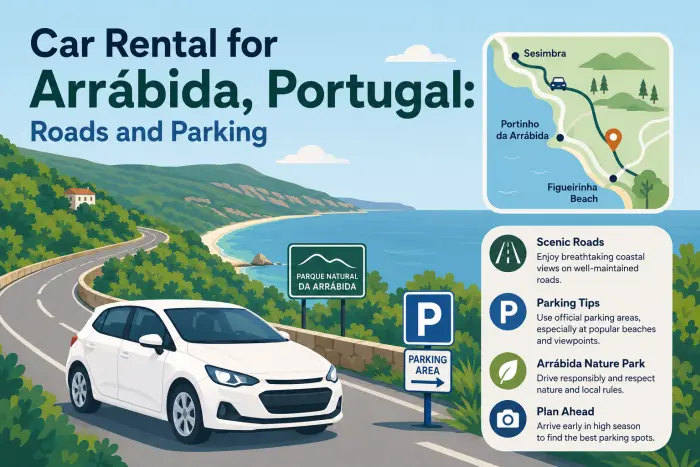
- Arrábida Natural Park sits about 40 km, roughly 40 minutes, south of Lisbon via the A2
- The N379, and its more dramatic offshoot the N379-1 (the Estrada de Escarpa, or “escarpment road”), is a genuinely spectacular 14 km ridge drive with sweeping Atlantic views on one side and forested slopes on the other
- GNR actively fines illegal roadside parking here — the specific rule is that all four wheels must be off the tarmac, not just two
- The coastal road between Praia do Creiro and Praia da Figueirinha (and near Praia de Galápos) closes to non-local traffic roughly 8am to evening, from May through October
- Beach parking lots fill by around 9am during summer, with no meaningful overflow capacity at most sites
- Campervans and motorhomes are prohibited from entering the park entirely, not just restricted to certain areas
The Drive Itself Is the Point
Most of the destinations covered elsewhere on this site are places you drive to. The N379-1 is different, it’s a place you drive through, and the driving is genuinely the experience rather than a means to one. The Estrada de Escarpa follows the highest ridge of the Serra, rising to around 500 meters, with the Atlantic dropping away on one side and wooded slopes on the other. Three viewpoints along the way are worth the stop: Miradouro do Norte, looking back across the valley toward Lisbon on a clear day, Miradouro do Portinho da Arrábida, the highest and busiest of the three, and the spot near Convento da Arrábida, a 16th-century Franciscan monastery visible through the trees that’s only open Wednesday through Saturday if you want to actually visit rather than just glimpse it from the road.
See the regional guide to the Lisbon coast for how Arrábida connects to Setúbal and Comporta.
The Parking Rule That Actually Costs People Money
This is worth knowing before you pull over for a photo. GNR enforces roadside parking here specifically, and the rule isn’t the vague “don’t block traffic” standard you might expect, it’s that all four wheels of your car need to be off the tarmac when you park at the roadside. Two wheels on the shoulder and two still on the road isn’t compliant, and it’s a rule that’s actively fined rather than just theoretically on the books. If a viewpoint’s designated pull-in area is full, that’s a signal to keep driving to the next one rather than squeeze in with wheels still on the asphalt.
The Road Closure Nobody Mentions Until You Hit It
Here’s a detail that catches visitors off guard specifically because it’s easy to miss in general trip planning: the coastal road connecting Praia do Creiro and Praia da Figueirinha, including the stretch near Praia de Galápos, closes to non-local traffic for a large chunk of the day, roughly 8am until evening, during the May-to-October season. If your plan depends on that specific coastal connector during those hours, you’ll need the longer detour via the N379 through the hills instead, adding real time to the trip. It’s worth checking current signage or asking locally before you commit to a route that assumes this road is open.
Beach Parking: Arrive Early or Don’t Bother
The beaches themselves, Praia do Creiro, Praia de Galapinhos, and the tiny, five-house cove of Portinho da Arrábida, are genuinely among the most beautiful stretches of coast in Portugal, still water so clear you can watch your own shadow on the sand below. They’re also genuinely small, with parking to match.
| Beach | Parking Reality | Public Transport |
|---|---|---|
| Praia da Figueirinha | Largest lot in the park, still fills by mid-morning in summer | Yes — the only beach with a bus connection to Setúbal |
| Praia do Creiro | Small, limited spaces | None |
| Praia de Galapinhos | Small, limited spaces, often called one of the prettiest | None |
| Portinho da Arrábida | Very tight; tuk-tuks shuttle from a separate lot in summer | None |
In summer, lots fill by around 9am, and Portinho da Arrábida specifically is tight enough that tuk-tuks run from a separate parking area to ferry people the final stretch when demand outpaces the handful of spaces right at the beach. Praia da Figueirinha, the largest beach in the park, is the one exception with an actual bus connection to Setúbal, worth knowing if driving and parking sounds like more hassle than it’s worth for that particular stop.
No Campervans, Full Stop
Worth flagging plainly since it trips up a specific type of traveler: campervans and motorhomes aren’t permitted inside Arrábida Natural Park at all, not restricted to certain roads, simply not allowed in. If your Portugal trip involves a camper rental, this is one park where you’ll need to plan around the boundary rather than through it.
Wine, Dinosaurs, and What Else Is Worth the Detour
The northern slopes of the Serra produce Moscatel de Setúbal, the sweet fortified wine that put this stretch of coast on the map, and the Azeitão wine region, home to estates like Bacalhôa alongside smaller family-run quintas, sits an easy detour off the main route. If tasting is part of your day, the same rules apply here as anywhere else in Portugal: drink-driving limits are strict enough that a single glass can matter, so plan a designated driver if you’re stopping at more than one estate. Further along the N379 toward Cabo Espichel, the Jazida dos Lagosteiros site holds genuine dinosaur footprints from the Cretaceous period, free to visit, signposted off the main road, and a strange, low-key stop that’s easy to combine with the drive.
💸 Don’t Overpay at the Airport
Compare real-time rental deals with no hidden fees or credit card needed.
Getting There From Setúbal or Sesimbra
The N379-1 can be approached from either direction, from Setúbal in the east or the coastal town of Sesimbra in the west, and it’s genuinely worth driving it both ways if you have the time, since the views read differently depending on which direction you’re facing. If you’re basing yourself in Setúbal for a wider trip, Arrábida is the natural extension of that base rather than a separate expedition.
The Ponte 25 de Abril Warning
If you’re driving back into Lisbon at the end of the day, it’s worth knowing that the Ponte 25 de Abril bridge gets genuinely bad northbound traffic during evening rush hour and on weekends, largely beachgoers returning from exactly this stretch of coast. Timing your return outside those windows, or simply expecting a slower crossing, saves real frustration at the end of what should be a relaxed day.
The Basics Before You Go
If it’s your first time driving in Portugal, it’s worth a quick read of general driving rules, and Arrábida shows up regularly on lists of the best day trips from Lisbon by rental car for good reason. Given the ridge driving and the winding sections of the N379-1 specifically, it’s also worth a look at our broader notes on road safety and defensive driving in Portugal, since this is a road that rewards a slower, more attentive pace than the motorways most visitors get comfortable with first. The A2 stretch down from Lisbon includes tolled sections, so it’s worth having Via Verde sorted beforehand, and signal can thin out along parts of the ridge itself, so setting up mobile data for GPS use in Portugal before you leave the motorway is a sensible precaution here too.
Practical Notes Before You Set Off
- Drive the N379-1 for the road itself, not just as a way to reach the beaches — it’s genuinely one of the best drives in the country
- Park with all four wheels off the tarmac at roadside pull-ins, or risk a real GNR fine
- Check current hours for the coastal road near Galápos before relying on it during the May-October restricted window
- Arrive at beach parking lots by 9am in summer if you want any real chance of a space
- Skip this park entirely if you’re driving a campervan or motorhome — they’re not permitted inside
- Time your return crossing of the Ponte 25 de Abril to avoid evening rush hour and weekend beach traffic
Frequently Asked Questions
How far is Arrábida from Lisbon by car? About 40 km, roughly a 40-minute drive via the A2.
What’s the specific parking rule GNR enforces along the N379? All four wheels of your car must be off the tarmac when parking at the roadside. Parking with only two wheels on the shoulder is treated as a violation and actively fined.
Is the coastal road near Praia de Galápos always open? No. It closes to non-local traffic roughly from 8am until evening, from May through October, requiring a longer detour via the N379 through the hills during those hours.
How early do I need to arrive to get beach parking in summer? Around 9am is a realistic cutoff at most of the park’s beaches. Lots fill quickly after that during peak season, with little meaningful overflow capacity.
Can I bring a campervan or motorhome into Arrábida Natural Park? No. Campervans and motorhomes are prohibited from entering the park entirely.
Is the N379-1 difficult or dangerous to drive? It’s winding and narrow in places, with real drops in some sections, so it rewards a slower, more attentive pace rather than being genuinely dangerous if driven carefully.
What’s worth stopping for along the drive besides the beaches? The Azeitão wine region for Moscatel tastings, the Convento da Arrábida monastery (open Wednesday through Saturday), and the Jazida dos Lagosteiros dinosaur footprint site near Cabo Espichel are all realistic add-ons.
Is there a beach in Arrábida that’s easier to reach without dealing with the parking situation? Praia da Figueirinha, the park’s largest beach, has an actual bus connection to Setúbal, making it the one option that doesn’t fully depend on finding a parking space.