If your final rental car invoice from Portugal has more lines on it than you expected, that’s genuinely normal, a typical bill combines your base rate, taxes, several possible surcharges, protection add-ons, a deposit that may or may not have actually been charged yet, and a separate toll bill that often arrives weeks later, and almost nobody explains what each piece actually represents until you’re staring at a statement trying to work it out yourself after the trip is already over.
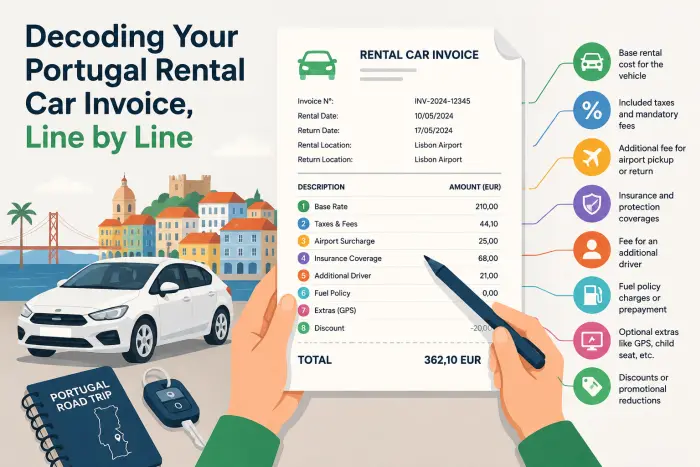
What You’re Actually Looking At
- The base rental rate is your daily price multiplied by the number of days, before taxes or anything else is added to the total
- Portugal applies 23% IVA (VAT) to most rental charges, which should already be reflected in your total rather than added as a surprise
- A deposit hold shown on your invoice or card statement is usually an authorization, not an actual charge, and it releases separately from your final bill once the rental closes
- Protection add-ons like CDW (Collision Damage Waiver) reduce your liability but don’t necessarily eliminate it entirely — check what “excess” or “deductible” amount remains
- Toll charges typically appear as a separate, later charge, not part of your initial invoice at all
- If you booked through a broker like Discovercars, your prepaid amount and the rental company’s own charges are two genuinely separate transactions, which is why the numbers don’t always seem to add up at first glance
The Base Rate and Taxes
This is the simplest part of the invoice and usually the first line: your agreed daily rate multiplied by the length of your rental. Portugal’s standard IVA rate of 23% generally applies to rental charges, and a properly issued invoice should already include this in the total you were quoted rather than tacking it on as a separate surprise later, though it’s still worth glancing at the breakdown to confirm tax was factored in correctly. If a final charge looks higher than your original quote for reasons unrelated to tax, that’s usually where the other line items below come in.
Surcharges You Might See
| Line Item | What It Actually Means |
|---|---|
| Airport surcharge | An extra fee for picking up at an airport location rather than a city office, common across most rental brands |
| Young driver surcharge | An additional daily fee for drivers under a certain age threshold, typically 25 |
| Additional driver fee | A charge for adding a second named driver to the rental agreement |
| One-way fee | Applies if you’re returning the car to a different city or location than where you picked it up |
| Late return fee | Charged if you return the car meaningfully later than your contracted time |
None of these are hidden exactly, but they’re easy to miss when comparing an initial quote against a final bill, since some only apply based on choices you made at the counter rather than at the time of original booking.
CDW, Excess, and What “Protection” Actually Covers
This is where the terminology gets genuinely confusing, and it’s worth understanding rather than just seeing “CDW” on a line and assuming it means you’re fully covered. Collision Damage Waiver generally reduces your financial responsibility for damage to the car, but it usually doesn’t reduce it to zero, there’s typically still an “excess” or “deductible” amount you’d owe if something happened, and that figure can vary considerably depending on the car class and the specific rental company. Our rental terminology glossary goes deeper into exactly how these terms relate to each other, which is worth reading before you’re trying to interpret an invoice that references coverage you don’t fully understand.
The Deposit Line: Charge or Just a Hold?
This confuses a lot of travelers specifically because it can look identical to an actual charge on your card statement while functioning completely differently. A deposit is typically an authorization, a hold placed on your available credit rather than money that’s actually left your account, and it should release on its own within a set period after you return the car, though how long that takes varies by company and by bank. It’s worth reading our guide on deposit release timing if you’re watching your statement and unsure whether a specific line represents a genuine charge or just a temporary hold.
The Toll Charge That Isn’t on Your Original Invoice
If your invoice doesn’t show any toll charges at all, that’s expected, not an oversight. Portugal’s Via Verde system bills tolls separately and considerably later than your main rental invoice, sometimes weeks after you’ve returned the car, since the rental company reconciles everything you owe across the whole trip before sending a consolidated bill. It’s worth reading our breakdown of Via Verde’s actual billing timeline so a delayed toll charge doesn’t look like an unexplained mystery arriving out of nowhere on your statement.
If You Booked Through Discovercars or a Similar Broker
Here’s a distinction that trips up a fair number of first-time renters: if you booked through a comparison platform like Discovercars, the amount you paid at booking and the amount the actual rental company charges you at pickup or return are genuinely two separate transactions from two separate entities, and they’ll typically show up as two different line items on your card statement, sometimes weeks apart. Our Discovercars review covers how this platform works in more depth, and it’s also worth understanding the general difference between prepaying versus paying at pickup, since which model you chose at booking affects which charges you should expect to see from which party.
💸 Don’t Overpay at the Airport
Compare real-time rental deals with no hidden fees or credit card needed.
When a Charge Genuinely Looks Wrong
Sometimes, after accounting for all of the above, a charge on your final bill still looks incorrect, whether that’s a duplicate charge, an amount that doesn’t match your agreed rate, or a fee you don’t recall being told about. If that happens, it’s worth reading our guide on what to do if you’re charged after your final invoice already closed, and if the rental company isn’t resolving it satisfactorily, understanding your options around a credit card chargeback for a disputed charge.
Practical Checklist for Reading Your Rental Invoice
- ✅ Confirm your base rate matches days rented multiplied by your agreed daily price, before tax
- ✅ Check whether 23% IVA is already included in your total or listed as a separate line
- ✅ Identify which surcharges apply to you specifically — airport, young driver, additional driver, one-way, or late return
- ✅ Understand your actual excess/deductible amount under CDW, not just that “protection” was included
- ✅ Distinguish between a deposit hold and an actual charge on your card statement
- ✅ Expect toll charges to appear separately and later, not as part of your original invoice
- ✅ If you booked through a broker, keep both the booking confirmation and the rental company’s own paperwork, since they represent separate transactions from separate parties
Frequently Asked Questions
Why does my final invoice have more charges than my original quote? Usually because of surcharges tied to choices made at pickup, like an airport fee, young driver surcharge, or additional driver, which aren’t always reflected in an initial online quote.
Is the deposit shown on my invoice an actual charge? Typically no, it’s an authorization hold on your available credit that releases separately within a set period after your return, rather than money that’s actually left your account.
Does CDW mean I have zero financial responsibility if something happens to the car? Not necessarily. CDW generally reduces your liability but usually leaves an “excess” or “deductible” amount you’d still owe, so it’s worth checking that specific figure rather than assuming full coverage.
Why doesn’t my invoice show any toll charges? Because Portugal’s Via Verde toll system bills separately and considerably later than your main rental invoice, sometimes weeks after you’ve returned the car.
If I booked through Discovercars, why do I see two different charges? Because you’re dealing with two separate transactions: the amount paid to the booking platform at reservation, and the amount charged by the actual rental company at pickup or return, which can include deposits, extras, and any add-ons selected at the counter.
What does 23% IVA mean on my invoice? IVA is Portugal’s value-added tax, generally applied at 23% to rental charges. A properly issued quote should already include this in your total rather than adding it as a separate surprise.
What should I do if a charge on my final bill genuinely looks wrong? Compare it against the line items covered here first to rule out a normal explanation, and if it still looks incorrect after contacting the rental company directly, consider a credit card chargeback as a next step, keeping your own documentation ready to support your case.
Are one-way fees always shown clearly on the invoice? They should be, but it’s worth confirming this at booking if you’re planning to return the car to a different location, since it’s a charge that’s easy to overlook until it shows up on the final bill.