Portugal’s motorways are dotted with rest stops roughly every 40 kilometers, but not every one of them offers the same thing, and knowing the difference between a full área de serviço and a bare-bones rest area before you’re desperately searching for a working bathroom or a decent coffee makes a real difference on a long drive. Most major routes like the A1, A2, and A22 are covered well, with 24-hour fuel, food, and clean facilities at the larger stops, but the smaller ones can be little more than a parking layby with a portable toilet.
The Practical Rundown
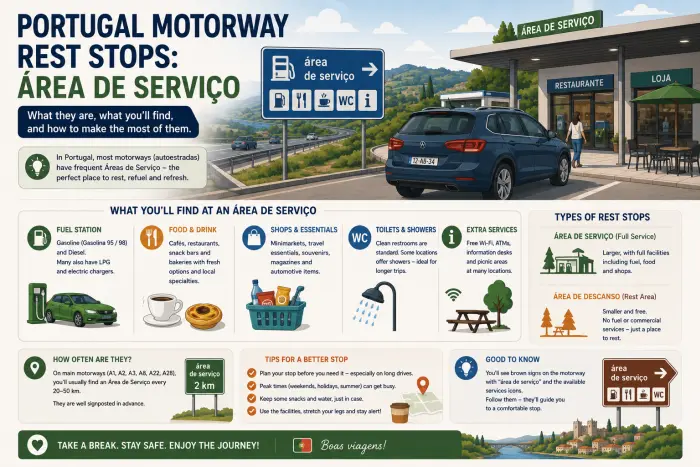
- Full-service stops (área de serviço) typically appear roughly every 40 km on major motorways and include fuel, a restaurant or café, a convenience shop, and restrooms
- Smaller rest areas (área de repouso) offer just parking and basic toilets, with no fuel or food
- Most full-service stops operate 24 hours a day, which matters if you’re driving early morning or late at night
- Fuel prices at motorway stations tend to run somewhat higher than in nearby towns, a fairly standard European pattern
- EV charging is increasingly available at larger service areas, though coverage still varies by route and operator
- Brisa, Portugal’s main motorway operator, runs the largest network of service areas, spaced at intervals of roughly 40 km across its routes
Área de Serviço vs. Área de Repouso: Know the Difference
This distinction is worth understanding before you’re relying on a specific stop for a real break. An área de serviço is the full package: fuel pumps, a restaurant or café area, a small shop for snacks and essentials, and proper restrooms, generally open around the clock. An área de repouso, sometimes just marked as a parking or rest area, is a much more basic pull-off with parking and toilets, intended for a quick stretch or a short rest rather than a full stop. If you’re planning your fuel or food stops around specific exits, it’s worth confirming which type you’re actually aiming for, since GPS apps don’t always distinguish clearly between the two, and arriving at a bare rest area expecting a restaurant can be a frustrating surprise on a long drive.
| Type | What’s Available | Best Used For |
|---|---|---|
| Área de Serviço (full service) | Fuel, restaurant/café, convenience shop, restrooms, often EV charging | Meal breaks, refueling, longer stops |
| Área de Repouso (rest area) | Parking and basic restrooms only | Short breaks, stretching your legs, quick rest |
How Often You’ll Actually Find One
On Brisa’s network, which covers a large share of Portugal’s major motorways, service areas are spaced at roughly 40 km intervals, which generally works out to a comfortable break every 25-30 minutes of driving. On a route like the A2 from Lisbon toward the Algarve, real named stops like Palmela, not far south of Lisbon, and Alcácer do Sal further along offer proper restaurants and reasonably priced fuel, making them sensible points to plan around rather than stopping the moment your tank looks low.
What the Food Situation Actually Looks Like
Don’t expect fine dining, but Portuguese motorway service areas generally do better than their reputation in some other countries. Most larger stops have a proper cafeteria-style restaurant serving hot meals alongside the usual pastries and coffee, and it’s a genuinely reasonable option for a real lunch break on a long drive rather than just a vending machine snack. Smaller convenience shops stock basic groceries, drinks, and road-trip essentials, which is useful if you realize halfway through your trip that you’re missing something simple, whether that’s sunscreen, phone chargers, or snacks for kids in the back seat.
Fuel Prices: Worth Knowing Before You Fill Up
Fuel at motorway service stations typically costs a bit more than what you’d pay at a station in a nearby town, which is a pattern that holds across most of Europe, not something specific to Portugal. If your route allows it and you’re not in a rush, filling up just before or after leaving the motorway, rather than at the service area itself, can save a small amount over a longer trip. It’s worth reading up on realistic rental car fuel costs in Portugal generally if you’re budgeting for a longer road trip.
EV Charging at Motorway Stops
If you’re driving an electric rental car, charging infrastructure at motorway service areas has expanded meaningfully in recent years, though it’s still not uniform across every stop on every route. Larger, more heavily trafficked service areas are considerably more likely to have working chargers than smaller ones, and it’s worth cross-checking your planned route against a current EV charging network overview for Portugal road trips before setting off, rather than assuming every stop will have what you need.
Toll Roads and Why Most Stops Sit Inside the Tolled Network
Nearly all of Portugal’s major motorway service areas sit within the tolled highway network, which means your rental car’s Via Verde transponder handles the road charges automatically as you pass through, separate entirely from anything you spend at the service area itself. Worth keeping in mind so you’re not confusing a toll charge on your statement with anything related to fuel or food purchases.
Planning Stops for a Longer Road Trip
If you’re mapping out a longer drive, like Lisbon to the Algarve or any of the more popular day trips from Lisbon by rental car, it’s worth identifying one or two specific service areas along your route in advance rather than just stopping wherever looks convenient in the moment. This matters especially with kids or on a tight schedule, where knowing you’ll hit a proper stop with real food and clean bathrooms at a predictable point removes a lot of uncertainty from the drive.
💸 Don’t Overpay at the Airport
Compare real-time rental deals with no hidden fees or credit card needed.
Late-Night and Early-Morning Stops
If your trip has you on the road outside normal daytime hours, either arriving on a late flight or setting off early to beat traffic, it’s worth knowing that larger área de serviço stops generally stay open 24 hours, while some of the food and shop counters at smaller ones may have reduced hours overnight even if the fuel pumps themselves stay accessible. It’s also worth reading our broader tips on night driving in Portugal if a significant part of your route falls after dark.
Staying on Route With Reliable Navigation
Rural stretches between service areas sometimes have patchy cell coverage, which matters if you’re relying on your phone to find the next stop or check opening hours. Setting up reliable mobile data for GPS use in Portugal before a longer road trip removes one more variable, particularly if your route includes any less-traveled sections between major cities.
Practical Checklist for Motorway Stops in Portugal
- ✅ Know the difference between a full área de serviço and a basic área de repouso before relying on a specific exit for fuel or food
- ✅ Plan one or two specific full-service stops in advance on longer routes, rather than deciding in the moment
- ✅ Expect fuel to cost slightly more at motorway stations than in nearby towns
- ✅ Check EV charging availability along your specific route in advance if you’re driving an electric rental
- ✅ Confirm your rental car has a working Via Verde transponder, since most service areas sit inside the tolled network
- ✅ Assume 24-hour fuel access at larger stops, but check ahead if you need food or shop access very late at night
Frequently Asked Questions
How often are there rest stops on Portugal’s motorways? Roughly every 40 km on major routes operated by Brisa, Portugal’s main motorway operator, which generally works out to a comfortable break every 25-30 minutes of driving.
What’s the difference between an área de serviço and an área de repouso? An área de serviço is a full-service stop with fuel, a restaurant or café, a shop, and restrooms. An área de repouso is a more basic rest area with just parking and toilets, no fuel or food.
Are Portuguese motorway service areas open 24 hours? Larger, full-service stops generally are, though food and shop counters at smaller locations may have reduced hours overnight even if fuel pumps remain accessible.
Is fuel more expensive at motorway service areas than in towns? Generally yes, by a modest margin, which is a common pattern across most of Europe rather than something specific to Portugal.
Can I find EV charging at Portuguese motorway rest stops? Increasingly, yes, especially at larger and more heavily trafficked service areas, though coverage still varies by route, so it’s worth checking your specific journey in advance.
Is the food at Portuguese motorway service areas actually decent? Most larger stops have a proper cafeteria-style restaurant with hot meals, which tends to be a genuinely reasonable option for a real lunch break rather than just vending-machine snacks.
Do I need cash at motorway service areas, or do they take cards? Cards are widely accepted at fuel pumps, restaurants, and shops at full-service stops, though it’s still sensible to carry some cash as a backup for smaller purchases.
Should I plan my fuel stops around specific service areas on a long drive? It’s a good habit, especially on longer routes, since it removes the uncertainty of searching for a suitable stop when your tank is already getting low.