Realizing partway through filling up that the nozzle in your hand doesn’t match your rental car’s actual fuel type triggers an immediate wave of panic, especially in an unfamiliar country far from home and with an unfamiliar vehicle you’re still getting used to. It’s a genuinely common mistake, particularly for travelers unfamiliar with diesel vehicles or switching between vehicle types across trips, and it’s also a well-understood, entirely manageable problem with a clear correct response, not a disaster that ends your trip.
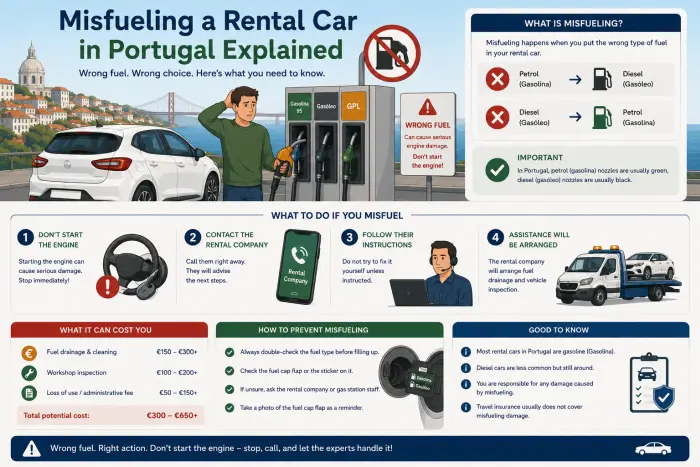
Quick verdict: the single most important rule is don’t start the engine if you realize the mistake before driving. If you haven’t started the car, the fix is straightforward and relatively inexpensive, draining the tank before any fuel reaches the engine. If you’ve already driven even a short distance, the situation is more serious and requires professional help immediately rather than continuing to drive.
The Critical Difference: Before vs After Starting the Engine
This distinction determines almost everything about how serious your situation actually is, so it’s worth understanding immediately rather than panicking about the mistake itself in the moment. If you catch the error at the pump, before turning the key or pressing start, the wrong fuel is sitting in the tank but hasn’t reached the engine at all, making this a straightforward, if slightly expensive, fix that most stations and rental companies handle routinely. If you’ve already started the engine, and especially if you’ve driven any distance, the wrong fuel has circulated through the fuel system, creating a genuinely more serious mechanical problem requiring professional intervention rather than a simple tank drain.
What to Do If You Catch It Before Starting the Engine
| Step | Action |
|---|---|
| Don’t start the car | Even briefly, since this is what prevents the wrong fuel from reaching the engine |
| Move the vehicle away from the pump if needed | Ask the station for help pushing it, rather than starting the engine to move it yourself |
| Call your rental company’s roadside assistance | The same number used for a breakdown, since this is a recognized scenario they handle |
| Arrange a tank drain | A professional service removes the incorrect fuel before you attempt to start the car |
What to Do If You’ve Already Started or Driven the Car
This is a more serious situation requiring immediate action rather than continuing to drive to your next destination hoping the problem resolves itself. Stop the vehicle as soon as it’s safe to do so and turn off the engine immediately, then call your rental company’s roadside assistance line right away rather than attempting to drive further, even a short distance, since continued driving circulates the wrong fuel further through the system and can cause meaningfully more expensive damage than stopping immediately would.
Why Diesel-Into-Petrol and Petrol-Into-Diesel Differ
The mechanical severity isn’t identical in both directions, worth understanding if you’re trying to gauge how serious your specific situation is. Putting petrol into a diesel engine is generally considered the more damaging combination, since diesel engines rely on fuel as a lubricant for internal components in a way petrol engines don’t, making contamination potentially more costly to fully resolve. Putting diesel into a petrol engine, while still a genuine problem requiring the same don’t-start-the-engine response, is sometimes considered slightly less immediately damaging, though neither scenario is something to treat casually or attempt to resolve yourself.
Who Pays for the Recovery Process
This is worth understanding honestly rather than hoping the rental company absorbs the cost. Misfueling is considered driver error under virtually all standard rental terms, meaning the cost of the tank drain, and any more serious engine work if you drove before realizing the mistake, is generally your responsibility rather than covered under standard damage waiver or excess coverage. Some third-party excess insurance policies may cover this scenario specifically, worth checking your own policy’s terms if you have one, though standard rental company coverage typically excludes it as a driver-caused issue rather than genuine mechanical failure or collision damage.
Preventing This in the First Place
A simple habit worth building at every single fill-up, not just the first one: check the fuel cap or the vehicle’s own documentation for the correct fuel type before selecting the pump, every time, even if you’re confident you remember from an earlier fill-up during the same trip. This is particularly worth emphasizing if you’re driving a diesel vehicle for the first time, covered in more depth in our guide on diesel versus petrol rental cars in Portugal, since diesel vehicles are less common in some travelers’ home countries, making the mistake more likely for someone unfamiliar with which pump to use by habit.
Self-Service Stations Make This More Likely, Not Less
It’s worth being specifically alert at self-service petrol stations, which are the norm at most Portuguese stations, since there’s no attendant present to catch an obvious mistake the way there might be at a full-service station in some other countries. This isn’t a reason to avoid self-service stations, since they’re standard practice throughout Portugal, but it does mean the responsibility for checking the correct fuel type rests entirely with you as the driver, without a second set of eyes to flag an error before it happens.
💸 Don’t Overpay at the Airport
Compare real-time rental deals with no hidden fees or credit card needed.
Documenting the Situation If It Happens
If you do realize the mistake, whether before or after starting the engine, it’s worth taking a photo of the pump you used and the fuel type it dispensed, similar to the documentation habit worth building for any unexpected vehicle incident. Our guide on avoiding a rental car damage dispute in Lisbon covers this broader principle, useful here specifically since clear documentation of exactly what happened supports a smoother resolution process with your rental company rather than relying purely on your own account after the fact.
Does This Affect Your Trip Itinerary?
Realistically, yes, similar to the disruption covered in our guide on what happens if a rental car breaks down in Portugal, since a tank drain or more serious repair takes real time, sometimes a few hours, occasionally longer if a replacement vehicle needs to be sourced. Building flexibility into tightly scheduled plans, the same general precaution worth taking against any unexpected vehicle issue, applies here as much as it does to a genuine mechanical breakdown.
Staying Calm While You Wait for Help
It’s worth acknowledging that the wait for roadside assistance after a misfueling mistake can feel considerably longer than it actually is, given the stress and self-recrimination that often accompanies the situation. Using this time productively, confirming your exact location for the assistance team, reviewing your rental agreement for the specific roadside contact number if you haven’t already saved it, and simply accepting that this is a recoverable situation rather than catastrophizing about cost or lost time, makes the actual wait considerably more manageable than treating it as an emergency requiring constant anxious monitoring.
📋 Wrong Fuel Checklist for a Portugal Rental Car
- Never start the engine if you realize the mistake before turning the key
- Call your rental company’s roadside assistance immediately, the same number used for a breakdown
- If you’ve already driven, stop immediately rather than continuing to your next destination
- Expect the recovery cost to fall on you under standard rental terms, since this is treated as driver error
- Build the habit of checking fuel type at every single fill-up, not just the first one of your trip
❓ Frequently Asked Questions
What’s the most important thing to do if I realize I’ve put the wrong fuel in a rental car? Don’t start the engine. This single action prevents the wrong fuel from reaching the engine and keeps the fix relatively simple and inexpensive.
What should I do if I’ve already driven with the wrong fuel in the tank? Stop the vehicle immediately and call your rental company’s roadside assistance rather than continuing to drive, since further driving circulates the wrong fuel and can cause more expensive damage.
Who pays for fixing a misfueling mistake in a rental car? Generally you, since it’s treated as driver error under standard rental terms rather than covered by typical damage waiver or excess coverage.
Is putting petrol in a diesel engine worse than putting diesel in a petrol engine? Generally considered more damaging, since diesel engines rely on fuel as a lubricant for internal components in a way petrol engines don’t, though neither situation should be treated casually.
Are self-service petrol stations more likely to cause this mistake? Somewhat, since there’s no attendant to catch an obvious error the way there might be elsewhere, placing the responsibility for checking fuel type entirely on the driver at Portugal’s predominantly self-service stations.
Should I document a misfueling mistake the same way I would document damage? Yes, worth photographing the pump and fuel type used, since clear documentation supports a smoother resolution process with your rental company rather than relying solely on your own account afterward.
To compare suppliers generally known for responsive roadside support, our best car rental companies at Lisbon Airport roundup is a useful starting point.