Portuguese road signs follow the same broad Vienna Convention framework used across most of Europe, which means the shapes and colors carry consistent meaning even before you can read the Portuguese text underneath any specific sign. Learning this shape-and-color system, rather than trying to memorize individual words one by one, is the fastest way to drive confidently without needing fluent Portuguese from the very first mile.
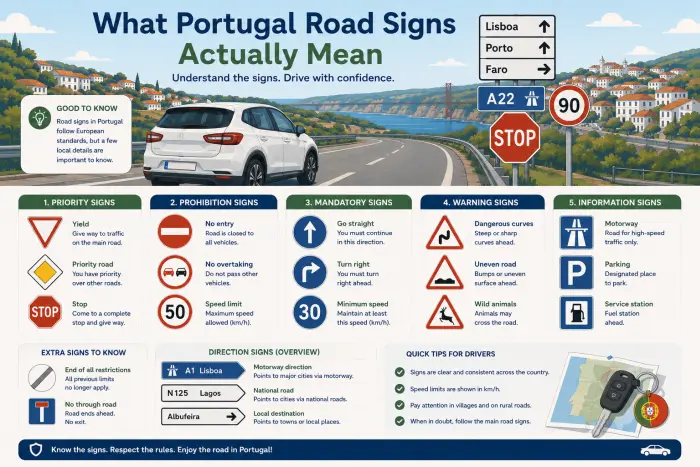
The one rule: shape and color tell you the category before you even read the words. Red triangles warn you of a hazard ahead. Red circles mean something is prohibited or restricted. Blue circles mean an action is mandatory. Learning to recognize these three categories at a glance covers the vast majority of signs you’ll actually encounter.
The Shape-and-Color System at a Glance
| Shape and Color | Meaning | Example |
|---|---|---|
| Red-bordered triangle | Warning of a hazard ahead | Sharp bend, pedestrian crossing, animals on road |
| Red-bordered circle | Prohibition or legal restriction | Speed limit, no entry, no overtaking |
| Blue circle | Mandatory instruction | Required turn direction, minimum speed |
| Red octagon | Stop, always | “PARE” |
| Downward red triangle, no text | Yield / give way | No wording, just the shape itself |
| Yellow diamond | Priority road begins | Same shape with black line = priority ends |
Key Words Worth Recognizing
Beyond shape and color alone, a handful of Portuguese words appear frequently enough on signage that recognizing them speeds up your reaction time, even though the shape system alone would eventually get you to the right conclusion.
| Portuguese | English Meaning |
|---|---|
| Perigo | Danger |
| Obras | Roadworks |
| Desvio | Diversion / detour |
| Sentido único | One-way street |
| Portagem / Pedágio | Toll |
| Saída | Exit |
| Auto-estrada (AE) | Motorway |
| Estacionamento | Parking |
| Devagar | Slow |
Why the Yield Sign Has No Text
This is a small but genuinely useful detail worth knowing in advance, since it can otherwise cause a moment of hesitation the first time you see it. Portugal’s give-way sign is simply a downward-pointing red triangle with nothing written on it, relying entirely on the shape convention rather than any word, unlike some countries where a yield sign includes explicit text. Recognizing this shape specifically, separate from the standard upward-pointing warning triangle, avoids a confused pause at an intersection wondering whether you’re looking at a general hazard warning or a specific yield instruction.
No Entry, No Parking, and No Stopping: Telling Them Apart
These three prohibition signs look similar at a glance but mean genuinely different things, worth distinguishing clearly rather than assuming they’re interchangeable at a quick glance from behind the wheel. No entry is a plain white circle with a red ring and a horizontal white bar across it, meaning don’t enter this road or area at all under any circumstance. No parking uses a single diagonal red line across a circle, meaning you can stop briefly but not leave the vehicle unattended for any extended period. No stopping uses two crossing diagonal lines, a stricter restriction meaning you can’t even pause briefly, not just avoid parking long-term in that specific zone. Confusing these three, particularly no parking versus no stopping, is a common and avoidable mistake worth taking a moment to get right before it costs you a fine.
Motorway Signage Colors: What Green, Blue, and White Mean
Directional signage color isn’t random in Portugal, and recognizing the pattern helps you anticipate what kind of road you’re being directed toward before you even reach it. Green backgrounds indicate motorways and main national routes. Blue backgrounds indicate urban expressways specifically. White backgrounds indicate secondary, more local roads. This color coding is worth watching for specifically when you’re navigating a complex junction with multiple route options, since it tells you at a glance which sign corresponds to the faster main route versus a slower secondary alternative.
Roundabout Arrows: A Detail Worth Noticing
Since Portugal drives on the right, roundabout direction arrows on signage point counter-clockwise, the opposite of what a driver from a left-hand-drive convention might instinctively expect if they’re used to a different system. Our guide on Portuguese roundabout rules for tourists covers the actual right-of-way mechanics of navigating a roundabout itself in more depth, useful to read alongside this glossary entry specifically about how the directional signage represents that flow.
Rural-Specific Signs Worth Knowing
Beyond the standard European sign set, certain warnings show up more specifically on rural Portuguese roads than you might expect from city-based driving alone, most notably a warning for livestock or cattle crossing in agricultural areas. Seeing this kind of sign is worth taking as a genuine cue to slow down and stay alert, rather than a formality, particularly relevant to the wildlife and rural-road caution covered in our guide on night driving in Portugal, where reduced visibility compounds the same underlying hazard these signs are warning about.
Road Markings: The Signs Painted on the Road Itself
Signage isn’t the only visual language worth understanding; the painted lines on the road carry their own meaning. A solid white line means no crossing, marking a lane boundary you shouldn’t cross to overtake. A broken white line permits crossing when it’s safe, the standard marking for a normal overtaking opportunity. Solid yellow generally indicates no stopping or parking along that stretch, while broken yellow allows a brief stop but not extended parking. Blue markings typically indicate a regulated, paid parking zone, worth connecting to our guide on Lisbon parking apps if you encounter this specific marking and need to actually pay for the space.
💸 Don’t Overpay at the Airport
Compare real-time rental deals with no hidden fees or credit card needed.
Temporary and Construction Zone Signage
Worth expecting specifically on longer road trips: temporary signage around roadworks or construction zones follows its own distinct visual convention, typically yellow-backgrounded rather than the standard white or colored backgrounds used for permanent signage, signaling that the instruction is temporary rather than a fixed permanent rule for that stretch of road. These zones often come with reduced speed limits and altered lane configurations that override the normal permanent signage for that specific section, worth watching for actively rather than assuming your GPS’s stored route information reflects any very recent, temporary changes.
Documenting Confusing or Unclear Signage
If a specific sign’s meaning genuinely isn’t clear in the moment, whether due to weathering, an unfamiliar symbol, or simply driving past too quickly to process it fully, it’s worth treating this the same cautious way you’d treat any ambiguous driving situation: slow down rather than guess, and if relevant to a later dispute, footage from a dash cam can help clarify after the fact exactly what a specific sign said if it becomes relevant to a fine or an incident review.
Distance and Speed Numerals: A Small Reading Tip
Numbers on Portuguese signs follow standard European conventions, kilometers rather than miles for distance, and kilometers per hour for speed, worth confirming explicitly if you’re used to a mile-based system at home, since misreading a speed limit number by assuming a different unit is an easy and entirely avoidable mistake. A speed limit sign showing “50” means 50 kilometers per hour, not miles per hour, a distinction that matters considerably given how different the actual safe driving speed is between the two units for the same displayed number.
📋 Road Sign Recognition Checklist for Portugal
- Learn the shape-and-color system first: red triangle warns, red circle prohibits, blue circle instructs
- Recognize the textless downward triangle as the yield sign specifically
- Distinguish no parking (single diagonal line) from no stopping (two crossing lines)
- Watch for green, blue, and white signage colors to anticipate motorway versus secondary road options
- Take rural livestock warning signs as a genuine cue to slow down, not a formality
❓ Frequently Asked Questions
Do I need to read Portuguese to understand road signs in Portugal? Not for the majority of signs, since shape and color convey the core meaning consistently, following the same Vienna Convention framework used across most of Europe.
What does a red circle sign mean in Portugal? A prohibition or legal restriction, such as a speed limit or no-entry zone, distinct from a red triangle, which is a warning rather than a strict prohibition.
Does the Portuguese yield sign have any text on it? No, it’s simply a downward-pointing red triangle with no wording, distinct from the standard upward-pointing warning triangle used for general hazards.
What’s the difference between no parking and no stopping signs in Portugal? No parking uses a single diagonal line and allows a brief stop; no stopping uses two crossing diagonal lines and prohibits even a brief pause.
Do temporary construction zone signs look different from permanent signage in Portugal? Yes, typically yellow-backgrounded rather than the standard permanent colors, signaling that the rule is temporary and often overriding the normal signage for that stretch.
Is it worth having a dash cam to help clarify confusing road signage later? It can help, particularly if a specific sign’s meaning becomes relevant to a fine or incident review, since footage can clarify exactly what was posted at the time.
For the general road rules these signs enforce, see our driving rules in Portugal guide.