A dash cam sits in an unusual category of travel gear: genuinely useful in a small number of specific scenarios, largely irrelevant the rest of the time, and not something most short-term visitors think to bring or rent until after an incident makes them wish they’d had one. Whether it’s worth the extra step for your Portugal trip depends heavily on your specific driving plans and personal risk tolerance rather than being a universal yes or no answer.
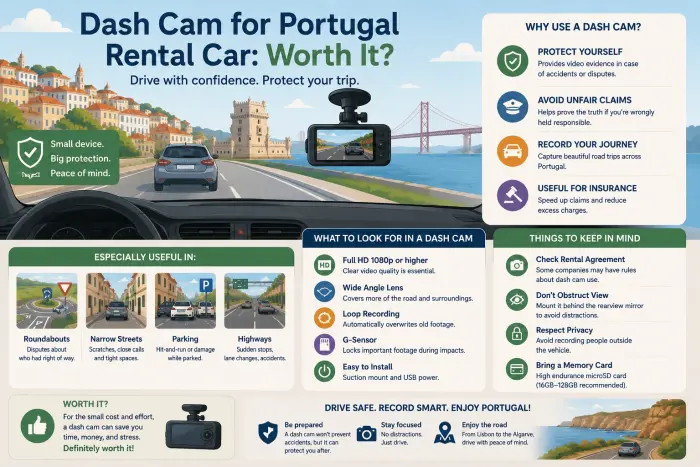
Quick answer: for a short city-based stay with minimal driving, a dash cam is probably unnecessary hassle. For a longer road trip involving unfamiliar roundabouts, rural roads, or simply a strong preference for objective evidence if something goes wrong, a compact, easy-to-set-up dash cam is a genuinely reasonable addition worth the modest cost and setup time.
What a Dash Cam Actually Solves
The core value is objective, timestamped evidence in exactly the situations where a dispute otherwise comes down to two conflicting accounts: a collision at a roundabout where right-of-way is contested, a scrape from another vehicle in a parking area, or a claim that damage occurred during your rental when you believe it was pre-existing before you ever took the wheel. Our guide on avoiding a rental car damage dispute in Lisbon covers the pickup and return documentation habit that addresses the pre-existing damage scenario specifically; a dash cam adds a different, continuous layer of protection covering what happens while you’re actually driving, which a pickup photo walkaround doesn’t capture at all.
Bring Your Own vs Rent One Locally
| Option | Trade-Offs |
|---|---|
| Bring your own from home | No language barrier for setup, familiar interface, but adds packing bulk and a device to manage |
| Rent a dash cam locally | No need to pack or own one, but availability and rental terms vary by supplier and aren’t universal |
| Use a smartphone mount with recording app | No extra device needed, but battery drain and phone availability for navigation simultaneously are real trade-offs |
| Skip it entirely | Simplest option, relies fully on post-incident documentation and any other driver’s own account |
The Smartphone Alternative
For many travellers, a smartphone mounted on the dashboard running a dedicated recording app is a reasonable middle ground between bringing a dedicated device and going without any recording at all. This avoids adding a new piece of gear to manage, but it does compete with your phone’s battery life and its use for navigation simultaneously, which matters if you’re relying on the same phone for turn-by-turn directions through unfamiliar roads. If you go this route, a car charger and a mount sturdy enough for actual driving, not just a light glovebox holder, are worth having alongside the recording app itself.
Legality and Privacy Considerations
Dash cams are broadly used and permitted across the EU, including Portugal, though privacy considerations around recording other people and vehicles exist in most European jurisdictions and are worth being generally aware of rather than dismissed entirely. If you’re genuinely concerned about the specifics for your situation, checking current guidance directly rather than relying on general assumptions carried over from a different country’s rules is the safer approach, since privacy and recording regulations can differ meaningfully between countries even within the EU.
What to Do With Footage After an Incident
If a dash cam does capture something relevant, having a clear plan for what to do with that footage matters as much as having captured it in the first place. Save the relevant clip immediately rather than letting the device overwrite it in a continuous-loop recording cycle, which many dash cams use by default to manage storage. Note the exact time and location, and if the incident involves the rental car itself, treat the footage the same way you would other pickup and return documentation, kept accessible and ready to share if a dispute arises rather than left buried on the device until you’re home.
Does a Dash Cam Help With a Parking Dispute Too?
Somewhat, though its usefulness is more limited for parking incidents than for moving collisions, since a stationary dash cam typically only records what’s happening while actively powered, which for most consumer models means while the car is running rather than continuously while parked. Some higher-end models offer a parking mode that records on motion detection even while the engine is off, worth checking specifically if this scenario concerns you, since it’s not a universal feature across all dash cam price points.
When It Genuinely Matters Most
The clearest case for a dash cam is a longer road trip covering unfamiliar roads, roundabouts, and rural driving where an incident, even a minor one, is more likely simply due to more total driving exposure and less familiar conditions than a short city stay. Our guide on Portuguese roundabout rules for tourists covers a specific scenario where dash cam footage is particularly valuable, since roundabout incidents frequently come down to a dispute over which vehicle actually had priority at the moment of contact.
💸 Don’t Overpay at the Airport
Compare real-time rental deals with no hidden fees or credit card needed.
When It’s Probably Not Worth the Hassle
For a trip confined mainly to Lisbon itself, relying primarily on Uber, walking, or public transport with only occasional or no self-driving, a dash cam is genuinely unnecessary extra gear to manage for the amount of actual driving exposure involved. The setup time, whether packing your own device or arranging a local rental, isn’t worth it if your actual driving is minimal, and the standard pickup and return documentation habit covers the more common dispute scenario for a light-driving trip anyway.
Cost and Setup Time Worth Weighing
A basic dash cam, whether purchased for the trip or a budget model already owned, is a modest cost relative to the potential value of clear evidence in a genuine dispute, and setup for a simple suction-mount model typically takes only a few minutes at pickup. Renting one locally, where available, adds a daily fee on top of your rental car cost, worth comparing against simply bringing an inexpensive model from home if you already own one or are willing to buy one before the trip specifically for this purpose.
Mounting and Video Quality Considerations
If you do decide to bring a dash cam, a few practical details are worth getting right before you’re on the road. A suction or adhesive mount rated for actual driving vibration, rather than a lightweight clip meant for stationary display, keeps the device stable enough to capture usable footage rather than a shaky, unreliable recording. Resolution matters less than most people assume for the practical purpose of settling a dispute, since even a modest 1080p recording is generally clear enough to establish the basic sequence of events, vehicle positions, and timing that actually matters in a claim, rather than needing the highest-resolution model available. Positioning the camera to capture a clear forward view without significant windshield glare or an obstructed angle from your specific vehicle’s dashboard shape is worth a quick check immediately after mounting, before you actually start driving, rather than discovering a positioning problem only after an incident when it’s too late to fix.
📋 Dash Cam Checklist for Portugal Car Rental
- Weigh your actual driving exposure, a long road trip carries more value from a dash cam than a light city-based stay
- Decide between bringing your own, renting locally if available, or using a smartphone mount with a recording app
- If using your phone, ensure a car charger and sturdy mount, since it will compete with navigation use
- Check current privacy and recording guidance if you have specific concerns, rather than assuming rules match your home country
- Combine dash cam footage with the standard pickup and return documentation habit rather than relying on either alone
❓ Frequently Asked Questions
Is a dash cam legal to use in a rental car in Portugal? Dash cams are broadly used and permitted across the EU including Portugal, though general privacy considerations around recording apply, similar to most European countries.
Is it better to bring my own dash cam or use my smartphone instead? Both are reasonable. A dedicated dash cam avoids competing with your phone’s battery and navigation use, while a smartphone mount avoids packing extra gear if you’re comfortable with the trade-off.
Do I need a dash cam for a short, mostly city-based Lisbon trip? Generally not. For minimal driving exposure, standard pickup and return documentation covers the more common dispute scenario without the extra gear and setup.
Can I rent a dash cam locally in Portugal instead of bringing one? Some suppliers may offer this, but availability isn’t universal, so it’s worth checking directly with your specific rental company rather than assuming it’s a standard add-on everywhere.
What should I do with dash cam footage if it captures an incident? Save the relevant clip immediately before it’s overwritten by continuous-loop recording, note the time and location, and keep it accessible the same way you would other pickup and return documentation.
Does a dash cam protect against parking-related disputes too? Only partially. Most consumer models only record while the car is running, so a parking incident may not be captured unless the specific device includes a motion-triggered parking mode.
To compare general supplier options once you’ve settled on your gear plan, our best car rental companies at Lisbon Airport roundup is a useful starting point.