There’s a specific kind of dread that sets in when you’re already committed to the ramp down into an underground garage, ticket in hand, ramp behind you, and the concrete beam ahead suddenly looks lower than it did from the street. For most rental cars, this moment never happens. For someone who upgraded to an SUV “for the extra space,” it happens more often than you’d expect — and by the time it does, reversing back up a one-way ramp with cars already queued behind you is not a great place to be having the realization, especially in a car you’ve only been driving for a few hours.
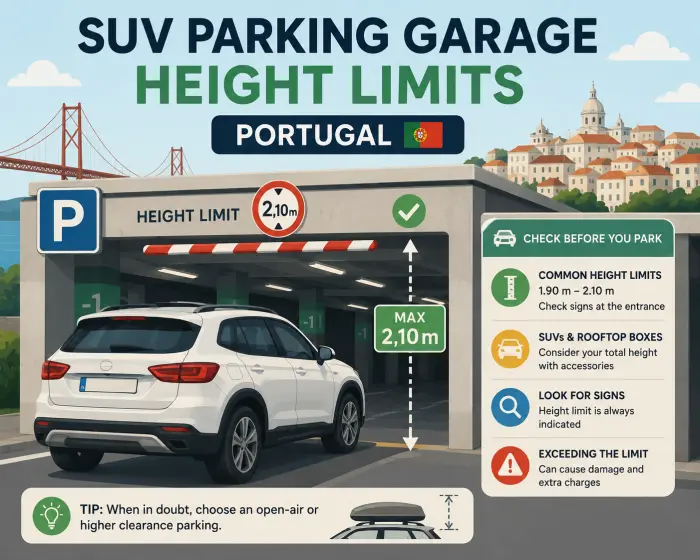
Lisbon and Porto’s older underground garages, particularly the ones built decades ago beneath city squares and shopping streets, were designed around the compact cars common in Portugal at the time — not the taller SUVs and family-size crossovers that now make up a large share of rental fleets. A height limit that never mattered to a Fiat 500 or a VW Polo becomes a real, physical constraint the moment you’re driving something built on a taller platform.
| Typical clearance | Vehicles it affects |
|---|---|
| ~1.9–2.0 meters | Most compact SUVs, sit right at or just under the limit |
| ~2.0–2.1 meters and up | Larger SUVs, minivans, roof-box equipped cars |
| Roof racks or cargo boxes | Add real height that’s easy to forget about mid-drive |
A quirk of older European cities, not a design flaw
It’s worth understanding why this happens rather than treating it as bad planning on the garage’s part. Lisbon and Porto’s historic centers were built centuries before cars existed at all, let alone underground parking, and the garages that eventually got built beneath their squares and streets were squeezed into whatever space was already there rather than designed from scratch around modern vehicle dimensions. Newer garages, particularly ones attached to shopping centers or built in the last couple of decades, tend to have considerably more generous clearance, closer to what you’d expect from a standard multi-story car park anywhere else in Europe today.
This means the risk isn’t evenly distributed across the whole city — it concentrates specifically in the older, more central garages that also happen to be the most convenient ones for a visitor wanting to park near the historic sights they came to see in the first place. The garages a tourist is most likely to want to use are, in a fair number of cases, exactly the ones built with the tightest tolerances.
Why this catches people off guard specifically in a rental
If you own an SUV at home, you already know its exact height and have probably long since internalized which garages you can and can’t use. A rental car resets that knowledge to zero. Few travelers check their specific rental’s listed height before driving into an unfamiliar garage, and fewer still notice the small height-limit sign mounted above the entrance — usually in centimeters, sometimes partially obscured, and easy to miss while focused on merging into a narrow ramp with traffic behind you and a queue of impatient locals who know exactly where they’re going.
Roof racks make this worse in a way that’s easy to forget mid-trip. A car that cleared a 2.0-meter garage on day one of the trip might not clear the same garage on day five, once a roof box or bike rack has been added for a specific leg of the journey — the vehicle itself hasn’t changed, but its effective height has, and it’s an easy detail to lose track of once it’s no longer top of mind during the busy middle stretch of a trip. A surfboard rack heading toward the coast, added specifically for that stretch of the trip, is exactly the kind of addition that quietly changes the math on a garage that worked fine earlier in the same rental.
What actually happens if you don’t fit
Some garages have a physical barrier at the entrance calibrated to the stated limit, which stops you before any contact happens — inconvenient, but harmless. Others rely only on a posted sign with no physical enforcement, which means the only thing preventing a scrape is the driver noticing and believing the number on the sign applies to their specific vehicle and its current configuration. A concrete beam doesn’t negotiate, and a rental SUV that clips one on the way in typically means real damage to the roof rails, a roof-mounted accessory, or the header panel above the windshield — exactly the kind of damage that becomes an expensive dispute at return, and worth documenting immediately the way our guide to preventing a damage dispute recommends if it does happen despite your best efforts.
Narrow entrance ramps compound the problem even for vehicles that do fit height-wise. Several of the older garages built beneath historic squares have entrance and exit lanes sized for a much narrower car than a modern SUV, with tight turns partway down the ramp that require careful, slow maneuvering rather than the confident drive-in most drivers expect from a parking garage. Mirrors folded in, a slow crawl rather than a normal driving speed, and a willingness to stop and reassess mid-ramp if something feels tighter than expected all matter more here than they would in a newer, wider facility.
💸 Don’t Overpay at the Airport
Compare real-time rental deals with no hidden fees or credit card needed.
Checking before you commit to the ramp
The practical fix is almost embarrassingly simple: know your specific rental’s height before you need it, and look for the posted limit sign before committing to any unfamiliar underground entrance. Your rental agreement or the manufacturer’s own specification sheet, easily searched by the exact model and trim, gives you an accurate number — round up rather than down if you’re not certain, and treat anything within 10 centimeters of a posted limit as a real risk rather than a safe margin, since exact clearances vary slightly by trim level and any accessories the specific vehicle carries.
If you’re driving something larger for a Portugal trip specifically because of a group size or luggage need, it’s worth building the habit of choosing surface-level or open-air parking over underground options by default, reserving the search for a specific underground garage only when you’ve confirmed the clearance in advance — our broader Lisbon parking guide covers the surface and street options that sidestep this issue entirely and are usually just as convenient for a short visit. Many hotels in Lisbon and Porto that advertise parking are working with exactly these older underground structures, so it’s a reasonable question to ask directly when booking accommodation for an SUV-based trip — a hotel used to fielding this question can usually tell you immediately whether their own garage or a nearby alternative handles taller vehicles, and it’s worth choosing a base with that confirmed in advance rather than discovering the mismatch on arrival with luggage already loaded.
Frequently asked questions
How do I find out my rental SUV’s exact height? Check your rental agreement, or search the specific model and trim’s manufacturer specification sheet — round up rather than down if you’re uncertain, since a small margin of error genuinely matters here.
Are height limits enforced with a physical barrier, or just a warning sign? It varies by garage. Some have a physical bar calibrated to the limit; others rely only on a posted sign, which means the driver is the only real safeguard against a collision with the structure above.
Does a roof rack or roof box count toward the height limit? Yes, and it’s easy to forget once it’s been on the car for a few days — always account for anything mounted on the roof when checking clearance, not just the vehicle’s base height as listed by the manufacturer.
Which Portuguese cities have the most restrictive underground garages? Older garages in central Lisbon and Porto, particularly ones built beneath historic squares decades ago, tend to have the tightest height and width limits, since they predate the modern SUV and were squeezed into whatever space centuries-old streets allowed.
What should I do if I realize my car won’t fit after I’ve already started down the ramp? Stop as soon as it’s safe, and reverse back out carefully rather than continuing — most garages expect this occasionally and the entrance area is usually wide enough to reverse, though it helps to alert anyone queued behind you before you start backing up.
Is it safer to just avoid underground parking entirely with a rental SUV? Not necessary, but it’s worth confirming clearance before committing to any garage you haven’t used before, rather than assuming a “standard” underground garage will accommodate a taller vehicle by default without checking first.
Do hotels with on-site parking usually have this same height restriction? Many do, especially older properties in city centers working with the same aging underground infrastructure — worth asking directly when booking if you’re renting something larger than a standard compact car for your Portugal trip.