Most Portugal rental car trips go smoothly, which is exactly why it’s worth knowing the right move in advance for the ones that don’t — a breakdown on the motorway calls for a completely different response than being handed a different car than you booked, and neither has anything to do with the process for a genuine dispute over a charge. Treating every problem the same way, or defaulting to whichever response feels most natural in the moment, tends to make each of these situations take longer to resolve than necessary.
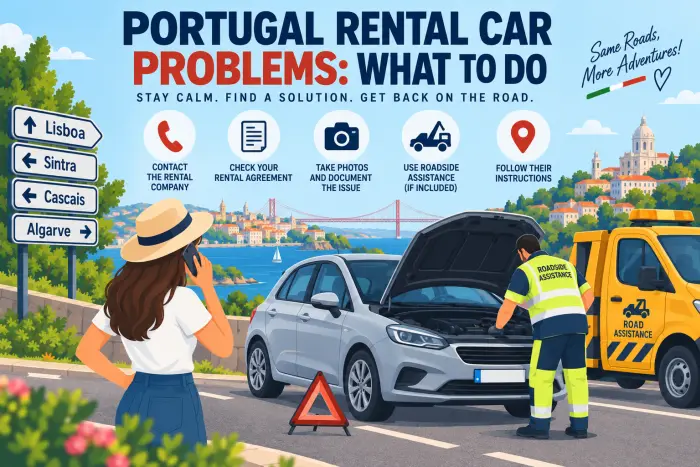
Which path fits which problem
| Problem | What actually helps |
|---|---|
| Car breaks down | Call the rental company’s roadside assistance line immediately |
| Different car than booked | Raise it at the counter before driving off, not after |
| Name on booking doesn’t match ID | Sort it out before pickup, not at the desk |
| Car stolen or broken into | Police report first, then the rental company |
| Standard complaint about service or a charge | Portuguese consumer channels, then a chargeback if needed |
| Cross-border dispute with an EU supplier | A dedicated conciliation service exists for this |
Why the order of your response matters
Nearly every problem on this list has a version that resolves cleanly and a version that turns into a drawn-out dispute, and the difference usually comes down to what happened in the first few minutes rather than anything about the underlying problem itself. Calling the rental company before trying to solve a mechanical issue yourself, raising a wrong-car substitution at the counter rather than after driving off, filing a police report before contacting the rental company about a theft — in each case, the sequence itself is part of what determines whether the resolution is straightforward or contested.
This isn’t about following rigid rules for their own sake. Each of these sequences reflects who actually has the authority or information to fix the problem, and calling the wrong party first, or documenting something after the fact rather than in the moment, tends to leave you with a weaker position regardless of how legitimate your underlying complaint is.
Mechanical problems on the road
A car that won’t start, stalls repeatedly, or throws a warning light mid-trip isn’t something to troubleshoot yourself — Lisbon rental car breakdown covers the right sequence: call the rental company’s emergency or roadside line first, since they’ll dispatch their own assistance or arrange a replacement vehicle, and trying to resolve a mechanical issue independently can complicate both your safety and any later claim about what actually went wrong with the car. Attempting your own fix, even a simple one, can also muddy the question of who’s responsible for the underlying problem if the rental company later disputes what caused it.
Getting a different car than you booked
Arriving at the counter to find a smaller, larger, or simply different vehicle than what you reserved is common enough to have its own playbook. Our guide to what to do when you’re given a different car than booked covers when you have grounds to push back, when a substitution is technically within the rental company’s rights, and how to handle the conversation at the counter — which is always the right moment to raise it, since accepting the keys and driving off makes any later objection considerably harder to act on. Rental agreements typically reserve some flexibility to substitute a similar or better vehicle class, but “similar” is doing real work in that sentence, and it’s worth knowing where the line actually sits before you’re standing at the desk trying to negotiate it on the spot.
When the name doesn’t match
A driver’s license or ID that doesn’t precisely match the name on the reservation — a middle name included on one but not the other, a recent legal name change, a nickname used when booking — can turn into a refused pickup treated as a no-show. Our coverage of name mismatches between a reservation and a license explains how to avoid this before it happens and what to do if you’re caught out by it at the counter with a flight already behind you. This is one of the easiest problems on this entire list to prevent, since the fix is simply checking the two documents against each other before you travel rather than discovering a discrepancy for the first time at the desk.
If the car is stolen or broken into
Theft or a break-in changes the priority order from every other problem on this list: police first, rental company second. Our guide to preventing rental car theft and break-ins covers both the prevention side — where and how thefts typically happen — and what the immediate aftermath actually involves, including the police report that both your insurance and the rental company will expect to see before processing anything further. Skipping or delaying the police report, even when the loss feels minor, tends to complicate whatever insurance or rental-company process follows, since most of those processes are built around having that report as a starting reference point.
💸 Don’t Overpay at the Airport
Compare real-time rental deals with no hidden fees or credit card needed.
Filing a complaint that actually gets somewhere
For a standard grievance — an unfair charge, a service issue, a policy the company didn’t honor — our guide to filing a car rental complaint in Portugal walks through the available channels in order of how likely they are to actually work, rather than just listing every option with equal weight. Starting with the most direct path and escalating only when it doesn’t get results tends to resolve things faster than jumping straight to the most formal option available, which can take considerably longer to produce an answer.
Cross-border disputes with EU suppliers
If your rental was booked through a supplier based elsewhere in the EU, or the dispute crosses jurisdictions in some other way, the standard Portuguese channels aren’t always the right fit. The European car rental conciliation service exists specifically for this kind of cross-border disagreement, offering a structured resolution path that a single-country complaint process isn’t built to handle, and it’s worth knowing this option exists rather than assuming a cross-border dispute has no formal channel at all.
Keeping records regardless of which problem you’re facing
Whichever of these situations applies, documentation helps every single one of them — a photo of the breakdown warning light, a note of exactly when you raised the wrong-car issue at the counter, a police report number, or a timestamped copy of a complaint you’ve filed. None of these problems resolve faster because you’re upset or insistent; they resolve faster because you can show specifically what happened and when, in a way the other party can’t easily dispute. Building the habit of documenting as you go, rather than reconstructing events from memory after the fact, is the one piece of advice that applies across every scenario covered here.
Frequently asked questions
What should I do first if my rental car breaks down in Portugal? Call the rental company’s emergency or roadside assistance number immediately rather than attempting to diagnose or fix the issue yourself — they’ll arrange the right next step, whether that’s a repair, a tow, or a replacement car.
Can I refuse a car that’s different from what I booked? You have grounds to raise it, and the counter is the right moment to do so — once you’ve accepted the keys and driven off, objecting to the substitution becomes considerably harder to act on.
What happens if my ID doesn’t exactly match the name on my reservation? It can result in a refused pickup treated as a no-show in the worst case. Catching and correcting any mismatch before you travel is far easier than resolving it at the counter.
What should I do if my rental car is broken into or stolen? File a police report first, then notify the rental company — both your insurance and the rental company will expect to see the police report before processing anything related to the incident further.
Is there a standard process for filing a rental car complaint in Portugal? Yes, and the available channels differ in how effective they tend to be — starting with the most direct and escalating only if needed generally works better and faster than jumping straight to the most formal option.
What if my dispute is with a rental company based in another EU country? A dedicated European car rental conciliation service exists specifically for cross-border disputes that don’t fit neatly into a single country’s standard complaint process, offering a real path forward rather than leaving you stuck between two jurisdictions.
Do all of these problems require contacting the rental company first? Most do, except theft or a break-in, where the police come first — the rental company still needs to know promptly, but the police report is the priority in that specific situation before anything else gets filed.