Somewhere in nearly every Portuguese rental car office sits a specific piece of paperwork most tourists have never heard of and almost never ask for — the Livro de Reclamações, a legally mandated complaint book that every business in Portugal, including rental car companies, is required by law to hand over the moment a customer requests it. It’s a Portuguese institution with roots going back decades, predating the current wave of online review platforms entirely, and it carries real regulatory teeth that a star rating on a booking site simply doesn’t.
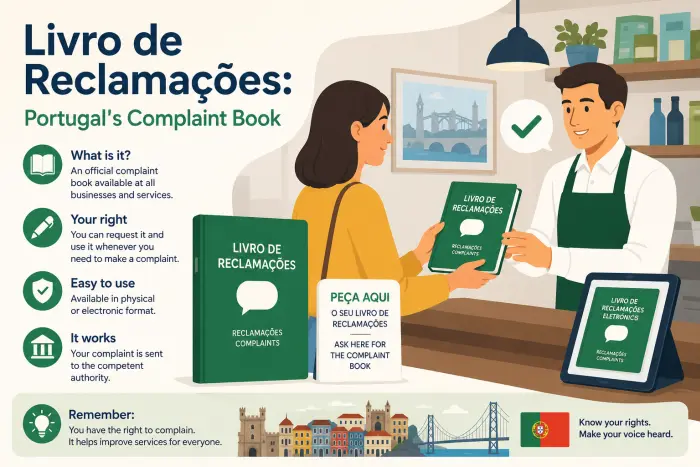
What it actually is
| What | An official, government-regulated complaint book |
| Legal status | Mandatory — every Portuguese business must provide it on request |
| Who can ask | Any customer, at any point during a dispute |
| What happens after | A copy goes to the relevant consumer protection authority automatically |
| Cost to use | Free |
Why this exists, and why it matters more than an angry review
Portugal’s Livro de Reclamações system predates the internet-review era by decades — it’s a formal consumer protection mechanism, not a customer-service courtesy. Any business operating in Portugal is legally obligated to keep one on hand and produce it the moment a customer asks, whether that’s a restaurant, a shop, or a rental car counter. Refusing to provide it, or making it difficult to access, is itself a violation that can be reported separately, regardless of how the underlying dispute eventually gets resolved.
What makes it more effective than an angry Trustpilot review or a heated argument at the counter is what happens next: a copy of whatever you write gets forwarded to the relevant Portuguese consumer protection authority, independent of the business itself. The company can’t simply delete it, argue it away, or let it quietly disappear the way an online review sometimes can. This creates a paper trail with actual regulatory weight behind it, which tends to change how a rental company responds to a dispute far more than a raised voice at the desk does — staff at the counter know this record exists and that it reaches someone beyond their own management chain.
Why tourists specifically miss this
Most of the complaint tools travelers instinctively reach for — a bad review, a heated phone call, a social media post — carry no formal weight and rely entirely on a company choosing to care about its reputation. The complaint book works differently precisely because it doesn’t depend on the company’s goodwill at all; it’s a regulatory mechanism that exists independent of whether the business wants to engage with the customer at all. Tourists tend to default to the tools they’d use at home, and few countries have an equivalent system this direct, which is exactly why it goes unused by visitors even when it would be the single most effective step available to them.
This gap shows up clearly in online complaint threads about Portuguese rental companies — travelers describing genuinely unfair charges, contract disputes, or damage claims they believe are false, working through every channel except the one specifically designed by Portuguese law to handle exactly this situation, simply because they didn’t know it existed. Reading enough of these accounts, a clear pattern emerges: the travelers who do mention the complaint book almost universally describe it as the single most effective step they took, well ahead of anything achieved through email, phone calls, or online reviews.
When to actually ask for it
The complaint book is most useful specifically at the moment a dispute happens, not after you’ve already left the country and are trying to resolve something remotely. If a rental company is charging you for damage you dispute, adding fees you didn’t agree to, or handling a return in a way that feels dishonest, asking calmly for the Livro de Reclamações on the spot accomplishes two things: it signals to the staff that you know your rights and are prepared to use a formal channel, and it creates the actual record if things don’t resolve informally.
Staff are legally required to provide it without argument. In practice, simply asking sometimes resolves the issue on its own — a company that knows a formal complaint is about to be filed and forwarded to a regulator has real incentive to reconsider an unreasonable charge before it gets to that point, and some travelers who’ve used this report exactly that pattern: a manager suddenly willing to waive a disputed fee the moment the book comes out from behind the counter.
How to actually fill it out
The book typically has a standardized format — your details, the company’s details, and a written description of the complaint. It’s usually completed in triplicate: one copy stays with the business, one goes to you, and one is submitted to the relevant authority (most consumer complaints fall under ASAE, Portugal’s food and economic safety authority, though the specific routing can vary). Write the complaint factually and specifically — dates, amounts, what was promised versus what happened — rather than venting broadly, since this document becomes part of an official record rather than a casual review. Include specifics like the rental agreement number, the exact charge in dispute, and any staff members involved by name if you have them, since a factual, well-documented entry carries more weight with the reviewing authority than a general expression of frustration.
💸 Don’t Overpay at the Airport
Compare real-time rental deals with no hidden fees or credit card needed.
Keep your copy. If the dispute continues after you’ve left Portugal, having a dated, formal complaint on record strengthens any further steps you take, whether that’s a follow-up with the rental company directly or, if needed, a credit card chargeback. A card issuer reviewing a chargeback request tends to take a documented, regulator-forwarded complaint more seriously than an unsupported claim that a charge was unfair, since it shows you pursued a formal resolution channel at the time rather than only raising the issue after the fact.
How this fits with other dispute options
The complaint book isn’t a replacement for the other tools available to a renter with a genuine grievance — it’s an additional layer that strengthens them. Our broader guide to filing a car rental complaint in Portugal covers the fuller process, including options like the European car rental conciliation service for cross-border disputes. Prevention matters too — thorough photo documentation at pickup makes any dispute, complaint book or otherwise, considerably easier to win, since a clear before-and-after record removes most of the ambiguity a dishonest counter agent would otherwise rely on.
It’s also worth recognizing the difference between a genuine dispute and red flags of an outright deposit scam — the complaint book is the right tool for the former; a pattern that looks more like deliberate fraud may call for a different response entirely, including involving the police directly rather than relying solely on the complaint process. The complaint book works well against a legitimate business making an unreasonable call on a genuinely disputed charge; it’s less suited to a case where the entire business model appears built around deceptive practices from the start. For the wider picture of what tends to go wrong with Portuguese rentals and how to respond to each situation, see our guide to car rental problems in Portugal.
Frequently asked questions
What is the Livro de Reclamações? A legally mandated complaint book that every business in Portugal, including rental car companies, must provide to a customer on request — a copy of the complaint is automatically forwarded to a Portuguese consumer protection authority, creating a formal record independent of the business itself.
Do I have a legal right to ask for the complaint book? Yes — any business operating in Portugal is required by law to produce it the moment a customer requests it, without argument, delay, or the need to justify why it’s being requested.
Does using the complaint book cost anything? No, it’s free to use and doesn’t require hiring a lawyer or filing any separate paperwork beyond completing the book itself at the counter.
What happens after I fill out a complaint in the Livro de Reclamações? A copy is submitted to the relevant Portuguese consumer protection authority, independent of the rental company, creating an official record of the dispute that the business cannot simply discard.
Can a rental company refuse to give me the complaint book? No — refusing to provide it on request is itself a violation of Portuguese law, separate from whatever the original dispute was about, and worth reporting on its own if it happens.
Is the complaint book only useful while I’m still in Portugal? It’s most effective used in the moment, at the counter when the dispute happens, though the copy you keep can still support a later chargeback or follow-up complaint after you’ve left the country entirely.
Should I use the complaint book instead of a credit card chargeback? They’re not mutually exclusive — using the complaint book first, while still at the counter, often helps resolve things before a chargeback is even necessary, and if it doesn’t, the record it creates can meaningfully support a chargeback afterward.