Most travellers never learn about it until they need it, but Portugal has a formal, legally backed consumer complaint mechanism that applies to car rental companies the same way it applies to any other business serving the public. Knowing how it works before a dispute happens, rather than scrambling to figure it out mid-argument at a counter, makes it a genuinely usable tool rather than an abstract right you never actually get around to exercising.
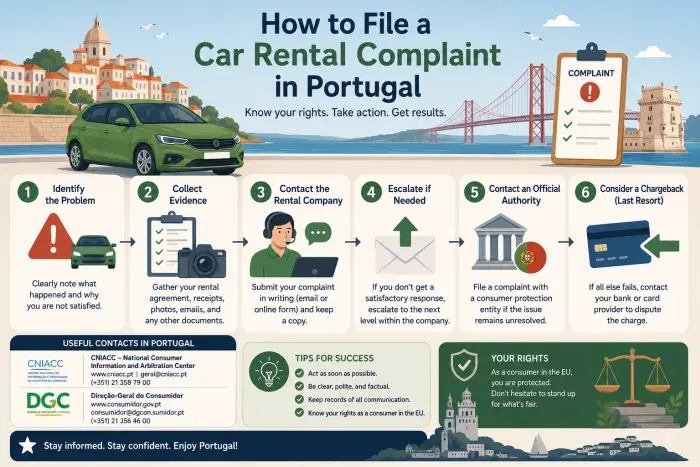
Ask for the “livro de reclamações” (complaints book) directly, in person or online, when a dispute with a rental company can’t be resolved through normal conversation. The business is legally required to provide it immediately and forward your complaint to the relevant regulator, creating an official record independent of the company’s own goodwill.
What the Livro de Reclamações Actually Is
The complaints book is a legal instrument every business with direct public contact in Portugal is required to make available, in physical or electronic form, free of charge, the moment a consumer requests it. A business cannot claim it’s unavailable or located elsewhere, and refusing to provide it is itself a violation worth noting if it happens. This isn’t a customer service gesture; it’s a legally mandated process with real regulatory teeth behind it, which is precisely what makes it more effective than an informal complaint email that a company can simply ignore.
How the Process Actually Works
| Step | What Happens |
|---|---|
| Request the book | In person, ask directly; online, visit the official electronic complaints platform |
| Complete the complaint form | Describe the issue factually and completely, including dates, amounts, and what you’re seeking |
| Submission creates three records | One copy for you, one stays with the business, one is forwarded to the relevant regulatory authority |
| Business must respond | Within a defined short window, and must forward the complaint to its regulator |
| Regulator reviews | The authority overseeing that sector investigates and can take action against non-compliant businesses |
You Don’t Need to Speak Portuguese or Be a Resident
Two common misconceptions worth clearing up directly: you don’t need Portuguese citizenship or residency to use this system, and you don’t need to complete the complaint in Portuguese either, businesses are expected to accommodate complaints in English or another language if that’s genuinely necessary for the consumer to communicate clearly and be understood. This makes the tool as accessible to a short-term visitor dealing with a rental car dispute as it is to a Portuguese resident, which is worth knowing if you assumed this was a locals-only mechanism reserved for people living in the country long-term.
Writing an Effective Complaint
The specific quality of what you write matters for how seriously and quickly it’s handled. A factual, complete account, what happened, when, what amounts are involved, and what resolution you’re seeking, is considerably more effective than an emotional or vague complaint that leaves the regulator guessing at the actual sequence of events. Avoid unnecessary adjectives or venting; focus on the concrete sequence of events and documentation you can point to, similar in spirit to the documentation habit covered in our guide on avoiding a rental car damage dispute in Lisbon, which is directly useful here since strong pickup and return documentation strengthens a formal complaint considerably beyond your own word alone.
Timing Matters More Than It Might Seem
Filing a complaint promptly after the issue occurs, rather than weeks or months later, generally works in your favour for two practical reasons: the details are fresher and easier to document accurately, and some disputes carry their own specific deadlines depending on the exact nature of the complaint, which is a further reason not to delay unnecessarily once you’ve decided direct resolution with the company isn’t working. This doesn’t mean a delayed complaint is automatically invalid, but treating promptness as a genuine advantage rather than an afterthought is worth building into how you approach the process if a dispute does arise during or shortly after your trip.
Physical vs Online Complaints Book
Both versions carry the same legal weight and follow the same underlying process, so the choice comes down to convenience rather than effectiveness. The physical book, requested directly from the business, is straightforward if you’re still at the counter or location where the issue occurred. The electronic version, accessible through the official platform, is useful if the dispute becomes clear only after you’ve left, during a later billing dispute discovered once home, for instance, or if you simply prefer submitting documentation digitally with attachments rather than handwriting a physical form.
DECO and Broader Consumer Support
Beyond the complaints book itself, DECO, Portugal’s consumer protection association, provides guidance on navigating disputes and generally recommends putting any complaint in writing so there’s a clear record to point back to. For a dispute that crosses borders, for instance a rental booked through a platform based in another EU country, the European Consumer Centre Network offers free assistance specifically for cross-border consumer disputes within the EU, worth knowing about as a separate resource if the complaints book process alone doesn’t resolve things with a foreign-based platform or company.
Which Regulator Actually Reviews a Car Rental Complaint?
The complaint’s copy goes to whichever regulatory authority oversees that specific sector, which for many consumer-facing businesses in Portugal falls under bodies like ASAE, the food and economic security authority that also handles broader consumer protection matters, though the specific regulator can vary depending on how the business is classified. You don’t need to know exactly which regulator applies before filing, since the system itself routes the complaint appropriately once submitted, but it’s worth understanding that a named authority does review your specific complaint rather than it simply disappearing into a general database.
💸 Don’t Overpay at the Airport
Compare real-time rental deals with no hidden fees or credit card needed.
Does This Process Work the Same for Bookings Made Through an Aggregator?
Largely yes, though it’s worth being clear about who exactly you’re complaining against. If your actual dispute is with the rental company operating in Portugal, the complaints book process applies to that company directly, regardless of whether you booked through an aggregator like Discovercars or the supplier’s own site. If your dispute is instead with the booking platform itself, a billing discrepancy on the platform’s side rather than the rental company’s, that’s a separate conversation with the platform’s own customer service, potentially supplemented by the European Consumer Centre Network if the platform is based outside Portugal.
When Is a Formal Complaint Actually Worth Filing?
It’s worth being realistic about scale here. A minor, one-off inconvenience is rarely worth the formal process, and Portuguese guidance on the system specifically cautions against trivial or excessive use, which can undermine the tool’s credibility. A genuine dispute over a significant charge, a documented case of pre-existing damage being wrongly billed to you, or a supplier refusing to honour disclosed terms is exactly the kind of situation this mechanism exists for. If you’ve already tried resolving the issue directly with the rental company and genuinely hit a wall, this is the point where the formal process becomes worth the time it takes.
Complaint Filing Checklist for Portugal Car Rental
- Try resolving the issue directly with the rental company first, keeping written records of that attempt
- Request the livro de reclamações directly if a resolution isn’t reached, either in person or via the online platform
- Write a factual, complete account rather than an emotional one, including dates, amounts, and your desired resolution
- Keep your copy of the complaint and any reference number for follow-up
- Consider DECO or the European Consumer Centre Network for additional guidance, particularly for cross-border disputes
For breakdowns, wrong cars, and other problems beyond a standard complaint, see our complete guide.
Frequently Asked Questions
Do I need to be a Portuguese resident to use the complaints book? No. Any consumer, including short-term visitors, can request and use the livro de reclamações regardless of residency status.
Can I file a complaint in English if I don’t speak Portuguese? Generally yes. Businesses are expected to accommodate a complaint in English or another language if needed for the consumer to communicate the issue clearly.
What happens after I submit a complaint through the livro de reclamações? A copy is forwarded to the relevant regulatory authority for that sector, which reviews the complaint and can take action against the business if it finds a genuine violation.
Do I need to know which regulator oversees car rental complaints before filing? No. The complaints book system routes your complaint to the appropriate authority automatically once submitted, so you don’t need to identify the correct regulator yourself in advance.
Does the complaints process work the same if I booked through an aggregator like Discovercars? Yes, if your dispute is with the rental company itself. A dispute with the booking platform’s own billing is a separate matter handled through that platform’s customer service instead.
Is a formal complaint worth filing for a minor rental car issue? Generally not. The system is intended for genuine disputes, significant charges, documented unfair treatment, rather than minor inconveniences, and excessive use can undermine its credibility.
If your dispute involves counter-level pressure tactics specifically, our rental car counter upsell tactics guide covers recognising that pattern before it escalates to a formal complaint at all.