Fill your tank before you cross into Peneda-Gerês National Park, because there isn’t a single gas station inside its boundaries, and running low on a mountain road with no signal and no fuel stop for the next 40 minutes is a genuinely avoidable mistake. That’s the first thing worth knowing about Portugal’s only national park, tucked into the far north near the Spanish border. The second is that Google Maps has a documented habit of routing visitors into narrow village streets that go nowhere useful, a mistake more than one travel blogger has written about after the fact.
Before You Cross In
- Peneda-Gerês sits in Portugal’s far north, roughly 1.5-2 hours from Porto and about the same from Braga, both reasonable starting points for a visit
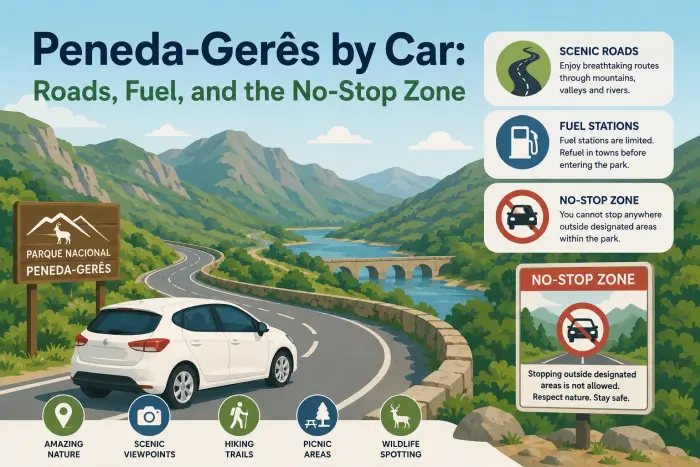
- There are no fuel stations anywhere inside the park — fill up completely before you enter, not when you’re already worried about the gauge
- Roads inside the park narrow considerably in places, sometimes down to barely enough width for two small cars to pass carefully
- One stretch is legally off-limits to stopping entirely: the section between Portela do Homem and Portela de Leonte, along with the unpaved, heavily potholed Geira Roman road near the Vilarinho das Furnas reservoir
- Near Lindoso, the road runs close enough to Spain that crossing the border is genuinely possible — but your rental agreement’s cross-border rules still apply here exactly as they would anywhere else
- Darkness falls fast in the mountains, and these roads have essentially no lighting once the sun’s down
The Roads Get Real Once You’re Inside
Most of the drive up from Porto or Braga runs on decent, well-maintained roads, largely the A3 and then the IC28. It’s once you actually cross into the park itself that things change. Roads narrow, climb, and wind in a way that rewards a slower pace than you’d default to elsewhere in Portugal. One well-documented stretch near Covide climbs into a road with barely enough space for two small cars to pass each other, and while blind luck might mean you never meet oncoming traffic on the tightest sections, it’s not something to count on. Add potholes in places, particularly on the old unpaved Roman road sections, and this is genuinely a “drive attentively, not casually” kind of park. It’s also worth budgeting for the distance when you’re thinking through rental car fuel costs in Portugal, especially since there’s nowhere inside the park itself to top up if you’ve misjudged your range.
The Section Where You Legally Can’t Stop
This is worth knowing before you plan a route rather than discovering it mid-drive: the stretch between Portela do Homem and Portela de Leonte is under specific protection, and stopping your vehicle there isn’t permitted at all. The same restriction applies along the unpaved Geira Roman road that runs near the Vilarinho das Furnas reservoir. If a viewpoint or photo opportunity falls within one of these zones, you’ll need to keep moving and find your stopping point elsewhere.
See the regional guide to northern Portugal for how Peneda-Gerês compares to the Douro Valley and the historic towns near Porto.
Parking, Such As It Is
Formal parking lots are genuinely rare inside Peneda-Gerês. The general etiquette, more custom than official signage in a lot of spots, is to pull well off the road onto a safe verge, never block a curve, a junction, or a walking path, and never assume the shoulder you’re eyeing is actually meant for parking just because someone else did it first. One travel writer’s account of the park describes making exactly this mistake near a monastery, leaving the car in a rough spot instead of driving the extra 500 meters down a cobbled road to the actual designated lot. Small mistake, easily avoided once you know to look for it.
Google Maps Isn’t Always Your Friend Here
More than one visitor has described the same frustration: GPS apps routing them through increasingly narrow village streets that clearly weren’t meant for through-traffic, sometimes ending in a dead end near a cemetery or a farm track rather than the actual parking area for a trail or monastery. It’s worth treating turn-by-turn directions here with a bit of healthy skepticism, especially in the smaller villages, and being willing to stop and reassess rather than trusting the app blindly into a lane that keeps getting narrower.
| What to Expect | Reality Inside the Park |
|---|---|
| Fuel | None available inside park boundaries — fill up beforehand |
| Road width | Narrows considerably in places; some stretches fit two small cars carefully |
| Parking | Mostly informal roadside pull-offs, not marked lots |
| GPS reliability | Can route through impractical village streets — worth double-checking |
| Stopping restrictions | Illegal to stop between Portela do Homem and Portela de Leonte, and along the Geira Roman road |
The Border Question Near Lindoso
If your route takes you toward Lindoso, you’re close enough to Spain that crossing is a real, physical possibility, the kind of open-border moment that makes Schengen travel feel almost seamless. Your rental agreement doesn’t see it that way. The same cross-border permission rules that apply anywhere else in Portugal apply here too, and driving into Spain without your rental company’s written authorization carries exactly the same risk to your insurance coverage it would on any other border crossing.
Villages, Waterfalls, and Why a Car Genuinely Matters Here
Soajo and Lindoso are both worth the detour for their espigueiros, traditional raised stone granaries that look almost sculptural lined up in rows against the hillside. Waterfalls like Arado draw hikers throughout the park, and the Caniçada Reservoir offers calmer water for kayaking or paddleboarding if you want a break from driving and walking. None of this is realistically stitched together without a car, since the park’s highlights, viewpoints, trailheads, and villages, are spread across genuinely large distances that public transport simply doesn’t connect efficiently. If this is your first proper mountain-road trip in Portugal, it’s worth a quick read of general driving rules before you set off, since local etiquette and right-of-way habits on narrow rural roads aren’t always intuitive.
💸 Don’t Overpay at the Airport
Compare real-time rental deals with no hidden fees or credit card needed.
Getting There From Porto or Braga
Porto and Braga both work as reasonable starting points, with Braga sitting closer and Porto offering more flight and rental options if you’re arriving from abroad. If you’re already planning time in Braga, Peneda-Gerês is a natural extension of that trip rather than a separate expedition requiring its own base entirely.
Toll Roads and the Basics
The A3 includes tolled sections on the way up, so it’s worth having Via Verde sorted before you set off. And given the genuinely demanding nature of some of the park’s roads, it’s worth reading our broader notes on road safety and defensive driving in Portugal beforehand, since this is one of the few places in the country where the driving itself, not just the destination, deserves real respect. If your visit runs later than planned, our night driving tips for Portugal are worth a read too, since these mountain roads offer essentially no ambient light once the sun goes down.
Practical Notes Before You Set Off
- Fill your tank completely before entering the park — there’s no fuel available once you’re inside
- Treat GPS directions with some skepticism in the smaller villages, and be ready to stop and reassess rather than following a route that keeps narrowing
- Know the no-stopping zone between Portela do Homem and Portela de Leonte before you plan your photo stops
- Park well off the road on safe verges, never blocking curves, junctions, or footpaths
- Don’t cross into Spain near Lindoso without your rental company’s written cross-border authorization
- Plan to be off the mountain roads before dark, since lighting is essentially nonexistent
Frequently Asked Questions
Are there gas stations inside Peneda-Gerês National Park? No, none. It’s essential to fill your tank completely before entering, since there’s no fuel available anywhere inside the park boundaries.
How far is Peneda-Gerês from Porto? Roughly 1.5 to 2 hours by car, depending on which part of the park you’re visiting, largely via the A3 and IC28.
Is it true I can’t stop my car in some parts of the park? Yes. The stretch between Portela do Homem and Portela de Leonte, along with the unpaved Geira Roman road near the Vilarinho das Furnas reservoir, is legally off-limits to stopping.
Can I drive across the border into Spain near Lindoso? Physically, yes, the border is open. Legally, your rental car needs the same written cross-border authorization from the rental company that applies to any other Portugal-Spain crossing.
Is Google Maps reliable inside the park? Not always. Several visitors report being routed through impractical, overly narrow village streets. It’s worth being willing to stop and reassess rather than trusting turn-by-turn directions blindly in smaller villages.
Do I really need a car to see Peneda-Gerês properly? Yes, genuinely. The park’s villages, waterfalls, and trailheads are spread across large distances that public transport doesn’t connect efficiently.
Are the roads inside the park difficult to drive? Some stretches are narrow and winding, occasionally down to barely enough width for two small cars to pass, plus some potholed unpaved sections. It rewards a slower, more attentive pace than most Portuguese roads.
Should I visit Peneda-Gerês from Porto or Braga? Both work well. Braga is somewhat closer, while Porto offers more flight and rental car options if you’re arriving from outside Portugal.