There’s a comment buried in an old travel blog thread about Marvão that sums the place up better than most guidebooks manage: someone grumbling that the write-up “forgot to mention it’s 5km up a mountain road and not much parking up there.” That’s Marvão in one sentence. It’s a village built on top of a quartzite crag near the Spanish border, roughly 230 km and about two and a half to three hours from Lisbon, and it is, without much competition, one of the places in Portugal where showing up without your own car simply isn’t a realistic plan.
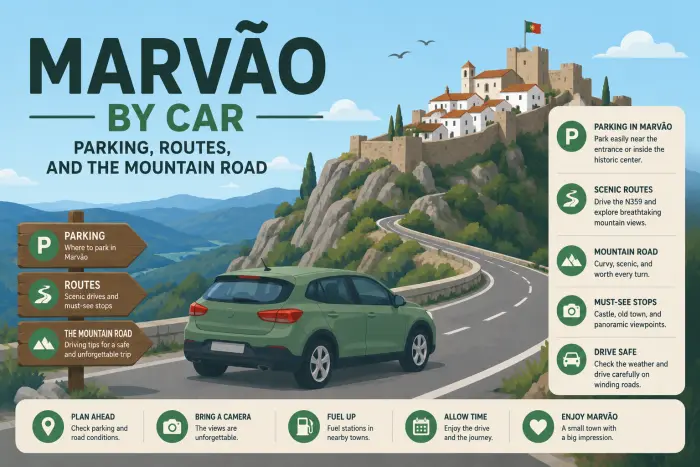
- Marvão sits about 230 km from Lisbon, reached via the A6 motorway and then the N246, generally a 2.5-3 hour drive
- It’s roughly 130-160 km, about two hours, from Évora if you’re coming from that direction instead
- The village itself is walled and hilltop, entered through the Porta de Ródão gate, with genuinely narrow medieval streets that aren’t built for cars
- There’s a car park near the entrance gate; park there, walk in, and don’t attempt to drive further unless you’re actually staying overnight inside the walls
- Public transport is thin: Rede Expressos buses connect Marvão to Portalegre and nearby Castelo de Vide, but the schedule is sparse and the ride is slow
- Parking gets genuinely tight during local festivals, the chestnut festival and the Moorish-Roman heritage celebrations shared with the region draw crowds the village’s limited lots weren’t built for
Why This Village Specifically Demands a Car
Plenty of Portuguese hill towns are “better with a car.” Marvão is closer to “not really possible without one.” It sits in the Alto Alentejo, the northern, more remote stretch of the Alentejo region, tucked into the Serra de São Mamede Natural Park, a long way from anywhere of meaningful size. The nearest town with any real infrastructure, Portalegre, is still a drive away, and Marvão’s own bus connections run early morning to early evening with real gaps in between. If your trip involves any spontaneity at all, arriving and leaving on your own schedule rather than a bus timetable, a rental car is genuinely the only version of this trip that works comfortably. It’s worth being comfortable with Portugal’s general driving rules before you tackle this route too, since the winding mountain roads around the Serra de São Mamede behave differently from the flat, wide motorways most visitors get used to first.
Parking: The Part Everyone Underestimates
Here’s where that grumpy blog comment earns its place in this article. Marvão’s car park sits near the Ródão gate at the village entrance, and it’s the sensible, sanctioned place to leave your car before walking in. On a quiet Tuesday in November, this is a non-issue. During festival weekends or peak summer, it fills, and there genuinely isn’t a large overflow lot waiting in reserve, because the village was built for a population that never anticipated tour buses and rental cars showing up in the same afternoon.
For the wider Alentejo picture and how Marvão connects to Elvas and Évora, see our regional guide.
| When You’re Visiting | What Parking Actually Looks Like |
|---|---|
| Weekday, off-season | Easy — the entrance lot rarely fills |
| Weekend, shoulder season | Manageable, but arrive by mid-morning |
| Local festivals (chestnut festival, Moorish-Roman heritage days) | Genuinely tight — the lot fills and stays full |
| Peak summer weekends | Best to arrive early; afternoon arrivals may circle for a while |
If your visit lines up with a local festival, plan to arrive earlier than you think you need to.
Don’t Drive Into the Village Itself
This is worth stating plainly, since a few guides gloss over it: once you’re through the Ródão gate, the streets inside Marvão’s walls are narrow, cobbled, and genuinely not built for a modern car, even a small one. Park outside, walk in. The only real exception is if you’ve booked accommodation actually inside the walls, in which case your host can usually tell you exactly where limited resident-adjacent parking exists, since it’s not something you’ll figure out by circling.
What You’re Actually Driving There to See
The castle, built in the 13th century under King Dinis, sits at one end of the hill above the village and is worth the climb for the views alone, out over the Serra de São Mamede on one side and toward Extremadura in Spain on the other. The town walls make for a proper walk in their own right, and the Porta de Ródão viewpoint just outside the gate is where most of Marvão’s postcard photos actually get taken. One day covers it at a relaxed pace; staying the night, when the day-trippers clear out and the village goes quiet, is where people who’ve done both say the real magic is.
Castelo de Vide: The Easy Add-On
Ten km down the mountain sits Castelo de Vide, a medieval village in its own right with cobbled streets, a hilltop castle of its own, and a notably less crowded feel than Marvão on a busy day. It’s roughly a 15-20 minute drive and genuinely worth pairing with Marvão if you’ve already committed to the trip out this way, since the two towns complement rather than duplicate each other.
The Drive Itself
The A6 motorway route from Lisbon runs largely on open, fast roads, with the final stretch on the N246 taking you into more rural, winding terrain as you approach the mountain. It’s a genuinely pleasant drive if you’re not in a rush, though it’s worth budgeting real time for it rather than treating Marvão as a quick detour on the way to somewhere else. It’s also worth a glance at realistic rental car fuel costs in Portugal given the distance involved, since this is a longer haul than most of the coastal day trips covered elsewhere on this site. If you’re combining it with Évora, the roughly two-hour connection between the two makes a coherent multi-day Alentejo loop rather than two separate, disconnected trips.
💸 Don’t Overpay at the Airport
Compare real-time rental deals with no hidden fees or credit card needed.
Toll Roads on the Way
The A6 includes tolled stretches, so it’s worth having Via Verde sorted before you go, since almost every rental car comes fitted with a transponder and the charge processes automatically, generally with a delay after you’re already home.
Signal Gets Patchy Out Here
This is genuinely remote terrain by Portuguese standards, and cell coverage along some stretches of the N246 and the smaller roads around Castelo de Vide isn’t as reliable as what you’d get closer to Lisbon or the coast. Setting up mobile data for GPS use in Portugal before you leave the motorway is worth doing here specifically, more so than for most of the day trips covered elsewhere on this site.
If You’re Coming From the Algarve or Elsewhere
Marvão sits far enough north and inland that it doesn’t fit neatly into most Algarve-based itineraries, but if you’re doing a longer loop through Portugal and want to avoid backtracking to your original pickup point, it’s worth checking whether one-way car rental makes more sense for your route than a standard round trip.
Practical Notes Before You Set Off
- Budget a proper half-day just for the drive, not a quick detour, especially from Lisbon
- Arrive earlier than feels necessary if your visit coincides with a local festival — parking is genuinely limited and doesn’t scale with crowds
- Park at the entrance gate and walk in; don’t attempt to drive into the walled village unless you’re staying inside it overnight
- Pair the trip with nearby Castelo de Vide if you’re already making the journey out
- Confirm your rental car has a working Via Verde transponder for the A6 tolled stretch
- Set up reliable mobile data before you leave the motorway, since coverage thins out on the approach roads
Frequently Asked Questions
How far is Marvão from Lisbon by car? About 230 km, roughly a 2.5-3 hour drive via the A6 motorway and then the N246.
Can I drive my car into the village itself? No, not practically. The streets inside Marvão’s walls are narrow and medieval, built long before cars existed. Park at the entrance gate and walk in, unless you’re staying overnight inside the walls.
Is parking actually a problem in Marvão? It can be, particularly during local festivals and peak summer weekends, when the limited car park near the entrance fills and there’s no significant overflow capacity.
Do I really need a car to visit Marvão, or is public transport realistic? A car is genuinely the practical option. Bus connections to Portalegre and Castelo de Vide exist but run on a sparse schedule, making spontaneous or flexible travel difficult without your own vehicle.
What else is worth visiting near Marvão? Castelo de Vide, about 10 km and a 15-20 minute drive away, pairs naturally with a Marvão visit and offers its own medieval charm without duplicating the experience.
Is Marvão worth an overnight stay, or is a day trip enough? A day trip covers the main sights comfortably, but many visitors who’ve stayed overnight say the village’s atmosphere after the day-trippers leave is genuinely worth experiencing.
How does a Marvão trip fit with a wider Alentejo itinerary? It pairs well with Évora, roughly two hours away, forming a coherent multi-day loop through the region rather than a standalone detour.
Is the drive to Marvão difficult? Not difficult exactly, but it runs through increasingly rural, winding terrain on the final stretch, and it’s worth budgeting real time for the trip rather than rushing it.