Elvas sits close enough to Badajoz, Spain, that the two feel like a single metro area split by an invisible line, and that proximity is exactly what makes a rental car worth having here — the star-shaped fortress town rewards a slow walk on foot, but reaching it, and reaching what’s just across the border, is squarely a driving trip.
| Distance from Lisbon | ~200 km (2–2.5 hrs via A6) |
| Distance from Évora | ~85 km (1 hr) |
| Distance from Badajoz, Spain | ~15 km (20 min) |
| Historic center | Largely pedestrian; park outside the walls |
| Cross-border driving | Usually allowed with prior authorization — confirm with your rental company |
Why Elvas draws a rental car crowd
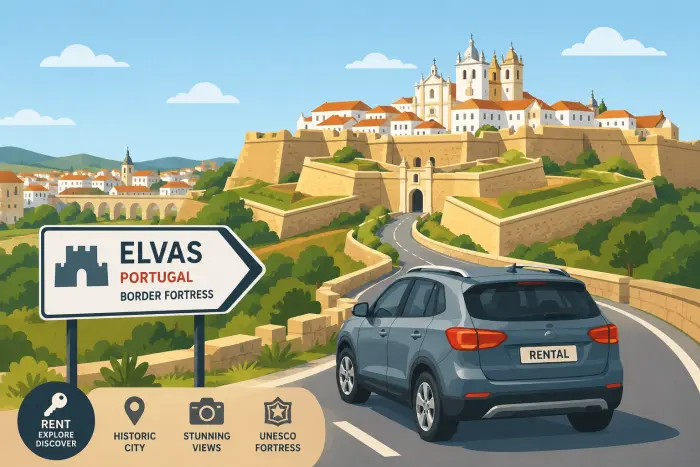
Elvas earned its UNESCO World Heritage status for a genuinely unusual reason: it’s one of the largest bulwarked dry-ditch fortification systems in the world, built up over centuries specifically because of its position facing Spain. The Amoreira Aqueduct, the star-shaped walls themselves, and the hilltop Castle of Elvas are all within walking distance of each other once you’re inside the historic center — but almost nobody arrives in Elvas without a car, since public transport connections here are thin compared to Évora or Lisbon.
The town also functions as a practical base for a very specific kind of trip: dipping from Portugal into Extremadura, Spain, to see Mérida’s Roman ruins or Cáceres’ old town, then returning to Portuguese soil the same day or the next. This pattern comes up often enough on travel forums that it’s worth addressing directly, since it changes what to check with your rental company before you ever reach Elvas.
See the Alentejo regional guide for how Elvas fits alongside Marvão, Évora, and Monsaraz.
Getting to Elvas
From Lisbon, the drive runs about two to two and a half hours via the A6 motorway, tolled for most of the route. From Évora, it’s a much shorter hop — around an hour, making Elvas a natural add-on to an Alentejo-focused itinerary rather than a destination requiring its own dedicated trip from the coast. Coming from Faro or the Algarve adds real distance, closer to three hours, and is less commonly done as a standalone trip than as part of a longer loop through the Alentejo interior.
The A6 itself is a straightforward, well-maintained toll motorway with light traffic outside peak holiday periods — this isn’t a technically demanding drive, just a long one if you’re coming from the coast.
Summer in Elvas runs hot even by Alentejo standards, with the interior location losing the coastal breeze that tempers Lisbon and the Algarve — worth planning sightseeing for morning or early evening if visiting in July or August, and worth knowing that some smaller shops and cafés close for a few hours around midday regardless of season, a rhythm more common in the Alentejo interior than in the coastal tourist towns most visitors are used to.
Parking near the fortifications
Elvas’ historic core, ringed by the star-fort walls, restricts vehicle access in the same way most of Portugal’s walled towns do — narrow, angled streets weren’t built with cars in mind, and driving in isn’t the intended way to experience it anyway. The most commonly used parking is around Praça da República, just outside the main gate, which puts you within a short walk of both the aqueduct and the castle without needing to navigate the interior streets at all.
Rates here are modest, and unlike Lisbon or Porto, Elvas rarely sees the kind of parking pressure that makes finding a spot genuinely difficult — even in peak season, this remains a relatively lightly visited town by Portugal’s overall standards, one of the reasons it appeals to travelers who’ve found Évora or the Algarve too crowded for their taste.
Crossing into Spain
This is the detail that trips people up most often. Not every rental agreement automatically permits taking the car across an international border, even within the EU and even for a short day trip to Badajoz. Some suppliers include cross-border travel to Spain by default; others require prior notice, an additional cross-border fee, or supplementary insurance — and a few restrict it entirely depending on the vehicle class or your specific rental terms.
The practical fix is simple: confirm this specifically at booking, not at pickup. If your plan includes even a short hop into Badajoz for lunch, mention it when reserving the car so it’s reflected in the contract, rather than discovering a restriction with the border a few kilometers away. Toll systems also differ between the two countries — a Via Verde transponder that works seamlessly in Portugal generally doesn’t work on Spanish toll roads, so a short trip into Spain sometimes means paying cash or card directly at Spanish toll booths instead.
💸 Don’t Overpay at the Airport
Compare real-time rental deals with no hidden fees or credit card needed.
None of this makes the crossing complicated once it’s sorted out — it’s a five-minute administrative check at the rental counter rather than anything that requires special documentation at the border itself, since Portugal and Spain share the Schengen area and there’s no passport checkpoint to navigate. The friction, such as it is, sits entirely on the rental contract side, not the actual driving.
Combining Elvas with the rest of an Alentejo trip
Elvas pairs naturally with Évora, an hour away and already one of the Alentejo’s best-known stops, and with Monsaraz and Marvão if a longer loop through the region’s fortified hill towns is part of the plan. Travelers wanting a completely different side of the Alentejo afterward sometimes continue on to the Costa Vicentina on the coast, though that’s a substantial extra drive rather than a same-day add-on. Travelers doing a broader Portugal-plus-Spain itinerary — Lisbon, the Alentejo, then into Extremadura toward Mérida, Cáceres, or even Seville — often route through Elvas specifically because it sits right at that seam, letting the border crossing happen on a quiet regional road rather than a major motorway interchange.
What kind of car makes sense for this trip
An economy or compact car handles everything described here without issue under Portugal’s standard driving rules — the A6 is a standard motorway, and the streets around Praça da República aren’t tight in the way some of Portugal’s coastal town centers can be. The one consideration worth a moment’s thought is trunk space if a day trip into Spain is part of the plan and you’re picking up groceries or wine in Badajoz’s larger supermarkets, which tend to be a draw for Portuguese visitors given some price differences between the two countries — nothing that requires upsizing the car, just worth factoring in if the trip includes any shopping alongside the sightseeing.
Fuel is worth topping up before crossing into Spain if you’re driving back into Portugal the same day, since prices and taxation differ slightly between the two countries and it’s a minor but easy way to save a few euros without any extra effort — fill up on whichever side happens to be cheaper that week rather than assuming it’s always the same direction.
A quieter alternative to Évora
Elvas doesn’t get anywhere near the visitor numbers Évora does, and that’s part of its appeal for travelers who’ve already spent a day or two in the more famous Alentejo town and want something with a similar historic weight but noticeably fewer other tourists. The fortifications alone — walkable in a loop along sections of the walls — offer a different kind of sightseeing than Évora’s Roman temple and bone chapel, more about scale and military engineering than any single standout monument, and the town center’s cafés and shops move at a pace that rewards an unhurried half-day rather than a checklist visit.
Frequently asked questions
Can I drive a Portuguese rental car into Spain from Elvas? Usually yes, but not automatically — confirm cross-border permission, any associated fee, and required insurance with your rental company when booking, not after you arrive.
Where should I park to visit the Elvas fortifications? Praça da República, just outside the main gate, is the most commonly used option and puts you within easy walking distance of the aqueduct and castle.
How far is Elvas from Lisbon by car? About two to two and a half hours via the A6 motorway, which is tolled for most of the route.
Is Elvas worth visiting as a standalone trip, or better combined with Évora? Most visitors combine it with Évora, about an hour away, or with a broader Alentejo loop — Elvas alone is a relatively short visit for most travelers.
Does my Via Verde toll transponder work in Spain? No, Via Verde is a Portugal-specific system. Expect to pay Spanish toll roads directly by cash or card if your route crosses the border.
Is the historic center of Elvas accessible by car? Not really, and it’s not meant to be — the fortified old town is narrow and largely pedestrian. Park near Praça da República and walk in.
Is Elvas a good base for visiting Mérida or Cáceres in Spain? Yes, both are within a reasonable drive — Mérida is about 45 minutes to an hour and Cáceres roughly an hour and a half, making Elvas a workable base for day trips into Extremadura if your rental permits the crossing.