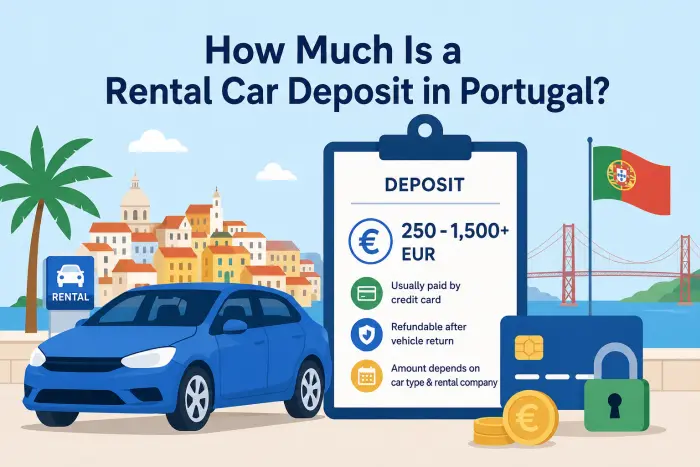
Rental car deposits in Portugal typically range from around €200 for a basic economy car up to €3,000 or more for premium and luxury classes, though the exact figure depends heavily on which company you book with and which insurance level you choose, and counterintuitively, some of the cheapest daily rates come attached to surprisingly high deposit holds that only become clear once you’re standing at the counter. It’s worth knowing the rough range for your specific car class before you arrive, so the number on the payment terminal doesn’t catch you off guard.
What to Actually Expect
- Economy and compact cars generally see deposits somewhere between €200 and €600, though budget operators sometimes hold considerably more
- Mid-size and SUV classes typically fall in the €500-1,500 range
- Premium and luxury vehicles regularly see deposits of €1,000-3,000 or higher, with some companies requiring two physical credit cards for these classes specifically
- A deposit is a hold on your available credit, not an actual charge, and it’s separate from your “excess,” which is the amount you’d actually owe if the car were damaged
- Buying a higher-tier insurance package (often called “zero excess” or “super cover”) frequently reduces the deposit hold as well as your damage liability
- Some deposits aren’t released until up to 30 days after you return the car, according to documented rental company policies
Why Cheaper Cars Sometimes Carry Higher Deposits
This genuinely surprises a lot of first-time renters. Budget operators offering very low daily rates often make up for the thin margin with a higher security deposit and more expensive optional insurance at the counter, while some pricier rentals from established brands include better coverage upfront that keeps the deposit comparatively lower. The headline daily rate you see when comparing prices doesn’t tell you anything about the deposit you’ll actually be asked to authorize at pickup, which is exactly why it’s worth checking deposit terms specifically rather than assuming the cheapest listed price is automatically the best overall deal once every cost is factored in.
Real Deposit Ranges by Car Class
| Car Class | Typical Deposit Range |
|---|---|
| Economy/Compact | €200-600 |
| Mid-size/Standard | €400-1,000 |
| SUV | €500-1,500 |
| Premium/Luxury | €1,000-3,000+ |
These ranges reflect what’s commonly reported across major rental companies operating in Portugal, though individual company policies vary, and it’s always worth confirming the exact figure for your specific booking before you arrive.
A Real Example: How One Major Company Structures It
Europcar’s published Portugal deposit policy is a useful concrete reference point. For their “Special” category vehicles, the deposit is €1,000, reduced to €500 if you purchase protection that brings your damage excess down to zero. For Premium and Luxury categories, the deposit jumps to €3,000, or €1,000 with the same zero-excess protection. Notably, Europcar also requires presenting two physical credit cards for any rental in these upper categories in Portugal specifically, regardless of which protection level you choose, a requirement that catches some travelers off guard if they’ve only brought one card. Other major companies structure their deposits somewhat differently, some calculate it as your rental price plus a fixed surcharge rather than a flat amount tied purely to vehicle class, so it’s worth checking the specific policy for whichever company you’re booking with.
Deposit vs. Excess: Don’t Confuse the Two
This distinction matters and it’s easy to get wrong. Your deposit is simply a hold placed on your card at pickup, released once you return the car without issues. Your excess (sometimes called deductible) is a completely separate figure representing the maximum you’d actually be liable for if the car were damaged, this is the number that matters if something actually goes wrong, not the deposit itself, which you get back regardless as long as the car comes back in the same condition it left in. Our rental terminology glossary breaks down exactly how CDW, excess, and deposit relate to each other, which is worth reading if the terminology still feels tangled after this.
How Long Until You Get Your Deposit Back?
Once you’ve returned the car undamaged, the hold should release, but the actual timing varies meaningfully by company and by your own bank’s processing speed, which adds another layer of unpredictability on top of the rental company’s own policy. Our dedicated guide to deposit release timing covers what’s realistic to expect here, since this article focuses specifically on how much gets held in the first place, while that one covers how long you’ll be waiting to get it back.
Ways to Reduce or Avoid a High Deposit
If a high deposit is genuinely a problem, whether because of a lower credit limit or simple preference, there are a few real options worth exploring. Purchasing a comprehensive “zero excess” insurance package at booking, rather than at the counter, often reduces the deposit meaningfully, and it’s usually cheaper booked in advance than as a counter upsell pushed on you after you’ve already committed to picking up the car. It’s also worth reading our guide to security deposit alternatives for other approaches some travelers use to reduce what gets held on their card.
Debit Cards, Prepaid Cards, and Deposit Complications
Deposit requirements interact directly with which type of card you’re using. Most Portuguese rental companies strongly prefer standard credit cards for deposits, and options are more limited if you’re relying on a debit card or a prepaid card, since these don’t always support the kind of temporary authorization hold a deposit requires. If you’re not traveling with a standard credit card, it’s worth confirming your specific rental company’s policy well before arrival rather than discovering a problem at the counter with no time to arrange an alternative.
Comparing Deposit Terms Before You Book
Since deposit terms vary so much between companies, it’s worth comparing them directly rather than booking purely on daily rate. Our breakdown of rental conditions score versus supplier rating on Discovercars covers how to evaluate a company’s actual terms, including deposit policy, rather than relying on a general star rating that might not reflect deposit-specific complaints at all, since a company can score well overall while still holding unusually high or slow-to-release deposits.
💸 Don’t Overpay at the Airport
Compare real-time rental deals with no hidden fees or credit card needed.
Understanding Your Full Invoice
The deposit is just one line among several on your overall rental paperwork, and it’s worth understanding how it fits alongside your base rate, taxes, and any add-ons. Our guide to decoding your rental car invoice walks through the rest of what you’ll typically see on a final bill, line by line.
Practical Checklist Before You Book
- ✅ Check the specific deposit amount for your car class and chosen company before booking, not just the daily rate
- ✅ Remember that a lower daily rate doesn’t guarantee a lower deposit — sometimes it’s the opposite
- ✅ Consider purchasing zero-excess protection in advance if a lower deposit matters to you
- ✅ Confirm your card type is accepted for deposit purposes well before your pickup date
- ✅ Understand the difference between your deposit (a hold) and your excess (your actual damage liability)
- ✅ Ask directly at pickup for the exact deposit amount and expected release timeline if it isn’t already clearly stated in your booking confirmation
See our full insurance and deposit guide for how deposits interact with CDW and excess coverage.
Frequently Asked Questions
How much is a typical rental car deposit in Portugal? It ranges roughly from €200 for economy cars up to €3,000 or more for premium and luxury vehicles, depending on the company and insurance level chosen.
Why would a cheap rental car have a higher deposit than an expensive one? Budget operators sometimes offset low daily rates with higher security deposits and pricier counter insurance, while some higher-priced bookings include better coverage upfront that keeps the deposit lower.
Is the deposit the same as the excess or deductible? No. The deposit is a temporary hold on your card, released after a clean return. The excess is a separate figure representing your actual maximum liability if the car is damaged.
Can I reduce my rental car deposit in Portugal? Often yes, typically by purchasing a comprehensive “zero excess” insurance package, ideally booked in advance rather than added at the counter.
Do all rental companies require the same deposit for the same car class? No, deposit policies vary meaningfully between companies, even for similar vehicle classes, so it’s worth checking the specific terms for your chosen provider rather than assuming a standard figure applies everywhere.
Can I use a debit card for my rental car deposit? Sometimes, but options are more limited than with a standard credit card, since debit cards don’t always support the type of temporary hold a deposit requires. It’s worth confirming your specific company’s policy in advance.
Do premium and luxury rentals in Portugal require anything extra for the deposit? Some companies require presenting two physical credit cards for premium and luxury categories specifically, regardless of which insurance protection you choose.
How long does it take to get my deposit back after returning the car? This varies by company, and some policies note release times of up to 30 days, though it’s often faster. It’s worth checking the specific timeline with your rental company.