The counter pitch at a Lisbon car rental desk follows a fairly predictable script: an insurance upgrade framed as essential, a prepaid fuel package framed as convenient, and a vehicle upgrade framed as a limited-time deal. None of these are inherently dishonest offers, some genuinely suit some travellers, but the pressure and framing used to sell them is worth recognising for what it is: a sales process optimised for margin, not necessarily for your actual needs.
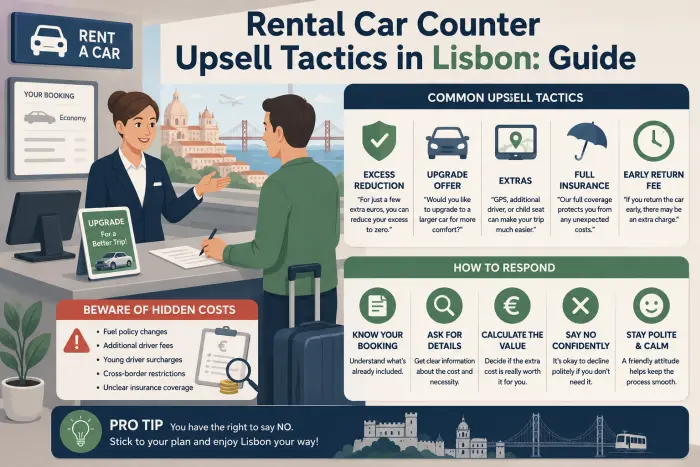
Quick answer: the most effective response to counter upselling is deciding what you actually need before you arrive, based on your own research rather than the counter’s framing, and being comfortable saying a simple “no thank you” without needing to justify the decision or feeling pressured to explain yourself.
The Insurance Upsell: What’s Actually Being Sold
This is the most common and often most aggressively pitched upsell, typically framed around fear, worst-case damage scenarios, rather than a neutral comparison of what you already have versus what’s being offered. If you’ve already arranged coverage, through a third-party excess insurance policy or a credit card benefit, the counter’s own insurance is very likely unnecessary and often considerably more expensive per day than either alternative. Knowing your existing coverage clearly before you arrive removes the uncertainty the insurance pitch is designed to exploit.
Common Upsell Types and How to Evaluate Each
| Upsell | What’s Being Pitched | How to Evaluate It |
|---|---|---|
| Insurance/excess reduction | Framed as essential protection | Compare against existing coverage you already hold before assuming it’s needed |
| Prepaid fuel package | Framed as convenient, avoiding a fuel stop | Usually costs more than pumping your own fuel unless you’re certain to return on empty |
| Vehicle category upgrade | Framed as a limited-time discount | Compare the actual upgrade price against booking that category directly, since “discounts” aren’t always genuine |
| GPS/navigation device rental | Framed as necessary for unfamiliar roads | Compare against your phone’s own navigation app, usually a free and equally capable alternative |
| Additional driver add-on | Framed urgently if a second person will drive | Legitimate if genuinely needed, but confirm the price matches what you’d have paid booking it in advance |
The Prepaid Fuel Package: Usually Not Worth It
Framed as a convenience, avoiding the hassle of finding a fuel station before returning the car, prepaid fuel packages typically charge for a full tank at a rate that assumes you’ll return the car essentially empty. Unless you’re genuinely certain you’ll use nearly the full tank and have no time to refuel before drop-off, this usually costs more than simply returning the car with fuel purchased at a regular station yourself. Our guide on rental car fuel cost in Portugal covers how fuel policy affects your real cost in more depth, useful context for evaluating this specific pitch on its actual merits rather than the convenience framing alone.
The Vehicle Upgrade “Deal”
A vehicle upgrade offered at the counter, often framed as a limited-time discount or the last available option in your booked category, is worth evaluating the same way you’d evaluate any upsell: by comparing the actual price against what booking that category directly would have cost. Sometimes the counter price is genuinely reasonable; often it’s priced to capture the moment’s urgency rather than reflecting a real discount. If you didn’t specifically need a larger vehicle when you booked, it’s worth asking whether anything about your trip has actually changed before accepting an upgrade purely because it was offered persuasively.
Recognising the Pressure Tactics Themselves
Beyond the specific products being sold, it’s worth recognising the general tactics used to create urgency: time pressure (“this offer is only available right now”), fear framing (“without this, you’re fully liable if anything happens”), and social framing (“most customers take this option”). None of these claims are necessarily false, but they’re designed to short-circuit careful evaluation in favour of a quick yes. Recognising the tactic itself, separate from whether the specific product might have some genuine value, helps you evaluate the offer on its actual merits rather than its persuasive framing.
The GPS Rental: Almost Always Skippable
A frequently pitched add-on that’s worth specifically calling out: a dedicated GPS navigation device rental, typically priced per day, framed as necessary for navigating unfamiliar Portuguese roads confidently. For nearly every traveller, a smartphone’s own navigation app, with offline maps downloaded in advance, provides equivalent or better functionality at no additional cost. Unless you have a specific reason to avoid using your phone for navigation, this is one of the more straightforward upsells to decline without any real trade-off in capability.
Does Off-Airport Pickup Change the Pressure Dynamic?
Yes, meaningfully, and it’s worth being extra prepared if you’ve booked with an off-airport supplier. At a terminal counter, declining an upsell and simply walking to a different desk is always an available option if pressure becomes uncomfortable. At an off-site location reached by shuttle, that option effectively doesn’t exist, which can make firm, confident declines even more important, since there’s less natural exit available if the sales pressure continues past a clear no.
💸 Don’t Overpay at the Airport
Compare real-time rental deals with no hidden fees or credit card needed.
How to Say No Without Feeling Pressured
A simple, calm “no thank you, I have that covered already” is sufficient and doesn’t require further justification or debate. Counter staff are following a sales process, not making a personal judgment about your decision, and a confident, brief decline is typically met with acceptance rather than continued pressure. If pressure does continue past a clear decline, it’s worth treating that persistence itself as a signal worth documenting, similar to the broader pattern covered in our guide on rental car deposit scam red flags.
Preparing Before You Arrive
The single most effective preparation is deciding, before you’re at the counter, exactly which of these common upsells you genuinely need based on your own research, insurance coverage confirmed, fuel policy preference decided, vehicle category settled. Arriving with these decisions already made removes the counter’s ability to introduce doubt or urgency into a choice you’ve already thought through carefully, which is considerably more effective than trying to evaluate each pitch fairly for the first time while tired from a flight and standing at a counter.
Why Fatigue Makes You More Susceptible
It’s worth being honest about a factor that has nothing to do with the counter’s tactics themselves: arriving tired after a long flight genuinely reduces careful decision-making, which is precisely the state most travellers are in when facing a counter pitch. This isn’t a character flaw, it’s a well-documented effect of travel fatigue on judgment, and it’s exactly why deciding your insurance, fuel, and vehicle preferences in advance matters more than trying to evaluate each pitch fairly for the first time while jet-lagged. If you know you tend to be more agreeable when tired, treating your pre-trip research as a firm plan rather than a loose preference gives you something concrete to fall back on at the counter rather than relying on in-the-moment judgment.
📋 Counter Upsell Checklist for Lisbon Car Rental
- Confirm your existing insurance coverage before arriving, so the counter’s insurance pitch has nothing new to offer
- Decide your fuel policy preference in advance rather than being persuaded by convenience framing at the counter
- Compare any vehicle upgrade price against booking that category directly before accepting
- Recognise time pressure and fear-based framing as sales tactics, separate from whether the product itself has genuine value
- Practice a simple, confident decline that doesn’t require justification or debate
❓ Frequently Asked Questions
Is the insurance pitch at a Lisbon rental counter usually necessary? Often not, particularly if you already hold coverage through a third-party policy or credit card benefit. Confirming your existing coverage before arrival removes most of the pitch’s leverage.
Is a prepaid fuel package worth buying at the counter? Usually not, unless you’re certain to return the car nearly empty with no time to refuel yourself. It typically costs more than pumping your own fuel before return.
How should I respond if counter staff keep pushing after I’ve declined an upsell? A calm, brief decline is usually sufficient. If pressure continues beyond that, treat it as a signal worth documenting, similar to other counter-level red flags.
Should I ever accept a vehicle upgrade offered at the counter? Only if the actual price compares favourably to booking that category directly and something about your trip has genuinely changed, rather than accepting purely because it was offered persuasively.
Is it worth renting a GPS device at the counter? Almost never. A smartphone with offline maps downloaded in advance provides equivalent or better navigation at no extra cost, making this one of the easiest upsells to decline.
Is upsell pressure harder to handle at an off-airport pickup location? Yes, somewhat, since walking to a different counter isn’t an option at a shuttle-bus location the way it is at a terminal, making a firm, confident decline even more important there.
To compare suppliers generally known for straightforward counter service, our best car rental companies at Lisbon Airport roundup is a useful starting point.