Madeira is a volcanic island with almost no flat land, and its road network reflects that directly: a genuinely impressive system of modern tunneled expressways coexisting with narrow, winding secondary roads and a scattering of old cliff-edge routes that predate the tunnels entirely. Understanding which kind of road you’re actually on at any given moment, and what each demands of you as a driver, matters more here than it does on Portugal’s mainland.
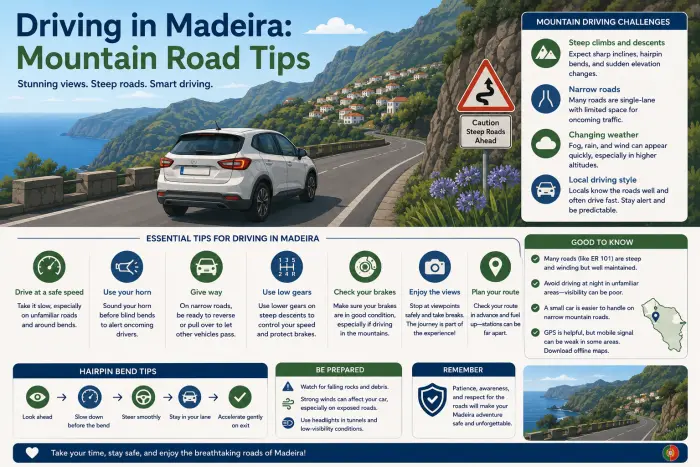
Quick verdict: the VR expressway network handles most of your point-to-point travel comfortably and doesn’t require any special skill beyond normal motorway driving. It’s the secondary ER roads and old mountain routes, the ones that actually deliver Madeira’s most spectacular scenery, that demand real attention: hairpin bends, steep grades, and narrow sections where local courtesy conventions matter as much as posted rules.
Three Types of Roads, Three Different Experiences
| Road Type | What to Expect |
|---|---|
| VR expressways (VR1, VR3, VE roads) | Modern, well-maintained, well-lit tunnels, toll-free, comparable to standard motorway driving |
| Secondary roads (ER101-ER220) | Single lane each direction, winding, steep in mountain sections, numbered regional routes |
| Old pre-tunnel coastal/mountain roads | Narrow, cliff-edge, scenic, some sections closed due to rockfall, not required for point-to-point travel |
The Tunnel Network: Modern vs Old
Over 100 tunnels connect Madeira’s mountainous terrain, and the distinction between modern VR-road tunnels and older secondary-road tunnels matters practically, not just aesthetically. Tunnels on the main expressway network are modern, well-lit, and well-maintained, requiring nothing beyond standard tunnel driving practice, headlights on, steady speed, awareness of posted limits which sometimes drop within the tunnel itself. Older tunnels on secondary or historic roads, cited specifically along parts of the North Coast, can be narrow, damp, and lack artificial lighting entirely, genuinely requiring headlights and reduced speed to navigate safely.
The Unofficial Uphill Priority Rule
This is a genuinely useful local convention worth knowing before you encounter it rather than discovering it in the moment on a narrow mountain road. On single-lane sections where two vehicles meet travelling in opposite directions, local courtesy generally gives priority to the vehicle heading uphill, since restarting on a steep incline, particularly in a manual transmission vehicle, is considerably harder than a downhill vehicle simply reversing to a passing point. If you’re heading downhill and meet oncoming traffic on a narrow stretch, being prepared to pull over or reverse to let the uphill vehicle pass is the expected local practice, not a sign you’ve done something wrong.
Engine Braking: Why It Matters More Here
Sustained descents on Madeira’s mountain roads put real strain on standard braking if relied upon exclusively, with overheated brakes being a genuine documented risk on longer downhill stretches. Using a lower gear to let engine braking do more of the work, rather than riding the brake pedal continuously on a long descent, is standard local practice worth adopting even if it’s not something you’d typically think about on flatter mainland driving. This matters considerably more on Madeira’s terrain than it would on most standard rental car itineraries elsewhere in Portugal.
Choosing the Right Vehicle for the Terrain
Given the combination of steep gradients and narrow village streets, a compact vehicle with reasonable power, commonly recommended around 1.2 liters or more, generally handles Madeira’s terrain better than either an underpowered economy car struggling on inclines or an oversized vehicle awkward on narrow lanes. Our guide on SUV car rental at Lisbon Airport covers vehicle category trade-offs generally, useful context even though Madeira’s specific narrow-street constraints favor a genuinely compact footprint over sheer size. Automatic transmission is worth considering specifically for comfort on repeated steep starts and stops, an area where manual transmission adds noticeably more physical effort on this terrain than on flatter routes.
Don’t Trust Google Maps Time Estimates on Rural Routes
Multiple independent accounts specifically warn that navigation app time estimates are frequently inaccurate for Madeira’s rural and mountain routes, sometimes significantly underestimating actual driving time due to winding roads, elevation changes, and slower-moving local traffic in narrow sections. Building genuine buffer time into any itinerary involving secondary or mountain roads, rather than trusting a GPS estimate literally, avoids arriving later than planned to a scheduled activity or, worse, rushing through genuinely challenging road conditions to compensate for lost time.
Weather and Visibility at Altitude
Fog can develop suddenly at higher elevations even during a day that started clear at sea level, a documented pattern worth planning around specifically for any drive into Madeira’s mountainous interior. Checking current conditions before heading into higher-altitude areas, and being prepared to slow down significantly or reconsider a route if visibility drops unexpectedly, matters more here than it would for most standard Portugal road trip planning.
Should Nervous or Inexperienced Drivers Rent a Car in Madeira at All?
Worth answering honestly rather than assuming everyone should self-drive regardless of comfort level. Experienced mountain-road drivers generally adapt within the first day and describe the experience as genuinely rewarding despite the initial intensity. Less experienced or particularly nervous drivers have a real alternative worth considering: sticking primarily to the VR expressway network for point-to-point travel while using organized tours or a hired driver for the most demanding scenic mountain routes specifically, capturing much of what makes Madeira special without requiring confidence you don’t yet have behind the wheel.
💸 Don’t Overpay at the Airport
Compare real-time rental deals with no hidden fees or credit card needed.
Documentation Worth Having on Narrow Roads
Given how frequently narrow single-lane sections require close passing or courtesy negotiation with oncoming vehicles, a dash cam is worth genuinely considering for a Madeira road trip specifically, more so than for a standard mainland itinerary, since a close call or minor scrape on a tight mountain section is exactly the kind of scenario where objective footage settles a dispute that two conflicting accounts otherwise wouldn’t resolve cleanly.
Fuel Planning for Remote Stretches
Petrol stations concentrate in Funchal and the island’s larger towns, meaning a full day exploring the more remote north coast or central plateau areas is worth planning around a full tank at the start, similar in principle to remote-route fuel planning covered in our guide on rental car fuel cost in Portugal, rather than assuming a station will be conveniently nearby once you’re deep into a scenic but sparsely populated stretch of the island.
Parking in Funchal and Small Villages
Beyond the driving itself, parking in Funchal and Madeira’s smaller hillside villages presents its own specific challenge, given the same steep terrain and narrow streets that shape the driving experience generally. Looking for designated public parking areas or garages rather than assuming street parking will be straightforward, particularly in the older, steeper parts of Funchal, avoids arriving at a destination only to spend considerable extra time searching for anywhere to leave the car at all.
📋 Madeira Driving Checklist
- Distinguish VR expressways from secondary and old mountain roads before planning your route
- Give way to uphill traffic on narrow single-lane sections, following local courtesy convention
- Use engine braking on long descents rather than relying solely on the brake pedal
- Choose a compact vehicle with reasonable power, automatic if steep repeated starts concern you
- Build real buffer time into any itinerary using secondary or mountain roads, rather than trusting GPS estimates literally
❓ Frequently Asked Questions
Is driving in Madeira significantly harder than mainland Portugal? On the VR expressway network, no, it’s comparable to standard motorway driving. On secondary and old mountain roads, yes, meaningfully, due to steep grades, hairpin bends, and narrow single-lane sections.
Who has the right of way on Madeira’s narrow mountain roads? By local unofficial courtesy convention, the vehicle travelling uphill generally has priority, since restarting on a steep incline is harder than a downhill vehicle reversing to a passing point.
Do I need a 4×4 or powerful vehicle to drive in Madeira? Not a 4×4, but a reasonably powered compact vehicle, commonly recommended around 1.2 liters or more, handles the terrain better than an underpowered economy car.
Are Madeira’s tunnels safe to drive through? Modern VR-road tunnels are well-lit and well-maintained. Some older tunnels on secondary or historic roads are narrower, damp, and unlit, requiring extra caution and headlights.
Is a dash cam worth having for a Madeira road trip specifically? Genuinely more so than for a standard mainland trip, given how often narrow roads require close passing with oncoming traffic, making objective footage useful if a close call or minor scrape occurs.
Should I fill up before driving into Madeira’s remote areas? Yes. Petrol stations concentrate in Funchal and larger towns, so planning a full tank before a day exploring the north coast or central plateau avoids running low in a sparsely populated stretch.
To compare Madeira airport pickup and booking specifics, our Madeira Airport car rental guide covers that separate logistics topic.