Collision Damage Waiver sounds, from the name alone, like it should cover essentially anything that goes wrong with a rental car. In practice, CDW is built around a specific, narrower category of damage, and a fairly consistent list of exclusions sits underneath nearly every standard policy, regardless of supplier or vehicle category. Knowing what’s actually excluded, before something happens rather than after, is worth understanding as its own topic separate from the general coverage-tier comparison most insurance guides focus on.
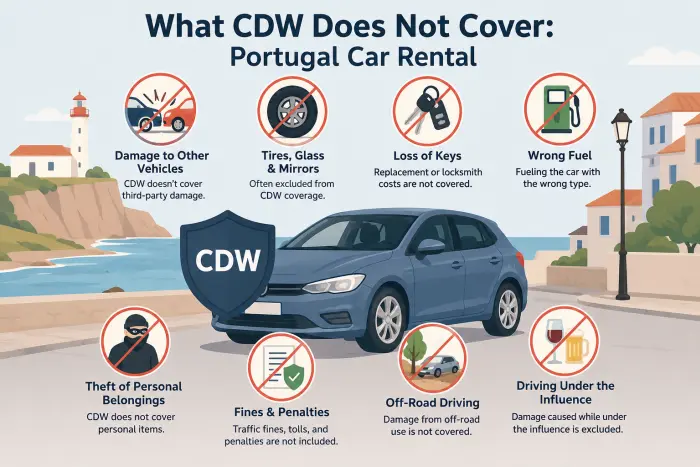
CDW typically covers body damage from a collision but commonly excludes windows and windscreens, tyres and wheels, the vehicle’s undercarriage, the interior, and any damage from driving on unpaved or off-road surfaces. These exclusions are usually covered by a separate, specific add-on if you want to close the gap, rather than being included by default.
What CDW Actually Covers, Before Getting Into the Gaps
Standard Collision Damage Waiver is built around reducing your liability for damage to the vehicle’s body and mechanical components resulting from a collision, the core scenario most renters picture when thinking about “damage” in the first place. Within that core scope, CDW does its job reasonably well, reducing what would otherwise be full liability for repair costs down to a defined excess amount. The confusion comes from assuming this core scope is comprehensive, when in practice it’s a specific slice of possible damage scenarios rather than an all-encompassing policy covering every possible mishap.
The Common Exclusion List
| Excluded Item | Why It’s Typically Not Covered |
|---|---|
| Windows and windscreen | Often requires a separate glass coverage add-on |
| Tyres and wheels | Treated as a wear item and driver responsibility in most standard policies |
| Vehicle undercarriage | Damage from low clearance, potholes, or rough surfaces usually excluded |
| Interior damage | Stains, tears, or burns typically fall outside collision-focused coverage |
| Off-road or unpaved surface damage | Standard CDW usually assumes on-road driving only |
| Keys, lockouts, and towing in some cases | Sometimes covered separately or not at all, worth checking specifically |
Why Windows Are Excluded So Consistently
This is one of the more commonly misunderstood exclusions, since a cracked windscreen feels like exactly the kind of thing “damage coverage” should include. Glass damage is statistically common enough, road debris, gravel kickback from another vehicle, that insurers treat it as a higher-frequency risk warranting its own separate pricing rather than folding it into standard CDW. A dedicated glass coverage add-on, often inexpensive relative to the actual cost of windscreen replacement, closes this specific gap if it’s a genuine concern for your planned route, particularly on rural or gravel-adjacent roads.
Tyres: Almost Always the Renter’s Responsibility
Tyre damage sits in a similar category, treated as closer to a wear-and-tear or driver-responsibility item than genuine collision damage. A puncture from road debris, a sidewall cut from curbing a wheel while parking, or wear from underinflation are all typically excluded from standard CDW, on the reasoning that tyre condition is something the driver has some meaningful control over during the rental, unlike a collision. If tyre coverage matters to you specifically, perhaps because your planned route includes some genuinely rough rural roads, it’s worth asking directly whether it’s available as an add-on rather than assuming it’s bundled into any standard policy.
The Undercarriage Gap and What Causes It
Undercarriage damage, scraping the underside of the vehicle on a steep driveway, an unexpectedly deep pothole, or an unpaved rural track, is excluded from most standard CDW policies specifically because it’s associated with driving choices, route selection, speed over rough terrain, that the insurer considers within the driver’s control in a way a highway collision isn’t. This exclusion is worth taking seriously if your Portugal itinerary includes exploring rural villages or coastal tracks with genuinely rough surfaces, since undercarriage repairs can be expensive and this specific gap is one of the least commonly known among renters until it’s too late.
Interior Damage: The Exclusion Renters Forget About
Stains, cigarette burns, tears in upholstery, and similar interior damage sit outside the collision-focused scope of standard CDW almost universally. This connects directly to keeping the vehicle’s interior in good condition throughout your rental, since interior damage claims are assessed at return the same way exterior damage is, just against a different, often less obviously understood, coverage boundary. Our guide on avoiding a rental car damage dispute in Lisbon covers the documentation habit worth building regardless of which specific exclusion might apply to a given incident.
Keys, Lockouts, and Towing: An Often-Overlooked Gap
Beyond physical damage exclusions, it’s worth knowing that losing keys, locking yourself out, or needing a tow for a non-collision mechanical issue sometimes falls into its own separate category, occasionally covered, occasionally charged as a standalone service fee regardless of your CDW status. This varies more between suppliers than the damage exclusions above, since it’s less standardised across the industry, making it worth asking specifically rather than assuming your CDW coverage extends to these roadside-assistance-style scenarios the same way it covers collision damage.
Does Vehicle Category Change Which Exclusions Matter Most?
Somewhat. If you’re renting a larger vehicle like an SUV specifically because your itinerary includes rougher terrain, it’s worth being extra attentive to the undercarriage and tyre exclusions covered above, since the very reason you chose that vehicle category, ground clearance and capability for less maintained roads, is also where these specific coverage gaps are most likely to actually matter. A compact car kept to motorways and city streets carries much lower practical exposure to the same exclusions, even though the policy terms themselves don’t differ by vehicle category.
💸 Don’t Overpay at the Airport
Compare real-time rental deals with no hidden fees or credit card needed.
Closing the Gaps: Your Options
If any of these specific exclusions concern you for your planned trip, a few paths exist to close the gap rather than accepting the exposure as unavoidable. The rental company’s own counter typically offers additional coverage tiers specifically addressing glass, tyres, or undercarriage protection, usually at a per-day add-on cost that’s worth comparing against the actual risk your itinerary carries. Independent third-party excess insurance sometimes includes broader coverage than the rental company’s base CDW, though this varies by provider and is worth checking specifically rather than assuming. See our guide on third-party excess insurance for Portugal car rental for how that separate purchasing decision interacts with these specific exclusions.
Does This Matter More for Certain Types of Trips?
Yes, meaningfully. A trip confined to well-maintained motorways and city driving carries relatively low exposure to most of these exclusions, tyres, undercarriage, and off-road damage specifically, since the driving conditions themselves rarely create the scenarios that trigger them. A trip including rural exploration, coastal tracks, or hillier terrain in regions like the Algarve’s interior or parts of central Portugal carries meaningfully higher exposure, making it worth taking these specific gaps more seriously when deciding whether to add supplemental coverage.
CDW Exclusion Checklist for Portugal Car Rental
- Confirm whether glass, tyre, and undercarriage coverage are included or available as separate add-ons before you need them
- Take interior condition as seriously as exterior condition when documenting pickup and return
- Weigh your planned route’s exposure to rough or unpaved surfaces before deciding whether undercarriage coverage matters for your trip
- Check whether third-party excess insurance closes any of these specific gaps better than the rental company’s own base coverage
- Ask directly rather than assuming, since exclusion lists vary somewhat by supplier despite the common pattern
For how this fits with excess insurance and deposits generally, see our full guide.
Frequently Asked Questions
Does standard CDW cover a cracked windscreen on a Portugal rental car? Usually not. Glass damage is typically excluded from standard CDW and requires a separate coverage add-on if you want it included as part of your overall protection.
Am I responsible for tyre damage even with CDW coverage? Generally yes. Tyres are commonly treated as a driver-responsibility item excluded from standard collision coverage, similar to wear-and-tear items rather than collision damage.
Does CDW cover damage from driving on unpaved or rural roads in Portugal? Usually not, including undercarriage damage from rough surfaces. Standard CDW generally assumes on-road driving conditions and excludes off-road or unpaved scenarios.
Is interior damage covered under standard rental car insurance? Typically no. Stains, tears, and similar interior damage usually fall outside the collision-focused scope of standard CDW policies.
Does CDW cover a lockout or lost keys on a Portugal rental car? It varies more than damage exclusions do, since this is less standardised across suppliers. Some treat it separately as a service fee regardless of CDW status, so it’s worth asking specifically.
Do these exclusions matter more if I rent an SUV for rougher terrain? Yes. The undercarriage and tyre exclusions become more practically relevant precisely when your itinerary involves the kind of rough or unpaved roads an SUV is often chosen for in the first place.
For the broader picture of how rental insurance tiers and excess levels work generally, see Portugal car rental insurance explained.