Portugal’s high-speed rail connection between Porto and Lisbon is fast, comfortable, and the default recommendation for most travellers moving between the country’s two biggest cities. It’s a genuinely good option. But it isn’t automatically the better choice for every itinerary, and the case for driving instead is stronger than the blanket train advice usually acknowledges, particularly for anyone who wants to see anything between the two cities rather than just arrive.
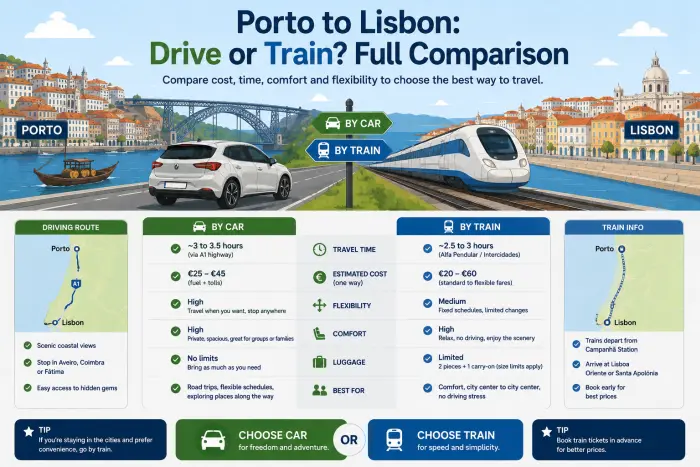
Quick verdict: the train wins clearly for a direct city-to-city transfer with no interest in stops along the way. Driving wins for anyone wanting to break the journey with towns like Coimbra, Óbidos, or the Silver Coast, or who’s continuing a broader Portugal road trip rather than treating this leg as a simple transfer.
The Train’s Genuine Strengths
The Alfa Pendular high-speed service between Porto and Lisbon covers the roughly 300-kilometre distance in around 2.5-3 hours, comfortably faster than driving the same route directly, with no traffic risk, no parking to arrange at either end, and the ability to work, read, or simply relax rather than concentrate on the road. For a traveller whose only goal is getting from one city centre to the other as efficiently as possible, this is a legitimately strong option that a car doesn’t meaningfully beat on pure point-to-point speed.
Where Driving Changes the Calculation
| Trip Type | Better Option |
|---|---|
| Direct city-to-city transfer, no interest in stops | Train, clearly, on speed and convenience |
| Porto to Lisbon with a stop in Coimbra | Car, since the train doesn’t easily support a flexible stopover |
| Continuing a broader road trip beyond Lisbon or Porto | Car, since you’ll need the vehicle regardless of this specific leg |
| Wanting to see the coastline or interior towns en route | Car, since the train route doesn’t follow the scenic road options |
Coimbra: The Stop the Train Doesn’t Serve Well
This is the clearest case for driving over the train. Coimbra, roughly halfway between Porto and Lisbon, is a genuinely worthwhile stop, home to one of Europe’s oldest universities and a well-preserved historic centre, but visiting it via train from either Porto or Lisbon means treating it as a separate day trip with its own dedicated journey, rather than a natural stopover on the way between the two main cities. Driving turns this into a simple detour, adding perhaps an hour or two to break up the journey, compared with the train’s all-or-nothing structure that doesn’t accommodate a flexible mid-route stop nearly as easily.
Cost Comparison: Train Ticket vs Rental and Fuel
A one-way Alfa Pendular ticket is moderately priced per person and scales directly with the number of travellers, since each person needs their own ticket. A rental car’s cost for this leg, combined with fuel and any one-way drop-off fee if picking up in one city and returning in the other, is largely fixed regardless of passenger count, which shifts the comparison meaningfully for groups. Our guide on one-way car rental in Portugal covers the specific fee structure for exactly this Porto-to-Lisbon pattern, worth checking directly since the one-way fee is the main variable cost that can tip the comparison either way depending on the specific supplier.
Does Group Size Change Which Option Wins?
Significantly. A solo traveller or couple doing a direct transfer with no interest in stops will very likely find the train cheaper and less hassle than renting a car for this specific leg. A family or group of three or more, especially one planning to stop in Coimbra or elsewhere en route, often finds the total cost comparable or genuinely cheaper by car once train tickets are multiplied across everyone in the group, on top of the added flexibility a car provides for the journey itself.
The Route Options If You Drive
Driving between Porto and Lisbon offers a genuine choice the train doesn’t: the A1 motorway for the fastest direct route, comparable in total time to a slower train connection, or a more scenic inland or coastal alternative trading some time for considerably more interesting driving and stopping options along the way. This flexibility to choose your own route, rather than being fixed to the rail line’s single path, is one of the underappreciated advantages of driving this leg specifically, even for travellers who ultimately prioritise speed over scenery.
Toll Costs on the Porto-Lisbon Motorway Route
Worth factoring into the cost comparison specifically: the A1 motorway between Porto and Lisbon is a tolled route, and this cost should be added to fuel and any one-way rental fee when comparing total driving cost against the train ticket price. Most rental cars come with an electronic toll device that logs charges automatically as you drive, simplifying the payment process but not eliminating the cost itself, which is worth budgeting for realistically rather than comparing only the headline rental rate against the train fare.
💸 Don’t Overpay at the Airport
Compare real-time rental deals with no hidden fees or credit card needed.
Does Booking in Advance Matter for Either Option?
Yes, for both, though in different ways. Alfa Pendular train tickets, like many high-speed rail fares, are cheaper the earlier they’re booked, with prices climbing as the departure date approaches, similar in principle to airline pricing. Rental cars follow a broadly similar pattern, with our guide on best time to book a Lisbon Airport car rental covering the general booking-timing curve that applies to this route as much as any other. Comparing both options’ advance-booking prices rather than last-minute rates gives a fairer picture of the actual cost difference, since both sides of the comparison shift meaningfully with lead time.
Other Towns Worth Considering Beyond Coimbra
Coimbra is the most commonly cited stop, but it’s not the only one worth considering if you’re driving rather than training between Porto and Lisbon. Aveiro, sometimes called the Venice of Portugal for its canals, sits a shorter distance south of Porto and makes a reasonable early stop for a driving day that starts there, while towns further south like Óbidos offer a walled-town detour closer to the Lisbon end of the route. None of these are accessible as an easy stopover via the direct train route, reinforcing that the real advantage of driving this leg isn’t just Coimbra specifically, but the general flexibility to build a more interesting day out of what the train treats as a single uninterrupted transfer.
Weather and Season Considerations for Driving This Route
Portugal’s A1 motorway is well-maintained year-round, so winter weather rarely poses a serious obstacle the way mountain routes in other countries might, but summer traffic around both Porto and Lisbon’s outer suburbs can add meaningful time to what’s otherwise a fairly predictable drive. If you’re travelling during peak holiday periods, particularly weekends in July and August, it’s worth building in extra time buffer for the drive, especially near either city’s approach roads, where local traffic compounds with through-traffic on the same stretches of motorway.
📋 Porto to Lisbon Checklist: Car vs Train
- Choose the train for a direct, no-stops transfer between the two city centres
- Choose driving if Coimbra or another en-route stop is part of your plan
- Compare total group cost, not just per-ticket price, for three or more travellers
- Budget for A1 motorway tolls on top of fuel and any one-way rental fee when comparing driving cost
- Consider the scenic or inland route options driving offers if time allows, rather than defaulting to the fastest motorway path
❓ Frequently Asked Questions
Is the train always faster than driving between Porto and Lisbon? For a direct transfer, generally yes, at around 2.5-3 hours compared with a similar or slightly longer driving time depending on traffic and route choice.
Is it worth driving instead of the train if I want to stop in Coimbra? Yes, this is one of the clearest cases for driving, since the train doesn’t easily support a flexible mid-route stopover the way a simple driving detour does.
Is driving cheaper than the train for a family travelling between Porto and Lisbon? Often comparable or cheaper for three or more travellers, since train tickets scale per person while a rental car’s cost stays largely fixed regardless of group size.
Are there tolls on the motorway route between Porto and Lisbon? Yes, the A1 motorway is tolled, and this cost should be factored into a fair comparison against the train ticket price alongside fuel and any one-way rental fee.
Does booking in advance make train tickets or car rental cheaper for this route? Both, generally. Alfa Pendular fares rise closer to departure similar to airline pricing, and rental car rates follow a broadly similar advance-booking pattern.
Is Coimbra the only worthwhile stop between Porto and Lisbon by car? No. Aveiro and Óbidos are also worth considering depending on your route and timing, none of which are easily reached as a stopover via the direct train.
To compare suppliers and pricing for this route, our Discovercars.com review and best car rental companies at Lisbon Airport roundup are useful starting points.