“Damage” and “normal wear and tear” sound like they should be obviously different categories, but in practice, the line between them often comes down to a specific, commonly cited measurement: roughly five centimeters, a number worth remembering more than any lengthy legal definition might otherwise be. Understanding this general threshold, and a few related ones, helps you assess your own rental car more realistically rather than either panicking over every minor mark or assuming nothing you notice will ever actually matter to your final bill.
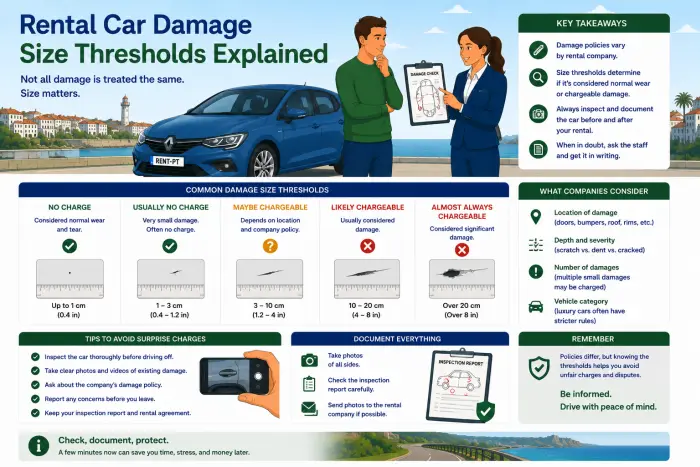
A single scratch shorter than roughly 5cm is generally treated as normal wear and tear across the industry, not something you’d typically be charged for. A dent larger than roughly 5cm, or multiple dents on a single panel, generally crosses into genuinely chargeable damage. Windshield or glass scratches of roughly 2.5cm or more generally require reimbursement, a lower threshold than body panel scratches given the safety implications of glass damage specifically.
The General Thresholds Worth Knowing
| Damage Type | Commonly Cited Threshold |
|---|---|
| Single body scratch | Under roughly 5cm generally treated as normal wear |
| Dent | Over roughly 5cm, or multiple dents on one panel, generally chargeable |
| Windshield or glass scratch | Roughly 2.5cm or more generally requires reimbursement |
| Interior damage (upholstery, etc.) | Often assessed more strictly, with lower tolerance than exterior wear |
These figures come up consistently enough across independent industry sources to be worth remembering as a general baseline, even though, as covered further below, they don’t represent a universal legal standard applying identically to every rental agreement you might encounter.
Why These Specific Thresholds Exist
Rental companies process an enormous volume of vehicle turnovers, and drawing a clear, consistent line between genuinely normal cosmetic wear (which accumulates naturally across any vehicle’s rental life) and damage requiring actual repair helps standardize an otherwise highly subjective assessment process across many different staff members and locations. Some companies use what’s sometimes called a damage pricing matrix internally, a standardized reference table assigning specific costs to specific damage types and sizes, precisely to reduce the subjectivity and inconsistency that would otherwise make every single inspection a fresh negotiation between customer and staff member.
Why Glass Gets a Lower Threshold Than Body Panels
This distinction is worth understanding specifically, since it can seem inconsistent at first glance without the underlying reasoning explained. Glass damage carries genuine safety implications beyond pure cosmetics, since even a relatively small windshield chip or scratch can compromise structural integrity or obstruct visibility in ways a similarly-sized body panel scratch simply doesn’t create any comparable risk for. This is why the threshold for glass damage is commonly cited as considerably lower than for body panel scratches, reflecting a genuine safety consideration rather than an arbitrary inconsistency in how different damage types happen to be assessed by rental staff.
These Are General Conventions, Not Universal Law
Worth being clear about this limitation before treating any of these figures as fixed rules: these thresholds represent commonly cited, general industry patterns rather than a legally binding, universally enforced standard that applies identically to every single supplier across every market. Your own specific rental agreement’s terms take precedence over any general convention described in this article, making it worth checking your own agreement’s specific language on damage assessment, if it’s spelled out at all, rather than assuming a general industry figure automatically applies to your particular rental regardless of what your actual contract says.
How This Connects to Documentation
Understanding these general thresholds is most useful when combined with the broader documentation habit covered in our guide on avoiding a rental car damage dispute in Lisbon. Knowing roughly what size threshold matters helps you assess your own pre-existing damage documentation more usefully, specifically noting anything approaching or exceeding these general thresholds with extra care, rather than needing to document literally every microscopic mark with equal intensity regardless of whether it would ever plausibly become a genuine charge. This targeted approach makes your pickup inspection considerably more efficient without sacrificing the protection thorough documentation genuinely provides.
Does This Connect to Your Insurance Coverage Choice?
Yes, worth understanding together. Our guide on what CDW doesn’t cover covers specific exclusions that can apply regardless of damage size, worth reading alongside this size-threshold guide since even damage below these general chargeable thresholds might still be excluded from certain coverage tiers in specific circumstances, making both factors, size and coverage terms, worth understanding together rather than in isolation.
Does Strictness Vary by Specific Location?
Somewhat, worth being aware of rather than assuming uniform enforcement everywhere. Our guide on franchise versus corporate car rental operations covers how service and policy application can differ between locations under the same brand name, relevant here since how strictly a specific counter applies these general size thresholds during inspection can genuinely vary by location, worth factoring into your expectations alongside the general conventions covered throughout this guide.
💸 Don’t Overpay at the Airport
Compare real-time rental deals with no hidden fees or credit card needed.
Does Third-Party Insurance Change How These Thresholds Apply?
Somewhat, worth checking specifically. Our guide on third-party excess insurance for Portugal car rental covers a separate coverage layer that may reimburse you for a charge regardless of the specific size threshold that triggered it in the first place, worth understanding as a financial backstop distinct from the size-assessment question itself, since even a charge that legitimately crosses these general thresholds might still be recoverable through a separate policy.
Interior Damage Often Gets Assessed More Strictly
Worth understanding as a separate category with its own tighter tolerance: interior damage, upholstery stains, tears, or burns, is frequently assessed with less leniency than exterior body panel wear, given how much more visible and expensive interior repairs or reupholstering tend to be relative to typical cosmetic exterior wear. If your trip involves anything with genuine potential for interior mess, food, drinks, pets, or young children, it’s worth taking extra care specifically with interior condition, since the general size-threshold leniency that applies to minor exterior scratches doesn’t necessarily extend to the same degree for interior surfaces.
What to Actually Do With This Knowledge
Rather than treating these thresholds as a way to argue down a legitimate charge after the fact, the more useful application is proactive: use this knowledge during your own pre-pickup inspection to specifically flag and photograph anything approaching these general size ranges, ensuring it’s properly noted on your pickup documentation before you’re held responsible for it at return. This proactive approach, rather than a reactive dispute after a charge has already been applied, is considerably more effective at actually protecting you from an unfair or mistaken charge in the first place.
Damage Threshold Checklist for Portugal Car Rental
- Understand roughly 5cm as a commonly cited threshold separating normal scratch wear from chargeable damage
- Recognize that glass damage carries a lower threshold, roughly 2.5cm, given safety implications
- Confirm your specific rental agreement’s own terms rather than assuming a universal standard applies
- Document anything approaching or exceeding these general thresholds with particular care at pickup
- Combine this size awareness with your broader damage documentation and insurance coverage understanding
See our insurance and deposit guide for the full picture of CDW, excess, and deposits.
Frequently Asked Questions
Is a scratch under 5cm always considered normal wear and tear? Generally, yes, according to commonly cited industry conventions, though this isn’t a universal legal standard and your specific rental agreement’s own terms ultimately take precedence.
Why does glass damage have a lower size threshold than body panel scratches? Because glass damage carries genuine safety implications, structural integrity and visibility, that a similarly-sized body panel scratch doesn’t, justifying stricter assessment for glass specifically.
Should I document every tiny mark on the vehicle, no matter how small? Not necessarily with equal intensity, though it’s worth being particularly thorough documenting anything approaching or exceeding these general size thresholds specifically.
Do these thresholds apply the same way to every rental supplier? Not universally. These are general industry conventions, and your specific supplier’s own rental agreement terms take precedence over any general pattern described here.
Does strictness of damage assessment vary between different rental locations? Yes, potentially, particularly given how franchise arrangements can lead to different internal standards at different locations even under the same brand name.
Can third-party insurance cover a charge that legitimately crosses these thresholds? Often yes, worth checking, since a separate third-party policy can serve as a financial backstop even when a charge is legitimately triggered by damage exceeding these general size conventions.
To compare general supplier options and their specific damage policies, our best car rental companies at Lisbon Airport roundup is a useful starting point.