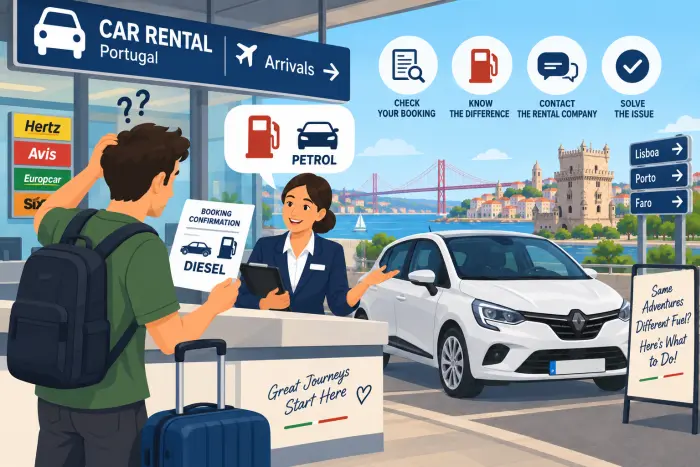
Booking a diesel and being handed the keys to a petrol car, or a hybrid neither requested nor expected, is a specific kind of counter surprise that’s become more common as Portugal’s rental fleets shift composition. It’s a different problem from putting the wrong fuel in a tank yourself — this is the rental company changing what you’re driving before you’ve even left the lot, often without much warning ahead of time.
Why this happens and what to do
| Root cause | Diesel vehicles are a shrinking share of rental fleets industry-wide |
| What you might get instead | Petrol or hybrid, without always being told in advance |
| When to raise it | At the counter, before signing or driving off |
| Who’s responsible | The rental company, not the aggregator or booking platform |
| Your leverage | A documented booking confirmation specifying fuel type |
Why diesel is getting harder to book
Diesel vehicles have been shrinking as a share of new car sales and rental fleets across Europe for several years, driven by a mix of emissions regulations, shifting manufacturer production, and rental companies buying more hybrids as their standard mid-range option. Portugal’s rental market reflects this broader trend rather than something unique to any one supplier — it’s an industry-wide supply shift, not a Portugal-specific quirk, though it shows up at Portuguese counters the same way it does elsewhere.
The practical result is that a diesel reservation made months in advance sometimes can’t be fulfilled by the time you actually arrive, simply because the supplier’s diesel inventory at that specific location has shrunk since the booking was made. Some counters handle this by proactively contacting the renter beforehand; others simply hand over whatever’s available at pickup and expect the renter not to mind, or not to notice the fuel type is genuinely different from what was reserved.
What actually changes with a different fuel type
This isn’t purely a preference issue. Diesel and petrol engines have different fuel economy characteristics, different refueling costs per liter, and — most relevantly for a road trip — different fuel type requirements at the pump that matter every time you stop to refuel, distinct from the separate issue of accidentally putting the wrong fuel in the tank yourself once you’re already driving. A traveler who planned a route around diesel’s typically better range on longer stretches, or who simply budgeted fuel costs based on diesel pricing, ends up with numbers that don’t match reality once the substitution happens.
Hybrid substitutions carry their own adjustment: different refueling patterns, sometimes different handling characteristics, and in some cases a genuinely different driving experience that a traveler didn’t sign up for when comparing rental options. For travelers curious whether going further and specifically renting electric might actually be a better fit than fighting over a hybrid substitution, it’s worth a look at what that option involves before dismissing it outright. None of this makes a hybrid a worse car — for many trips it’s arguably a better one — but it’s a different car than what was compared, priced, and selected during the booking process.
A trend worth understanding, not just a one-off inconvenience
This substitution problem isn’t a random glitch at one counter — it reflects a structural shift in what rental companies are actually buying. Diesel’s cost advantage on long-distance driving made it the default choice for rental fleets for years, but tightening emissions rules in city centers, changing manufacturer production priorities, and rental companies’ own fleet-renewal cycles have pushed many toward petrol and hybrid vehicles as the new standard mid-range option. A supplier isn’t necessarily being deceptive when this happens; in many cases, the diesel car simply isn’t there anymore by the time a months-old reservation comes due, and the substitution is the practical result of a fleet that’s genuinely changed composition since the booking was made.
Understanding this doesn’t mean accepting every substitution without question, but it does help frame the conversation at the counter more productively — this is rarely a single rogue employee trying to pull something over on you, and approaching it as a booking-fulfillment problem rather than an accusation tends to get a faster, more cooperative response from staff who are themselves just working with whatever inventory happens to be on the lot that day.
Why this matters more for certain kinds of trips
The stakes of a fuel-type substitution scale with how much your itinerary actually depends on the original fuel type. A short city-based rental with light driving rarely suffers much from a diesel-to-petrol swap — the fuel cost difference over a few days is modest, and refueling logistics barely change. A longer road trip through Portugal’s interior, where fuel stations space out more than they do along the coast, is a different situation: diesel’s typically better range matters more when the next station might be 30 minutes further than expected, and a last-minute switch to a less fuel-efficient petrol equivalent can turn a comfortably planned fuel stop into a tighter one.
💸 Don’t Overpay at the Airport
Compare real-time rental deals with no hidden fees or credit card needed.
This is worth factoring into how hard you push back at the counter. A substitution that barely registers on a short Lisbon-based trip is a much more reasonable thing to contest firmly if it’s happening on the first day of a two-week loop through the Alentejo or the Douro, where the original vehicle choice was made with real trip-planning logic behind it rather than as an arbitrary preference.
What to do when it happens at the counter
Raise it immediately, before signing the final agreement or taking the keys. If your booking confirmation specifies a fuel type — most do, at least implicitly through the vehicle description — you have a legitimate basis to ask why the assigned car doesn’t match, and to request an alternative if one’s available. This mirrors the same logic covered in our broader guide to getting a different car than booked: the counter, not after you’ve driven away, is when you have real leverage to fix a mismatch.
If no matching vehicle is available and you’re offered a substitute, it’s reasonable to ask specifically whether this changes anything about the price, the deposit, or the insurance terms — a fuel-type change shouldn’t typically increase your cost, and if a supplier tries to charge more for what amounts to their own inventory shortfall, that’s worth pushing back on directly rather than accepting as a fait accompli.
When it’s reasonable to accept the substitution
Not every fuel-type mismatch is worth fighting over. If the difference doesn’t meaningfully affect your trip — a short rental, a route without long unrefueled stretches, no strong personal preference either way — accepting a reasonable substitute and moving on is often the more practical choice than losing time at the counter over a swap that won’t actually change your trip. The cases worth pushing back on are the ones where the substitution genuinely affects your plans: a diesel-to-hybrid swap on a trip where range or refueling logistics were specifically planned around diesel, for instance.
Frequently asked questions
Why would a rental company give me a different fuel type than what I booked? Most commonly because diesel vehicles are a shrinking share of the fleet, and the specific car reserved may no longer be available by the time you arrive — the substitute offered is usually whatever’s on the lot that day.
Can I refuse a car with a different fuel type at pickup? Yes, and the counter is the right moment to raise it — once you’ve signed and driven off, objecting becomes considerably harder to act on than it is before you leave the lot.
Should a fuel-type substitution cost me more? No, not typically — if a supplier tries to charge extra for a change driven by their own inventory shortfall rather than a request you made, that’s worth questioning directly.
Is a hybrid substitute actually worse than a diesel car? Not inherently — for many trips a hybrid performs just as well or better. The issue is usually that it wasn’t what was compared and selected during booking, not that it’s a lower-quality vehicle.
Does this happen more with certain rental brands than others? It’s tied more to overall fleet composition and inventory at a specific location than to any one brand consistently, since the underlying driver is industry-wide diesel scarcity rather than one company’s policy.
How can I reduce the risk of this happening to my booking? Confirm the fuel type explicitly with the supplier close to your pickup date rather than assuming a months-old booking confirmation guarantees availability, especially if diesel specifically matters to your trip.
What if I only notice the fuel type is different after I’ve already left the lot? It’s a weaker position than catching it at the counter, but still worth raising with the rental company directly — document the discrepancy with your booking confirmation and ask how they’d like to address it.