At some point during your rental car payment, whether at the counter or on the card machine itself, you may be asked a seemingly helpful question: would you like to pay in your home currency instead of euros? It sounds like a convenience. It’s actually a quiet, entirely legal way for the transaction to cost you more, and the correct answer is almost always no.
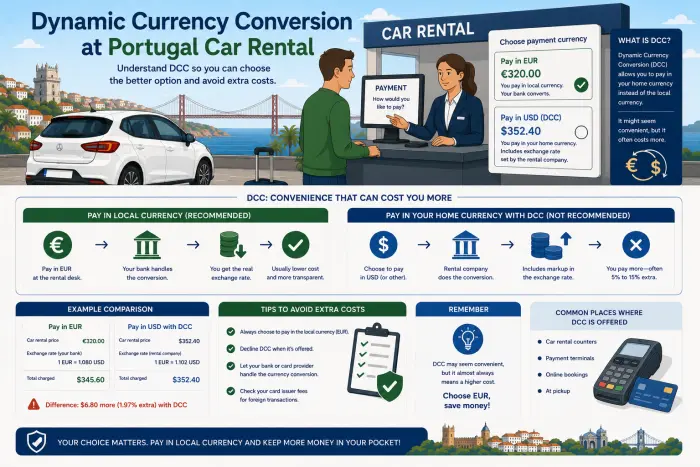
The essentials: always choose to pay in euros, the local currency, rather than accepting a conversion to your home currency at the point of sale. This mechanism, called dynamic currency conversion, uses an exchange rate set by the merchant’s bank rather than your own card network, and it consistently includes a markup that costs you more than simply letting your own card issuer handle the conversion afterward.
How This Actually Works
When you pay with a foreign card, either at a rental counter’s card machine or sometimes during an online prepayment, the system recognizes your card was issued outside Portugal and may offer to charge you in your home currency instead of euros. If you accept, the transaction processes at an exchange rate set by the merchant’s payment processor, which includes a markup on top of the actual market rate. If you decline and choose to pay in euros, your own card’s network (Visa, Mastercard, or similar) converts the charge afterward at a rate close to the genuine interbank rate, which is consistently the better deal.
The Two Options Compared
| Choice | What Happens |
|---|---|
| Accept payment in your home currency | Merchant’s bank sets the exchange rate, includes a markup commonly cited at 2-5%, sometimes higher |
| Decline and pay in euros | Your own card network converts afterward at a rate close to the genuine market rate |
Why This Feels Helpful But Isn’t
The framing of DCC is specifically designed to sound like a convenience, seeing the exact cost in dollars, pounds, or whatever currency you’re used to, before you commit to the charge. This genuine-sounding benefit is real in one narrow sense, you do get price certainty in your own currency, but the cost of that certainty is a markup you wouldn’t pay otherwise. For the vast majority of travelers, the small peace of mind of seeing a familiar currency figure isn’t worth the several percent premium built into that number.
You Have the Legal Right to Choose
This is worth knowing explicitly: card network rules require that you be given a genuine choice between local currency and your home currency, and a merchant isn’t permitted to simply decide for you or use visual tricks to steer your decision. If a card terminal or counter staff member doesn’t clearly offer this choice, or seems to be pushing you toward the home-currency option without asking, it’s worth explicitly requesting to pay in euros rather than assuming the displayed option is your only choice.
What to Actually Say or Do at the Counter
If a card machine displays a currency choice screen, look for the option showing “EUR” and select that, even if the home-currency option is displayed more prominently or appears to be the default. If a staff member asks verbally whether you’d like to pay in your home currency, a simple “no, euros please” is sufficient; you don’t need to explain your reasoning or justify the choice, since it’s a completely standard and expected preference.
Does This Still Matter If My Card Has No Foreign Transaction Fee?
Yes, still worth declining DCC regardless of your card’s own fee structure. A card with no foreign transaction fee still benefits from choosing euros over DCC, since the DCC markup is a separate cost layered on by the merchant’s payment processor rather than something your card issuer controls or can offset. The two costs, foreign transaction fees and DCC markups, are distinct and worth understanding separately, both generally worth avoiding where possible rather than assuming one makes the other irrelevant.
What If You Realize After the Fact You Accepted DCC?
If you notice after leaving the counter that you were charged in your home currency and suspect you weren’t given a genuine choice, this is worth raising with your card issuer directly, since card network rules specifically allow for disputing a transaction where DCC was applied without a fair choice being offered. This is a separate and distinct process from a general rental dispute, worth pursuing through your card issuer specifically rather than the rental company, since the currency conversion charge originates from the payment processing layer rather than the rental agreement itself.
Does This Apply to Any Online Prepayment Too?
Yes, worth checking specifically if part of your rental cost is prepaid online rather than entirely at the counter, since some booking platforms and payment pages present the same currency choice during checkout. Reviewing this carefully during any broker or aggregator booking checkout process, not just at the physical counter, is worth doing since the same principle, decline the home-currency option and pay in euros, applies equally to an online transaction as it does to a card machine at pickup.
💸 Don’t Overpay at the Airport
Compare real-time rental deals with no hidden fees or credit card needed.
This Isn’t Unique to Car Rentals
Worth knowing as broader context: dynamic currency conversion shows up across nearly every kind of foreign transaction, hotels, restaurants, shops, and ATM withdrawals, not just rental car counters specifically. Building the habit of automatically declining it and requesting local currency wherever you travel, rather than treating it as a decision specific to this one transaction, saves you the same markup consistently across your entire trip rather than just the rental itself.
Telling Your Bank You’re Traveling Doesn’t Fix This
Worth being clear about a common misconception: notifying your card issuer of your travel dates helps prevent your card being flagged or blocked for suspicious foreign activity, but it has nothing to do with dynamic currency conversion, a separate mechanism controlled entirely by the merchant’s payment terminal rather than your card issuer. Both are worth doing before a trip, informing your bank of travel dates and knowing to decline DCC at the counter, but they solve genuinely different problems and shouldn’t be confused with each other.
Does This Interact With Choosing How to Pay for Your Deposit?
Worth considering alongside your broader payment planning, since your rental deposit hold is a separate transaction from the base rental charge and may present its own currency choice prompt independently. Our guide on how long a rental car deposit takes to release covers the broader deposit process, worth reading alongside this currency guidance since declining DCC matters equally for the deposit hold transaction as it does for your base rental payment itself.
📋 Currency Conversion Checklist for Portugal Car Rental
- Always select euros when given a currency choice at any payment terminal during your rental
- Don’t assume the more prominently displayed currency option is your only choice
- Say “euros, please” clearly and confidently if asked verbally, without needing to explain why
- Understand that declining DCC benefits you even if your card has no foreign transaction fee
- Contact your card issuer directly if you suspect you weren’t given a genuine choice after the fact
- Remember that notifying your bank of travel dates doesn’t address DCC, since it’s a separate merchant-controlled mechanism
❓ Frequently Asked Questions
Should I pay in euros or my home currency when renting a car in Portugal? Always choose euros. Paying in your home currency through dynamic currency conversion includes a markup that costs more than letting your own card network handle the conversion.
Is dynamic currency conversion legal? Yes, it’s a legitimate and regulated practice, but card network rules require you be given a genuine choice to decline it and pay in local currency instead.
Does declining currency conversion matter if my card has no foreign transaction fee? Yes, it still matters. The DCC markup is separate from any foreign transaction fee your card might charge, so declining benefits you regardless of your card’s own fee structure.
What should I do if I think I wasn’t given a real choice about currency conversion? Contact your card issuer directly, since card network rules specifically allow disputing a transaction where a genuine choice between currencies wasn’t offered.
Does dynamic currency conversion apply to online rental prepayments too? Yes, some booking platforms present the same currency choice during online checkout, so it’s worth checking and declining the home-currency option there as well, not just at the physical counter.
Does this only apply to car rentals, or should I watch for it elsewhere too? It applies broadly across hotels, restaurants, shops, and ATMs, not just rental counters, so building the habit of declining it consistently saves money throughout your entire trip.
For the broader deposit and pricing transparency issues worth watching for at the counter, see rental car deposit scam red flags at Lisbon Airport. For handling counter-level pressure more generally, our guide on rental car counter upsell tactics covers recognizing similar dynamics beyond currency choice specifically.