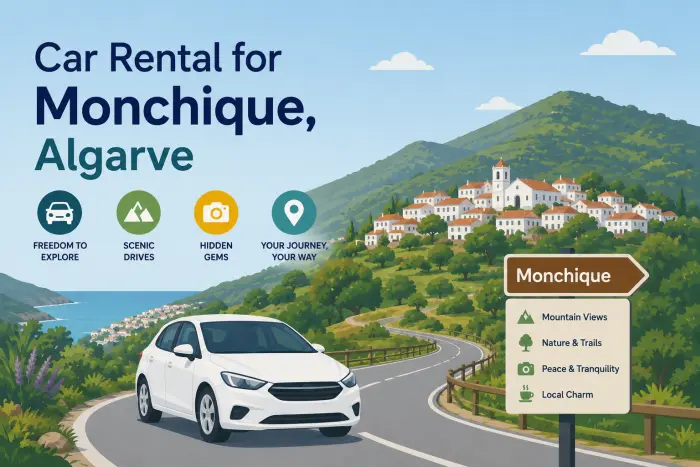
Most Algarve itineraries stay glued to the coast, which is exactly why Monchique feels like a different region entirely — a mountain town roughly 40 minutes inland from Portimão or Lagos, cooler, forested, and built around thermal springs rather than beaches, offering a genuinely different pace from anywhere else in this cluster.
| Distance from Portimão | ~40 minutes |
| Distance from Lagos | ~45 minutes |
| Distance from Faro Airport | ~80 km, just over an hour |
| Highest point | Fóia, 902m — the Algarve’s tallest peak |
| Known for | Thermal springs (Caldas de Monchique), mountain views, hiking |
Why Monchique is worth the drive inland
The Algarve’s coastal towns share a fairly similar formula — beaches, marinas, whitewashed old towns — and Monchique breaks from all of it. The N266 climbs out of the coastal plain through Caldas de Monchique, a small spa village built around thermal waters that have drawn visitors for centuries, before reaching Monchique itself and continuing on to Fóia, the highest point in the entire Algarve at 902 meters. On a clear day, the view from Fóia stretches across the region to the Atlantic — a genuinely different perspective on the Algarve than anything available from sea level.
This makes Monchique a natural day trip for travelers based anywhere along the central or western Algarve coast, and a good match for anyone who’s spent a few days on the beaches and wants a change of scenery without leaving the region entirely.
Getting there and parking
From Portimão, the drive to Monchique takes around 40 minutes via the N266, climbing steadily through switchbacks as the road gains elevation — slower going than a coastal motorway hop, but a scenic drive in its own right rather than just a means of transport. From Lagos, expect closer to 45 minutes on a similar route. Faro Airport sits furthest away at just over an hour, given Monchique’s position on the western side of the region, which is worth factoring in if you’re deciding where to base yourself for an Algarve trip that includes this detour.
Parking in Monchique itself is straightforward compared to the coastal towns — there’s a free car park near the Miradouro de Monchique, a short walk from the town center, and traffic pressure here rarely approaches what the busier coastal resorts see even in peak season. Caldas de Monchique has its own small parking area near the spa village, and the climb to Fóia ends at a viewpoint with space to park directly at the summit, weather permitting.
Combining Monchique with the coast
Most visitors treat Monchique as a half-day or full-day trip from a coastal base rather than an overnight stay, though the cooler mountain air makes it a reasonable one- or two-night detour for travelers wanting a break from beach-town heat in the height of summer. A common loop combines Monchique with Silves, the historic inland town built around a Moorish castle, given how naturally the two pair on a single inland day away from the coast.
Travelers based further west, near Lagos or Sagres, sometimes extend a Monchique day into a loop that also touches Aljezur and the Costa Vicentina to the north — a longer day, but one that strings together mountains, history, and wild coastline without much backtracking, since all three sit on the same general western side of the region.
Driving the N266 and mountain roads
The N266 is well maintained but genuinely mountainous once it leaves the coastal plain — narrow in places, with switchbacks climbing toward Caldas de Monchique and continuing up toward Fóia. This isn’t difficult driving by Portugal’s standards, but it rewards a slower pace than the flat coastal roads most Algarve visitors are used to, and it’s worth budgeting more time for the drive itself than the map distance alone would suggest. Fuel stations are sparser once you’re off the coastal main roads, so it’s worth topping up in Portimão or Lagos before heading inland rather than counting on finding one along the mountain route itself.
Weekends and midday hours during peak season bring more traffic to the route, largely from day-tour minibuses running the same Monchique-Silves-Caldas circuit — an early start avoids most of this and makes for a noticeably quieter drive up. Outside peak summer months, the road is genuinely quiet most of the time, closer in feel to the interior mountain driving covered in our guide to Serra da Estrela than anything else on the Algarve coast, though Monchique’s elevation and climate are considerably milder than the central mountains further north.
Picking up the car
Most visitors reach Monchique as part of a broader Algarve car rental trip rather than picking up locally — there’s no significant rental presence in Monchique itself, and nearly everyone arrives having rented from Faro Airport or one of the coastal towns already covered in this cluster. Given that Monchique sits toward the western side of the region, picking up in or near Portimão or Lagos generally makes for a shorter approach than starting from Faro.
💸 Don’t Overpay at the Airport
Compare real-time rental deals with no hidden fees or credit card needed.
Booking a car you’re comfortable driving on winding mountain roads pays off here more than it does on a flat coastal itinerary — nothing about the N266 requires a larger or more capable vehicle, but a compact or mid-size car with reasonably responsive handling makes the switchback climb noticeably more pleasant than a larger SUV would, especially on the tighter turns near the summit.
What to expect once you’re up there
Monchique itself is a small, unhurried town — a handful of restaurants known for regional specialties like medronho (a local fruit brandy) and smoked meats, craft shops selling wooden items made from the surrounding forests, and a noticeably slower pace than the beach towns most visitors are coming from. It’s not built around a single must-see monument the way Silves or Tavira are; the appeal is more about the setting itself — cork oak and eucalyptus forest, cooler air, and the sense of having left the tourist-dense coast behind for a few hours.
Caldas de Monchique, a few minutes below the main town, is worth a stop in its own right — a cluster of restored buildings around the thermal spring that gave the area its name, with a small spa still operating for anyone wanting to extend the visit into a proper wellness stop rather than just a scenic drive-through.
When to visit
Summer brings noticeably milder temperatures to Monchique than the coast, given the elevation — a genuine reason to head inland during the hottest weeks of July and August rather than simply a scenic detour. Spring and autumn offer the clearest visibility from Fóia and the most comfortable hiking conditions in the surrounding hills, while winter can bring cooler, occasionally foggy conditions at altitude that reduce the payoff of the summit viewpoint specifically, even though the town itself remains pleasant year-round.
Frequently asked questions
How far is Monchique from the main Algarve coastal towns? Around 40–45 minutes from Portimão or Lagos, and just over an hour from Faro Airport, given Monchique’s inland, western position in the region — worth factoring into where you base yourself for an Algarve trip.
Is Monchique worth visiting as a day trip, or does it need an overnight stay? A day trip covers the town, Caldas de Monchique, and the drive up to Fóia comfortably. An overnight suits travelers wanting a cooler break from the coast or more time for hiking in the surrounding hills, particularly during the hottest weeks of summer when the elevation makes a real difference.
What’s the highest point in the Algarve, and can I drive there? Fóia, at 902 meters, is the Algarve’s highest point, and yes — a paved road leads directly to a viewpoint and parking area at the summit.
Is parking difficult in Monchique? No, noticeably easier than the coastal resort towns — there’s a free car park near the Miradouro de Monchique a short walk from the center, with much lighter traffic pressure overall.
What towns pair well with Monchique for a single day trip? Silves is the most common pairing, given how naturally the two connect on an inland day away from the coast. Travelers based further west sometimes extend the loop to include Aljezur and the Costa Vicentina for a longer, more varied day.
Is the drive up to Monchique difficult? Not difficult, but genuinely mountainous — narrow roads and switchbacks that reward a slower pace than the flat coastal routes most Algarve visitors are used to, and a fuel top-up before heading inland is worth doing given sparser stations along the way.
What is Caldas de Monchique known for? A small spa village along the route to Monchique, built around thermal springs that have drawn visitors for centuries — worth a stop on the way up or down from the mountain town itself, with a small operating spa for anyone wanting more than a quick photo stop.