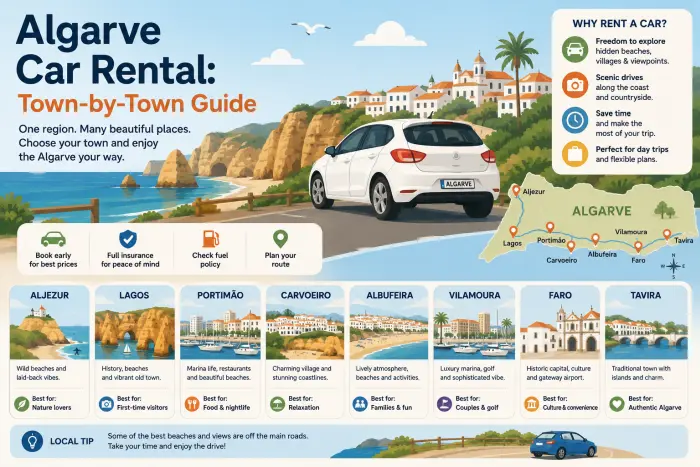
The Algarve stretches roughly 150 kilometers along Portugal’s southern coast, and no single town captures the whole of it — the cliffs and surf towns of the west feel like a different country from the marina resorts of the center or the quiet, tidal-flat towns near the Spanish border in the east. A rental car is what turns that stretch into one connected trip instead of three separate ones.
| Coastline length | ~150 km, Sagres to the Spanish border |
| Main airport | Faro, roughly central to the whole region |
| Fastest route | A22 motorway (Via do Infante), tolled, spans nearly the full coast |
| Best single base | Depends on trip style — see breakdown below |
| Peak season | July–August; shoulder months (May, June, September) trade some heat for far lighter crowds |
Picking a base: west, center, or east
Most Algarve trips fall into one of three shapes: stay in one town and take day trips, split the stay across two bases, or keep moving every couple of nights. All three work with a rental car; the choice mostly comes down to how much driving you want to do versus how much unpacking.
The western Algarve: cliffs, surf, and quieter towns
Lagos anchors the west and works as a base for nearly the whole western half of the region — walkable old town, a genuine local feel outside peak weeks, and short drives to almost everything else on this list. Sagres, at the very tip of mainland Europe’s southwest corner, sits about 30 minutes further and trades some convenience for dramatic cliffs and a proper end-of-the-road feeling — a common day trip from Lagos rather than a full base for most visitors.
Praia da Luz and Alvor sit between Lagos and Portimão, both smaller and quieter than the bigger resort towns, and both reasonable bases for travelers who want beach access without the nightlife density of somewhere like Albufeira. Portimão itself and neighboring Praia da Rocha offer a bigger-town base with more restaurants and services, useful if you want a central western hub rather than a beach village.
Further east along this stretch, Carvoeiro and Silves round out the western cluster — Carvoeiro for a smaller, cliff-backed beach town, Silves for something inland and historic, built around a Moorish castle rather than a beachfront.
Travelers wanting a break from the coast entirely sometimes head inland to Monchique, the Algarve’s mountain town and highest point at Fóia — a natural pairing with Silves for a single day away from the beaches.
The central Algarve: resorts and marinas
Albufeira is the Algarve’s best-known resort town, and it earns that reputation with the widest range of restaurants, nightlife, and beach options in one place — the trade-off is crowds and traffic in peak season that the smaller towns simply don’t have. Vilamoura, just east, leans more upscale, built around its marina and golf courses, and suits travelers prioritizing resort amenities over old-town character.
Loulé and Quinta do Lago sit slightly inland and further east respectively — Loulé for a genuine working Portuguese town with a well-known Saturday market, Quinta do Lago for one of the region’s most exclusive resort areas, both a short, easy drive from Faro Airport.
The eastern Algarve: quieter and less developed
Tavira represents the eastern Algarve almost on its own in this cluster — a historic riverside town with a noticeably slower pace than anywhere in the center, closer to the Spanish border than to Faro, and popular with visitors specifically looking to avoid the resort-town feel altogether. It’s a longer drive from Lagos (over an hour), which is part of why most itineraries treat the east as its own leg rather than a day trip from a western base.
How the towns connect
The A22 motorway (Via do Infante) runs the length of the Algarve and makes moving between any two of these towns straightforward — Lagos to Tavira, the two furthest points in this list, takes around an hour and a half on the motorway versus considerably longer on the coastal N125. The A22 is tolled, so factor in a Via Verde transponder or another toll-payment method regardless of which towns you’re connecting.
Faro Airport sits roughly in the geographic middle of the region, which means driving time to a base is fairly balanced whichever direction you head — Albufeira or Vilamoura are the shortest hop, Lagos and Tavira sit at roughly similar distances in opposite directions, and Sagres is the longest single drive from the airport at just under an hour.
Choosing between one base and several
A single-base trip works well if you’re staying under a week and don’t mind day trips of 30–60 minutes to see the towns outside your chosen base — Lagos or Albufeira both put most of the region within reasonable striking distance. A two-base trip (commonly west then east, splitting at Portimão or Albufeira) suits longer stays and avoids the longest repeated drives, at the cost of one packing-and-moving day partway through. Constantly changing towns every night or two rarely pays off here — the towns are close enough that day trips cover most of what a moving itinerary would, without the overhead of repeated check-ins.
💸 Don’t Overpay at the Airport
Compare real-time rental deals with no hidden fees or credit card needed.
What a rental car unlocks here that public transport doesn’t
The Algarve has a regional train line and long-distance buses connecting the bigger towns, but both run on a fixed, fairly infrequent schedule, and neither reaches most of the smaller beaches, viewpoints, and villages that make up a big part of what draws people here. A rental car turns a fixed list of stops into an open map — stopping at a roadside viewpoint on the way between towns, reaching a beach with no direct bus service, or simply leaving somewhere earlier or later than a timetable allows.
This matters more in the Algarve than in some other Portuguese regions because so much of the appeal sits outside the town centers themselves — cliff walks, isolated coves, inland villages a short detour off the main road. Public transport handles the point-to-point trip between towns reasonably well; it doesn’t handle the stops along the way.
When to visit, and how that changes the driving
July and August bring the heaviest crowds and the highest prices, along with real traffic on approach roads into the busier resort towns during peak check-in and check-out days (usually Saturdays). Parking in central Albufeira or Lagos gets genuinely difficult to find in these weeks, which is worth factoring into how much you rely on driving directly into town centers versus parking on the outskirts and walking in.
Shoulder months — May, June, and September in particular — offer a noticeably easier version of the same trip: lighter traffic, easier parking, and warm-enough weather for most of what draws people to the coast, without the peak-season premium on everything from car rental rates to restaurant reservations. Winter is quieter still, with some smaller coastal restaurants and shops closing for the season, though the driving itself is easy year-round given the region’s mild climate.
Extending beyond the classic Algarve
Travelers who’ve covered the towns in this guide and want something different sometimes push northwest into the Costa Vicentina, the wilder Atlantic coast just past Sagres and Aljezur — a genuinely different landscape from anywhere covered here, with almost no public transport and correspondingly more dependent on having a car. It’s a natural extension rather than a separate trip, connected by the same road network covered above.
For the airport side of the logistics — picking up the car itself, choosing a supplier, and what to expect at the counter — see the dedicated guide to renting at Faro Airport.
Frequently asked questions
Which Algarve town is the best base for a rental car trip? It depends on trip style. Lagos suits travelers focused on the western cliffs and surf towns; Albufeira or Vilamoura suit those wanting a resort base with nightlife and amenities; Tavira suits a quieter, slower-paced eastern stay.
How long does it take to drive across the whole Algarve? Around an hour and a half from Lagos to Tavira via the A22 motorway, the two ends of the region covered in this guide.
Do I need a car to visit more than one Algarve town? Practically, yes. Public transport connects the larger towns but on a schedule far less flexible than a rental car, and several of the smaller towns and beaches on this list have limited or no direct bus service.
Is it better to stay in one Algarve town or move between several? One or two bases generally work better than moving every night — the region is compact enough that day trips reach most nearby towns without the hassle of repeated packing and check-ins.
Which Algarve towns are quietest and least touristy? Tavira in the east and Silves inland are both noticeably quieter than the resort towns, along with smaller western towns like Praia da Luz and Alvor outside peak season.
Is the A22 motorway worth the toll, or should I take the free coastal road? For covering real distance, the A22 is worth it — the free N125 runs through town centers and adds significant time. For a short, scenic hop between neighboring towns, the coastal road is a reasonable alternative.
How far is Faro Airport from the main Algarve towns? Roughly balanced across the region — around 20–30 minutes to Albufeira or Vilamoura, 45 minutes to an hour to Lagos or Tavira in opposite directions, and just under an hour to Sagres at the far western tip.